
Local vs Imported Pumps – Truth Revealed


When buying a water pump, one of the biggest questions customers ask is:
“Should I buy a local pump or an imported pump?”
This question becomes even more important when the pump is used for agriculture, bore water, tube wells, solar systems, factories, homes, farms, or commercial water supply. A wrong pump can waste electricity, reduce water output, damage your bore, increase maintenance cost, and create daily frustration.
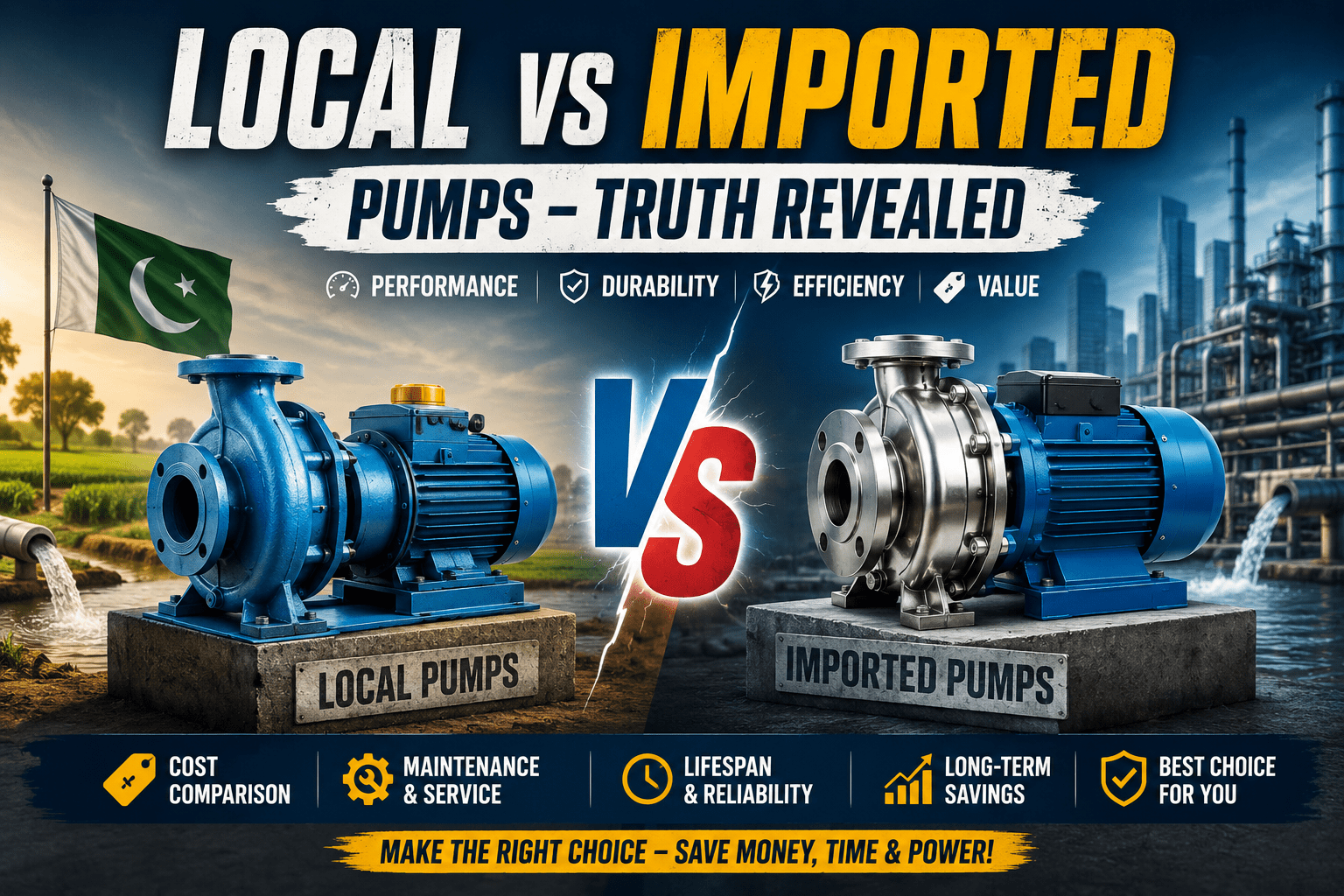
Many people believe that imported pumps are always better. Others believe that local pumps are cheaper and easier to repair. The truth is not that simple.
The real answer depends on:
- Your water depth
- Required water flow
- Motor horsepower
- Duty hours per day
- Electricity or solar setup
- Budget
- Availability of spare parts
- After-sales service
- Pump brand and build quality
- Correct installation
In this article, we will reveal the real difference between local pumps and imported pumps, including their pros, cons, performance, cost, durability, and which one you should choose.
What Are Local Pumps?
Local pumps are pumps that are either manufactured, assembled, or widely produced within the local market. In Pakistan, local pumps are commonly used in homes, farms, small agricultural setups, livestock farms, and basic water supply systems.
These pumps are usually more affordable and easily available. Many local workshops, dealers, and electricians understand them well, which makes repair and maintenance easier.
Local pumps are commonly available in:
- Centrifugal pumps
- Monoblock pumps
- Jet pumps
- Submersible pumps
- Turbine pumps
- Bore pumps
- Agriculture water pumps
- Domestic water pumps
Local pumps are often preferred by customers who want a budget-friendly solution and do not want to wait for imported spare parts.
What Are Imported Pumps?
Imported pumps are pumps brought from international markets such as China, Italy, Turkey, Germany, Japan, USA, and other countries. These pumps are usually manufactured with better technology, strict quality control, and more advanced engineering standards.
Imported pumps are commonly used in:
- Deep bore systems
- Solar pumping systems
- Industrial water supply
- High-pressure applications
- Long-running agricultural systems
- Commercial buildings
- Factories
- Heavy-duty irrigation
- Clean water and wastewater systems
Imported pumps are usually more expensive, but they often provide better performance, higher efficiency, longer life, and more stable output when selected and installed correctly.
Local vs Imported Pumps – Quick Comparison Table
| Feature | Local Pumps | Imported Pumps |
|---|---|---|
| Price | Usually cheaper | Usually expensive |
| Quality | Varies from average to good | Usually more consistent |
| Efficiency | Moderate | Generally higher |
| Durability | Depends on material and usage | Usually better in premium brands |
| Spare Parts | Easily available | Depends on brand and dealer |
| Repair Cost | Low | Medium to high |
| Electricity Consumption | Can be higher | Usually more energy efficient |
| Solar Compatibility | Limited in some models | Better in advanced models |
| Performance Accuracy | May vary | More reliable performance curves |
| Best For | Budget users, small setups | Long-term, heavy-duty, professional use |
| After-Sales Service | Easy through local mechanics | Depends on authorized dealer |
| Risk Factor | Quality inconsistency | Fake imports or poor dealer support |
| Resale Value | Low to medium | Medium to high if branded |
| Long-Term Cost | Can become high if inefficient | Lower if efficient and durable |
The Real Truth: Imported Does Not Always Mean Better
Many customers think that if a pump is imported, it must be better. This is not always true.
There are excellent imported pumps, but there are also low-quality imported pumps in the market. Some imported pumps are made only for cheap selling, not for long-term performance. Similarly, some local pumps are average, but some local brands and workshops produce very reliable pumps for normal use.
So the real comparison is not just:
Local vs Imported
The real comparison should be:
Poor-quality pump vs correctly selected high-quality pump
A good local pump can perform better than a bad imported pump. A premium imported pump can easily outperform an average local pump. The key is choosing the right pump for the right job.
Pros of Local Pumps
Local pumps have many advantages, especially for customers who want a simple and affordable water solution.
1. Lower Purchase Price
The biggest advantage of local pumps is their price. They are usually more affordable than imported pumps. This makes them attractive for:
- Small farmers
- Home users
- Low-budget projects
- Temporary installations
- Basic water supply systems
For customers who cannot invest heavily at the start, a local pump can be a practical option.
2. Easy Spare Parts Availability
Local pumps usually have easily available spare parts. You can find parts like:
- Impellers
- Seals
- Bearings
- Shafts
- Bushes
- Motor parts
- Couplings
- Capacitors
This makes maintenance easier and faster.
3. Easy Repair
Most local mechanics and electricians understand local pumps. Even in small cities and rural areas, repair is usually possible without sending the pump to a big service center.
This is a major benefit for farmers and users who cannot afford long downtime.
4. Suitable for Basic Applications
For basic water transfer, shallow water pumping, small agriculture, and domestic use, a good local pump can work well.
Examples include:
- Filling water tanks
- Garden water supply
- Small farm irrigation
- Shallow bore use
- General water transfer
5. Lower Maintenance Cost
Because spare parts and labor are cheaper, local pumps are usually less expensive to maintain.
Cons of Local Pumps
Local pumps also have some weaknesses that buyers should understand before purchasing.
1. Quality Is Not Always Consistent
One of the biggest issues with local pumps is inconsistent quality. Two pumps may look the same, but their internal material, winding quality, shaft quality, and impeller finishing may be different.
This can affect:
- Water output
- Motor life
- Electricity usage
- Noise level
- Vibration
- Pump durability
2. Lower Efficiency
Many local pumps consume more electricity for the same water output. This means the pump may be cheaper at the beginning, but expensive in the long run.
For example, a low-efficiency pump may save money at purchase time but increase monthly electricity bills.
3. Limited Performance Data
Imported branded pumps usually come with proper pump curves, head-flow charts, efficiency ratings, and technical specifications. Local pumps often lack accurate performance data.
This makes it harder to select the exact pump for:
- Bore depth
- Required discharge
- Pipe size
- Solar system
- Pressure requirement
4. Shorter Life in Heavy-Duty Use
Local pumps may not perform well in heavy-duty applications if used continuously for long hours. In deep bore, high-pressure, or industrial systems, weak material can fail quickly.
5. Not Always Suitable for Solar Systems
Solar pumping requires accurate matching between:
- Pump
- Motor
- VFD/inverter
- Solar panels
- Head
- Water requirement
Many local pumps are not designed with solar efficiency in mind. They may work, but output can be lower and power usage can be higher.
Pros of Imported Pumps
Imported pumps are usually preferred when performance, efficiency, and long-term reliability matter.
1. Better Engineering and Design
Good imported pumps are designed with proper engineering standards. Their impellers, motors, shafts, seals, and hydraulic design are often more accurate.
This helps deliver:
- Better water flow
- Better pressure
- Lower vibration
- Longer pump life
- Stable performance
2. Higher Efficiency
A high-quality imported pump usually gives more water with less electricity. This is very important for users running pumps daily.
Higher efficiency means:
- Lower electricity bills
- Better solar performance
- Less motor heating
- Longer system life
- Better return on investment
3. Better for Deep Bore and Heavy-Duty Use
Imported submersible pumps are often better for deep bore applications because they are designed for higher head, stable output, and continuous operation.
They are suitable for:
- Deep wells
- Tube wells
- Solar tube wells
- Center pivot irrigation
- Industrial water systems
- Commercial buildings
- High-pressure applications
4. More Accurate Technical Specifications
Good imported brands provide proper technical data such as:
- Flow rate
- Head range
- Motor rating
- Efficiency curve
- Voltage requirement
- Material details
- Maximum operating depth
- Temperature limits
This helps dealers and engineers select the correct pump.
5. Longer Life When Installed Correctly
A premium imported pump can last many years if:
- The bore is clean
- The cable is properly sized
- The voltage is stable
- The pipe size is correct
- The pump is not dry-running
- The pump is protected with control panels
Cons of Imported Pumps
Imported pumps are not perfect. They also have disadvantages.
1. Higher Initial Price
Imported pumps usually cost more than local pumps. For budget-conscious customers, this can be a big issue.
The higher price includes:
- Import cost
- Duties and taxes
- Brand value
- Dealer margin
- Better material
- Technology and quality control
2. Spare Parts May Be Expensive
For some imported brands, spare parts are costly or difficult to find. If the dealer does not keep proper stock, the pump may remain out of service for days or weeks.
3. Fake Imported Pumps in the Market
This is a serious issue. Some pumps are sold as “imported” but may be:
- Low-quality copies
- Rebranded products
- Fake brand pumps
- Poor-grade Chinese imports
- Pumps without warranty
- Products with no service backup
This is why customers must buy from trusted dealers.
4. Repair Requires Skilled Technicians
Imported pumps, especially high-end submersible and solar pumps, require trained technicians. Poor repair can damage the pump permanently.
5. Not Every Imported Pump Is Suitable for Local Conditions
Some imported pumps are designed for clean water and stable voltage. In local conditions, water may contain sand, voltage may fluctuate, and installation may not be perfect.
A pump that works well internationally may fail quickly if not suitable for local water and power conditions.
Local vs Imported Pumps – Which Performs Better?
Performance depends on the application.
For Home Use
For normal home use, a good local pump can be enough. If the water depth is not too high and usage is limited, local pumps can provide acceptable performance.
Best choice: Good-quality local or mid-range imported pump.
For Agriculture
Agriculture requires higher water output and longer working hours. In this case, pump efficiency matters a lot.
A cheap pump may look attractive, but if it consumes more electricity or gives less water, it becomes expensive over time.
Best choice: Imported or high-quality local pump selected according to bore depth and water requirement.
For Deep Bore
Deep bore pumping needs a reliable submersible pump with strong motor, correct stages, and proper head rating.
Local pumps may work in some cases, but imported pumps usually perform better in deep bore applications.
Best choice: Branded imported submersible pump.
For Solar Pumping
Solar systems need efficient pumps. A low-efficiency pump requires more solar panels and may still give poor output.
Imported solar-compatible pumps usually perform better because they are designed for energy efficiency.
Best choice: Imported solar-compatible pump with proper VFD/inverter.
For Industrial Use
Industries need reliability, pressure stability, and long service life. Downtime can cause financial losses.
Best choice: Premium imported pump or industrial-grade local solution from a trusted manufacturer.
Cost Difference: Cheap Purchase vs Smart Investment
Many customers only compare the purchase price. This is a mistake.
You should compare the total cost of ownership.
This includes:
- Pump price
- Installation cost
- Electricity cost
- Repair cost
- Spare parts cost
- Downtime cost
- Pump life
- Water output
- Efficiency
A local pump may cost less today, but if it consumes more electricity and needs frequent repairs, it may become more expensive in 2–3 years.
An imported pump may cost more today, but if it saves electricity, gives better water output, and lasts longer, it can be the smarter investment.
Eye-Opening Point:
The cheapest pump is not always the most affordable pump. The real affordable pump is the one that gives maximum water with minimum trouble and minimum running cost.
When Should You Buy a Local Pump?
A local pump can be a good choice when:
- Your budget is limited
- The application is simple
- Water depth is low or medium
- Usage is not heavy-duty
- Spare parts availability is important
- You need quick repair support
- The pump is for temporary use
- You have a trusted local brand or manufacturer
Local pumps are also suitable for small homes, small gardens, basic water transfer, and light agricultural work.
When Should You Buy an Imported Pump?
An imported pump is a better choice when:
- You need long-term reliability
- Your bore is deep
- You are using solar power
- You need high water output
- The pump will run for many hours daily
- You want better efficiency
- You need stable pressure
- The pump is for commercial or industrial use
- Downtime is costly
- You want professional-grade performance
Imported pumps are especially recommended for deep bore, solar tube wells, center pivot systems, large farms, and factories.
Common Mistakes Customers Make
Many pump problems happen because customers choose the wrong pump, not because the pump brand is bad.
Avoid these mistakes:
- Buying only by horsepower
- Ignoring bore depth
- Ignoring water level
- Using wrong pipe size
- Using thin cable
- Running pump on low voltage
- Installing without protection panel
- Buying without warranty
- Choosing pump without checking flow and head
- Using a cheap pump for heavy-duty work
- Buying fake imported products
- Not checking after-sales service
Important:
A 5HP pump from one brand may not give the same water as a 5HP pump from another brand. Horsepower alone does not decide performance. Pump design, stages, efficiency, head, and flow rate matter equally.
How to Choose the Right Pump
Before buying any pump, local or imported, check these points:
1. Water Depth
Know your bore depth and dynamic water level. This helps calculate the required head.
2. Required Water Flow
Decide how much water you need per hour or per day.
3. Application Type
Are you using the pump for home, farm, industry, solar, or irrigation? Every application needs a different pump.
4. Power Source
Check whether the pump will run on:
- Single-phase electricity
- Three-phase electricity
- Generator
- Solar system
- Hybrid solar and grid system
5. Pipe Size
Wrong pipe size reduces water output and increases pressure loss.
6. Brand Reputation
Choose a brand or dealer with a strong market reputation.
7. Warranty and Service
Never buy a pump without clear warranty and service support.
8. Spare Parts Availability
Ask whether parts are available locally.
9. Installation Quality
Even the best pump can fail if installation is poor.
10. Protection System
Use proper safety protection such as:
- Dry-run protection
- Overload protection
- Low-voltage protection
- Phase failure protection
- Control panel
- Non-return valve
Final Verdict: Local or Imported – Which One Is Better?
The honest answer is:
Imported pumps are usually better for performance, efficiency, deep bore, solar systems, and long-term heavy-duty use.
But:
Local pumps can be a smart choice for budget-friendly, simple, and easy-to-maintain applications.
So, the best pump is not decided by whether it is local or imported. The best pump is the one that matches your water depth, usage, budget, power source, and service requirement.
Simple Decision Guide
Choose a local pump if you want:
- Lower price
- Easy repair
- Cheap spare parts
- Basic water supply
- Light to medium use
Choose an imported pump if you want:
- Higher efficiency
- Better durability
- Deep bore performance
- Solar compatibility
- Heavy-duty operation
- Long-term value
Conclusion
The debate of local vs imported pumps is not about emotion. It is about smart selection.
A local pump is not always bad. An imported pump is not always perfect. The truth is that every pump has its own purpose.
For small and simple jobs, a good local pump can save money and work well. For deep bore, agriculture, solar systems, and industrial use, a quality imported pump is usually the better investment.
Before buying, do not just ask:
“Local hai ya imported?”
Ask the right questions:
- Is it suitable for my bore depth?
- Will it give the water flow I need?
- Is it energy efficient?
- Are spare parts available?
- Is the dealer trusted?
- Is there warranty and service support?
- Is it properly sized for my system?
The right pump will save money, time, electricity, and headaches.
Final Truth Revealed:
The best pump is not the cheapest pump. The best pump is the one that delivers reliable water, consumes less power, lasts longer, and gives peace of mind.