

Why Some Areas Have No Water: A Scientific Explanation


Introduction: Why Does One Area Have Water and the Next Area Goes Dry?
Water is one of the most important resources for farming, homes, industries, and livestock. But in many regions, especially agricultural belts, people face a confusing problem: one village has strong underground water while another nearby area has weak water, salty water, or no water at all. Sometimes even two farms located close to each other show completely different results. One bore gives excellent water flow, while another bore fails after spending lakhs of rupees.
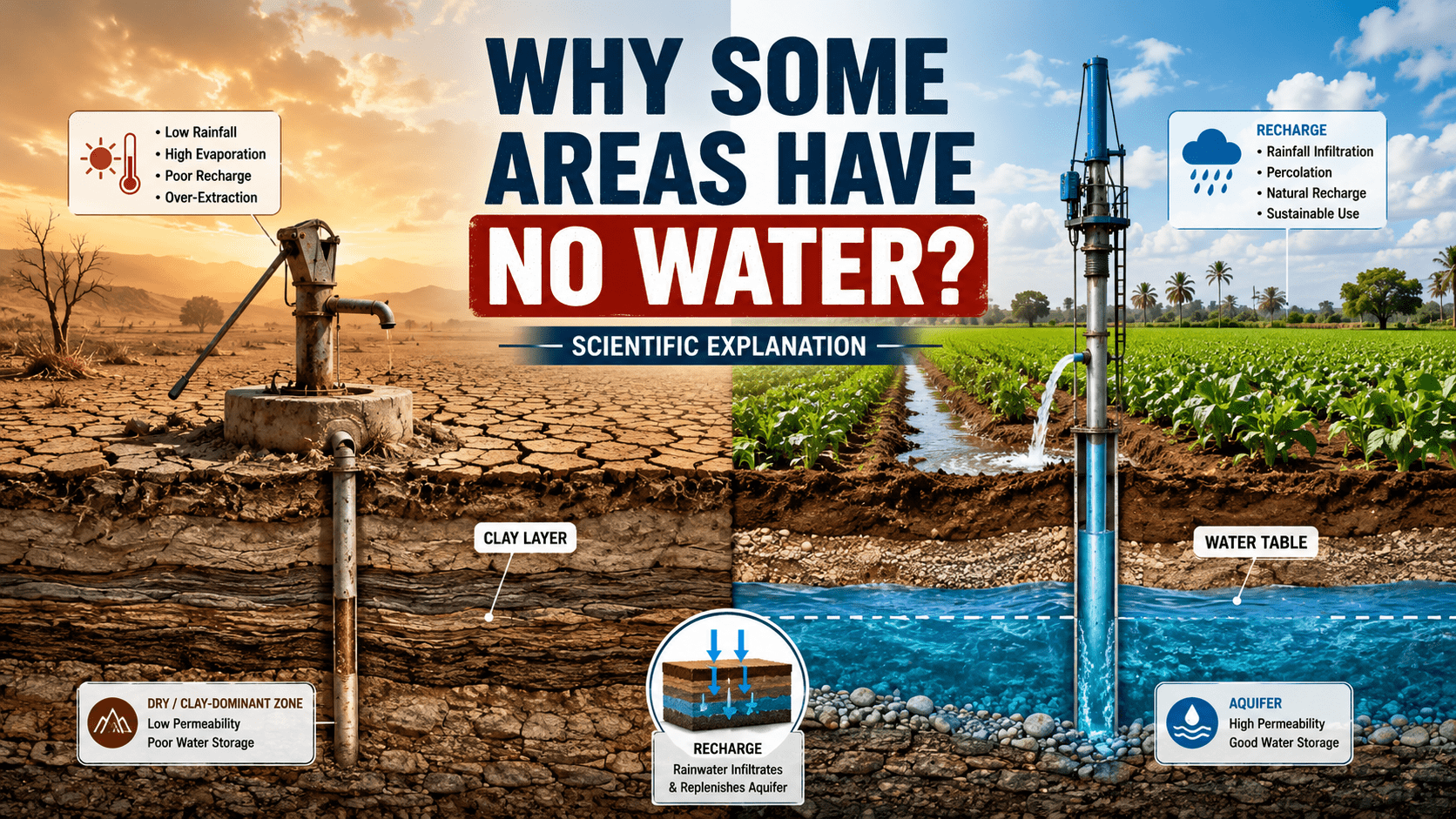
This is not magic. It is science.
Underground water does not exist like a huge open lake beneath the earth. Instead, it is stored inside tiny spaces between sand, gravel, clay, rocks, and soil layers. Some areas have underground formations that store and transmit water easily. Other areas have hard rock, compact clay, saline zones, or low recharge, making water difficult to find.
To understand why some areas have no water, we must understand:
- Aquifers
- Water table
- Soil and rock layers
- Recharge
- Over-pumping
- Salinity
- Bore depth
- Geological structure
- Rainfall and canal seepage
- Human water usage
This article explains the complete scientific reason behind dry areas, weak bores, and water scarcity in a simple and practical way.
1. What Is Underground Water?
Underground water, also called groundwater, is water stored below the earth’s surface. When rain falls or canal water seeps into the ground, some of it moves downward through soil and fills empty spaces between underground materials.
These underground water-holding layers are called aquifers.
A good aquifer usually contains:
- Sand
- Gravel
- Cracked rock
- Loose soil layers
- Permeable formations
A poor aquifer may contain:
- Thick clay
- Hard rock
- Cemented soil
- Saline deposits
- Very fine silt
- Dry compact layers
The main difference is permeability. Permeability means how easily water can move through soil or rock.
For example:
- Sand and gravel allow water to move easily.
- Clay holds water but does not release it easily.
- Hard rock may block water unless it has cracks.
- Saline formations may contain water, but it may not be usable.
So, an area may technically have water underground, but the bore may still fail because the water cannot move into the pipe fast enough.
2. The Role of Aquifers: The Underground Water Storage System
An aquifer is like a natural underground water tank. But unlike a plastic tank, it is made of soil, sand, rock, and sediment.
There are two major types of aquifers:
Unconfined Aquifer
This is a shallow aquifer close to the surface. It directly depends on rainfall, canal seepage, river flow, and surface recharge.
Features:
- Easier to access
- Usually used by shallow bores
- Quickly affected by drought
- More vulnerable to contamination
- Water level rises and falls seasonally
Confined Aquifer
This aquifer is trapped between less permeable layers like clay or rock. Water inside it may be under pressure.
Features:
- Usually deeper
- More stable than shallow water
- Less affected by short-term drought
- More expensive to access
- May need deeper drilling
Some areas have strong aquifers. Others have weak, thin, or broken aquifers. That is why two locations can have very different water results even if they are near each other.
3. Why Some Areas Have No Water
There are many scientific reasons why a location may have no usable water.
A. The Water Table Is Too Deep
The water table is the level below the ground where soil and rock are fully saturated with water.
In some areas, the water table is shallow. In others, it is very deep.
When the water table goes down:
- Shallow wells stop working.
- Old bores become weak.
- Pumps start sucking air.
- Electricity cost increases.
- Deeper drilling becomes necessary.
This happens due to:
- Less rainfall
- Excessive tube well pumping
- Drought
- Poor recharge
- High crop water demand
- Urban development
- Canal water shortage
A dry bore does not always mean there is no water in the area. Sometimes it means the bore was not deep enough to reach the active water zone.
B. The Area Has Clay or Hard Rock Layers
Some underground layers do not allow water to pass easily. Clay is a major example.
Clay can hold moisture, but it does not release water quickly. So, even if the soil looks moist, the bore may not produce enough water.
Hard rock areas also create problems. If rock has cracks, water may be found inside fractures. But if the rock is solid and unbroken, water flow may be very low.
Common problem layers include:
- Thick clay
- Hardpan
- Cemented gravel
- Solid rock
- Fine silt
- Saline clay
- Compacted sediment
A bore drilled into poor formation may give very low discharge even if nearby land has water.
C. Recharge Is Low
Recharge means the natural refilling of groundwater.
Groundwater recharge comes from:
- Rainfall
- River seepage
- Canal seepage
- Floodwater
- Irrigation return flow
- Ponds and water bodies
- Sandy soil infiltration
If recharge is low, underground water slowly declines.
Areas with poor recharge often have:
- Very little rainfall
- Concrete surfaces
- No canal system
- Compacted soil
- Poor drainage
- Deep clay layers
- Excessive evaporation
- High pumping pressure
When extraction is higher than recharge, the aquifer becomes weaker year by year.
D. Over-Pumping Has Lowered the Water Level
One of the biggest reasons for water shortage is over-pumping.
When many tube wells operate in the same area, they pull water from the same aquifer. If pumping continues faster than natural recharge, the groundwater level drops.
This creates a cone of depression around each bore. Imagine the water table being pulled downward like a funnel near the pump.
When many cones overlap:
- Water levels drop faster.
- Smaller pumps fail.
- Shallow bores dry out.
- New bores need more depth.
- Pumping cost increases.
- Water quality may become worse.
This is why an area that had good water 10 years ago may now have weak water.
E. Salinity Makes Water Unusable
Some areas have groundwater, but it is too salty, bitter, or mineral-heavy for agriculture or drinking.
Salinity can happen due to:
- Natural salt deposits
- Poor drainage
- Evaporation
- Seawater intrusion in coastal areas
- Excessive pumping
- Waterlogging
- Fertilizer and chemical movement
- Deep saline formations mixing with fresh water
Salty water can damage:
- Crops
- Soil fertility
- Pumps
- Pipes
- Motors
- Drip systems
- Household plumbing
So when people say “there is no water,” sometimes the real meaning is: there is no usable sweet water.
F. Wrong Bore Location
Groundwater does not spread equally everywhere. It often flows through underground channels, old river paths, sandy belts, fractures, and gravel zones.
A wrong bore location can miss the productive water zone by a short distance.
This is why water investigation is important before drilling.
Good investigation can identify:
- Probable water-bearing zones
- Depth variation
- Salinity risk
- Soil formation
- Best drilling point
- Expected bore depth
- Suitable pump size
A scientific survey cannot guarantee unlimited water, but it can reduce risk.
G. Poor Bore Design
Sometimes the area has water, but the bore fails because of poor design.
Common bore design mistakes include:
- Wrong screen placement
- Poor gravel packing
- Low-quality casing
- Incorrect bore diameter
- Incomplete development
- Pump installed too deep or too shallow
- Screen installed in clay instead of sand
- No proper flushing
- Wrong motor and pump selection
A bore is not just a hole in the ground. It is an engineered water system. If the design is wrong, even a good water area can give poor results.
4. Scientific Comparison Table
| Factor | Water-Rich Area | Water-Scarce Area | Scientific Reason |
|---|---|---|---|
| Soil Type | Sandy or gravelly | Clayey or compact | Sand and gravel allow better water movement |
| Aquifer Thickness | Thick and continuous | Thin or broken | Bigger aquifers store more water |
| Recharge | High | Low | Rain, canals, rivers, and seepage refill groundwater |
| Pumping Pressure | Controlled | Excessive | Over-pumping lowers water table |
| Water Quality | Sweet or usable | Salty or hard | Mineral concentration and poor drainage affect quality |
| Bore Success Rate | Higher | Lower | Productive layers are easier to access |
| Pumping Cost | Lower | Higher | Deeper water requires more energy |
| Long-Term Stability | Better | Risky | Recharge and extraction remain balanced |
| Geological Formation | Permeable | Impermeable | Water cannot flow easily through clay or hard layers |
| Best Solution | Managed pumping | Investigation and recharge | Scientific planning reduces failure risk |
5. Pros and Cons of Understanding Water-Scarce Areas
Pros
Understanding the science behind dry areas has many benefits:
- Better bore success rate: You can choose a better drilling point.
- Lower financial risk: Scientific investigation reduces blind drilling.
- Right pump selection: You can install the correct HP, head, and discharge.
- Improved water quality planning: Salinity and hardness risks can be checked earlier.
- Longer bore life: Proper design helps maintain water flow.
- Better crop planning: Farmers can select crops according to water availability.
- Lower electricity cost: Efficient pumping reduces energy waste.
- Reduced motor failure: Pumps work better when matched with water level.
- Better groundwater management: Communities can avoid over-pumping.
- More sustainable farming: Water use becomes smarter and more controlled.
Cons / Challenges
There are also challenges:
- Water investigation costs money: Scientific survey adds initial cost.
- Deep drilling is expensive: Areas with deep water need higher investment.
- No survey gives 100% guarantee: Groundwater conditions can change suddenly.
- Salinity can limit use: Even if water is found, it may not be suitable.
- Over-pumping affects everyone: One farmer’s excessive pumping can impact nearby wells.
- Recharge takes time: Aquifers do not recover overnight.
- Poor-quality drilling ruins good sites: Wrong casing or screen can damage results.
- Some areas are naturally weak: Geology cannot always be changed.
- Climate patterns affect recharge: Less rainfall means slower recovery.
- Maintenance is necessary: A bore needs cleaning, monitoring, and pump care.
6. Why Nearby Areas Can Have Different Water Results
One of the most common questions is: “My neighbor has water, why does my bore fail?”
The answer is underground variation.
Below the earth, layers are not perfectly flat. They can change suddenly within a short distance.
Possible reasons include:
- A sandy layer may exist under one farm but not the next.
- A clay lens may block water movement.
- An old river channel may pass through one side only.
- The neighbor’s bore may be deeper.
- The neighbor may be using a better screen design.
- One bore may be in sweet water while another hits saline water.
- The water table may slope underground.
- Pumping from nearby bores may reduce pressure.
- A fault or fracture zone may carry water in one direction.
This is why local experience matters, but scientific testing matters even more.
7. Signs That an Area May Have Low Groundwater
Before drilling, certain signs may indicate groundwater problems.
Possible warning signs:
- Old wells in the area have dried.
- Farmers are increasing bore depth every few years.
- Water taste is salty or bitter.
- Motors burn frequently due to low water.
- Pumps discharge sand or mud.
- Water flow reduces in summer.
- Nearby bores have low discharge.
- Electricity bills are rising due to deeper pumping.
- Soil has white salt marks.
- Crops show yellowing despite irrigation.
- Land has waterlogging in some places and dry patches in others.
- People report failed bores nearby.
These signs do not confirm failure, but they show that proper investigation is needed.
8. Role of Rainfall, Canals, and Rivers
Groundwater is connected with surface water. Rainfall, canals, rivers, and irrigation systems all influence underground water.
Areas near canals or rivers often have better recharge because water slowly seeps into the ground. Sandy soils allow this seepage to move deeper. Clay soils slow it down.
However, canal water does not always guarantee sweet groundwater. In some areas, poor drainage and high evaporation can increase salinity.
Good recharge depends on:
- Soil type
- Canal flow
- Rainfall amount
- Irrigation method
- Land slope
- Drainage system
- Vegetation
- Aquifer depth
- Pumping intensity
If recharge is high and pumping is controlled, groundwater remains stable. If pumping is too high, even canal areas can face decline.
9. How Over-Pumping Damages an Aquifer
Over-pumping is not just a temporary problem. It can permanently damage underground formations.
When water is removed from fine-grained layers like clay and silt, the ground can compact. This reduces the natural pore spaces that used to store water.
The result can be:
- Lower groundwater storage
- Land subsidence
- Permanent aquifer damage
- Higher pumping depth
- Reduced bore life
- More expensive irrigation
- Cracks in land or structures in severe cases
This is why groundwater should be treated like a bank account. If you withdraw more than you deposit, the balance will fall.
10. Practical Solutions for Areas With Low Water
Even if an area has weak groundwater, there are still practical solutions.
A. Conduct Water Investigation Before Drilling
Before drilling a bore, check the underground conditions. A proper survey helps identify the best point and expected depth.
B. Choose the Right Bore Depth
Do not copy another farmer’s bore blindly. Depth should depend on local formation, water table, and aquifer quality.
C. Use Proper Casing and Screen
The screen should be placed in the water-bearing layer, not in clay or dry formation.
D. Develop the Bore Properly
After drilling, the bore must be cleaned and developed so water can enter freely.
E. Match Pump With Water Level
Wrong pump selection can damage the bore and motor. Pump size should match:
- Depth
- Discharge
- Pipe size
- Water level
- Required pressure
- Crop requirement
F. Use Efficient Irrigation
Farmers can reduce water waste through:
- Drip irrigation
- Sprinkler systems
- Center pivot irrigation
- Laser land leveling
- Proper field channels
- Mulching
- Crop scheduling
G. Improve Recharge
Recharge can be improved through:
- Rainwater harvesting
- Recharge pits
- Farm ponds
- Canal seepage management
- Reducing concrete cover
- Water spreading during floods
- Soil moisture conservation
H. Monitor Water Level
A bore should be monitored regularly. If water level keeps dropping, pumping hours should be controlled.
11. Best Crops for Low-Water Areas
In water-scarce areas, crop selection is very important.
High-water crops can create pressure on groundwater. Low-water crops can reduce pumping needs.
Better options may include:
- Cotton
- Pulses
- Oilseed crops
- Millet
- Sorghum
- Vegetables with drip irrigation
- Orchards with controlled irrigation
- Fodder under efficient irrigation systems
Crops needing careful planning:
- Rice
- Sugarcane
- High-water fodder
- Flood-irrigated vegetables
- Crops grown without land leveling
The goal is not only to find water. The goal is to use water wisely.
12. Eye-Opening Example
Imagine two farms located only 500 meters apart.
Farm A has a bore at 180 feet with strong water flow. Farm B drills at 180 feet and gets weak water.
Why?
Because Farm A may be located above a sandy aquifer, while Farm B may sit above clay or fine silt. Farm A’s screen may be placed in a productive layer, while Farm B’s screen may be installed in the wrong formation. Farm A may have better recharge from a nearby canal, while Farm B may be affected by over-pumping or salinity.
This shows a very important lesson:
Groundwater is local. Every site should be studied individually.
13. Common Myths About No-Water Areas
Myth 1: “If one bore fails, the whole area has no water.”
Not always. The bore may have failed due to wrong depth, wrong location, or poor design.
Myth 2: “Deeper bore always means better water.”
Not always. Deeper water can sometimes be salty or mineral-heavy.
Myth 3: “Neighbor’s bore depth will work for me.”
Not guaranteed. Underground layers can change within a short distance.
Myth 4: “High HP pump solves low water.”
Wrong. A bigger pump can damage a weak bore faster.
Myth 5: “Water investigation is unnecessary.”
Blind drilling can waste far more money than proper investigation.
14. Final Conclusion
Some areas have no water because of natural geology, low recharge, deep water table, over-pumping, salinity, poor bore design, or weak aquifers. Groundwater is not evenly distributed underground. It depends on soil type, rock layers, rainfall, canal seepage, aquifer thickness, and human usage.
The biggest mistake is assuming that water exists equally everywhere.
A successful bore requires:
- Correct location
- Proper depth
- Good drilling method
- Right casing and screen
- Scientific water investigation
- Proper pump selection
- Controlled pumping
- Long-term water management
For farmers, industries, and homeowners, the smartest approach is simple:
Do not drill blindly. Study the land, understand the water, and build the bore scientifically.
Water is not just found by depth. It is found by understanding the earth beneath your feet.