

Water Problems in South Punjab – Explained


A Complete Guide to Causes, Effects, Solutions & Future Challenges
South Punjab is one of Pakistan’s most important agricultural regions. From Multan, Bahawalpur, Rahim Yar Khan, Lodhran, Vehari, Khanewal, Muzaffargarh, Layyah, Dera Ghazi Khan, Rajanpur, Bahawalnagar, and nearby districts, this region grows crops, supports livestock, supplies food, and provides livelihoods to millions of families.
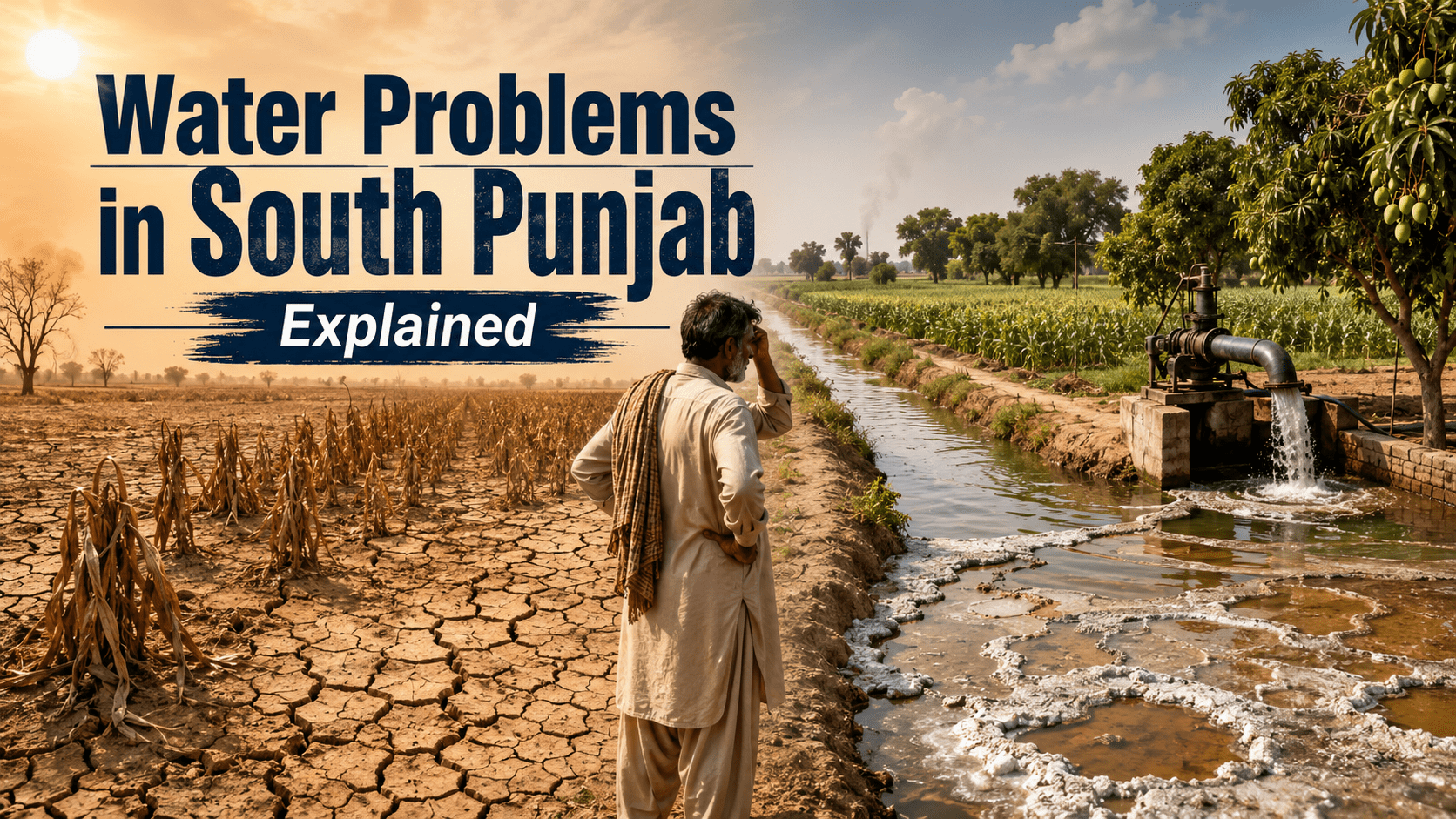
But behind this agricultural strength, one major issue is becoming more serious every year: water problems.
For some people, the problem is less water.
For others, the problem is bad quality water.
For farmers, it may be salinity, falling groundwater levels, expensive pumping, canal shortages, or poor irrigation efficiency.
For households, it may be unsafe drinking water, contaminated hand pumps, bad taste, smell, hardness, bacteria, arsenic, fluoride, or sewage mixing.
In simple words, South Punjab is not facing just one water problem. It is facing a full chain of water challenges.
Quick Overview: Main Water Problems in South Punjab
South Punjab’s water issues can be divided into six major categories:
- Groundwater depletion — water table going deeper in many areas
- Salinity — salty water damaging crops, soil, pumps, and pipelines
- Unsafe drinking water — contamination from bacteria, sewage, arsenic, fluoride, nitrate, and other pollutants
- Canal water shortage — uneven supply, tail-end losses, and seasonal shortages
- Poor irrigation practices — flood irrigation, water wastage, unlined channels, and low efficiency
- Climate pressure — droughts, heatwaves, irregular rainfall, and floods
The issue is serious because South Punjab depends heavily on water for:
- Agriculture
- Drinking water
- Livestock
- Tube wells
- Small industries
- Rural communities
- Urban growth
- Food production
When water becomes scarce or contaminated, the entire economy suffers.
Why Water Matters So Much in South Punjab
South Punjab is naturally hot and dry compared to northern Punjab. Rainfall is limited, summers are long, and agriculture depends mostly on canal water and groundwater.
Water is needed for:
- Wheat
- Cotton
- Sugarcane
- Mango orchards
- Citrus
- Vegetables
- Fodder
- Livestock
- Domestic use
- Small businesses
- Industrial work
For farmers, water is not just a utility. It is the foundation of income. A farmer with reliable water can grow better crops, protect orchards, and earn a stable income. A farmer without water faces crop failure, debt, and migration pressure.
That is why the water crisis in South Punjab is not only an environmental issue. It is also an economic, health, and social issue.
1. Groundwater Depletion: The Water Table Is Going Down
One of the biggest problems in South Punjab is the falling groundwater level. In many areas, people used to get water at shallower depths. Now, many farmers and households need deeper bores, stronger pumps, and more electricity or solar power to extract water.
Main Causes of Groundwater Depletion
- Too many tube wells
- Over-pumping for agriculture
- Lack of groundwater regulation
- Less natural recharge
- Canal seepage changes
- Urban expansion
- Drought and low rainfall
- Water-intensive crops
- Inefficient flood irrigation
- Solar pumps running for long hours without monitoring
Effects of Groundwater Depletion
- Bore depth increases
- Pumping cost increases
- Old tube wells dry up
- Farmers need bigger motors
- Electricity and solar system cost rises
- Poor farmers suffer the most
- Water quality often becomes worse at depth
- Salinity risk increases in some areas
Eye-Catching Point
When groundwater goes deeper, the problem is not only “more depth.” It means higher cost, harder pumping, more maintenance, and more risk of poor-quality water.
2. Salinity: The Silent Enemy of South Punjab Agriculture
Salinity is one of the most damaging water problems in South Punjab. Saline water contains dissolved salts. When this water is used repeatedly for irrigation, salts collect in the soil. Over time, the soil becomes hard, crop growth slows, and yield drops.
Common Signs of Salinity
- White salt layer on soil surface
- Poor crop germination
- Yellowing leaves
- Reduced plant growth
- Hard soil crust
- Low yield despite fertilizer use
- Bad taste in water
- Damage to pumps and pipes
- Scaling in pipelines
Why Salinity Is Dangerous
Salinity is dangerous because it grows slowly. A farmer may not notice it in the first season. But after repeated use of saline water, the soil becomes weaker year by year.
Crops Most Affected
- Cotton
- Vegetables
- Citrus
- Mango plants
- Wheat at early stage
- Fodder crops
- Nursery plants
Some crops tolerate salinity better than others, but even salt-tolerant crops suffer when salinity becomes too high.
3. Unsafe Drinking Water: A Health Crisis
Water quality is a serious concern in South Punjab. Many rural families depend on hand pumps, shallow bores, community water points, or untested groundwater. In urban areas, old pipelines, sewage mixing, and poor filtration can make the problem worse.
Common Drinking Water Problems
- Bacterial contamination
- Sewage mixing
- Bad smell
- High TDS
- Hardness
- Arsenic
- Fluoride
- Nitrate
- Chloride
- Muddy water
- Rusty pipelines
- Poor storage tanks
Health Problems Linked With Unsafe Water
Unsafe water can cause:
- Diarrhea
- Cholera
- Typhoid
- Hepatitis A and E
- Stomach infections
- Skin irritation
- Kidney stress
- Dental fluorosis
- Bone problems
- Weak immunity in children
Important Reminder
Clear water is not always safe water.
Many dangerous contaminants have no visible color, smell, or taste. That is why water testing is very important.
4. Canal Water Shortage and Uneven Distribution
South Punjab depends heavily on canal irrigation. Canal water is extremely important because it supports agriculture and helps reduce dependence on groundwater.
But canal water has its own challenges.
Common Canal Water Problems
- Tail-end farmers receive less water
- Seasonal shortages
- Sedimentation in canals
- Illegal cuts or theft
- Damaged watercourses
- Poor lining
- Rotation issues
- Low flow during peak crop demand
- Political and administrative pressure
- Poor maintenance of smaller channels
Impact on Farmers
When canal water is not available on time, farmers shift to tube wells. This increases groundwater pumping. If the groundwater is saline, the farmer faces a double problem: higher cost and lower soil quality.
5. Agriculture Uses Too Much Water Inefficiently
Traditional flood irrigation is still common in South Punjab. It is easy and familiar, but it wastes a lot of water.
Problems With Flood Irrigation
- Excess water applied to fields
- Uneven water distribution
- Waterlogging in some areas
- Salt movement in soil
- Fertilizer loss
- Weed growth
- More pumping hours
- Higher energy cost
- Low water productivity
Better Irrigation Options
Farmers can reduce water wastage by using:
- Laser land leveling
- Drip irrigation
- Sprinkler irrigation
- High-efficiency irrigation systems
- Lined watercourses
- Proper irrigation scheduling
- Soil moisture monitoring
- Crop selection based on water quality
- Mulching for orchards
- Alternate wetting and drying where suitable
Comparison Table: Water Sources in South Punjab
| Water Source | Main Use | Benefits | Problems | Best For |
|---|---|---|---|---|
| Canal Water | Agriculture | Low cost, helps recharge groundwater, usually better for soil | Shortage, uneven supply, tail-end issues | Crops, orchards, large farms |
| Shallow Bore Water | Domestic and small irrigation | Lower drilling cost, easy access | Higher contamination risk, may dry up | Villages with good water zones |
| Deep Bore Water | Domestic, agriculture, commercial use | More reliable in some areas | Expensive, can be saline or hard, needs testing | Areas with falling water table |
| Solar Tube Well | Agriculture | Low running cost, useful where electricity is costly | Can increase over-pumping if unmanaged | Farms with planned irrigation |
| RO/Filtration Plant | Drinking water | Removes many impurities, improves taste | Maintenance cost, membrane replacement | Homes, schools, mosques, villages |
| Rainwater Harvesting | Recharge and storage | Free natural source, helps recharge | Seasonal, needs storage system | Homes, farms, public buildings |
| Drip Irrigation | Orchards, vegetables | Saves water, improves fertilizer use | Initial cost, needs filtration | Mango, citrus, vegetables |
| Sprinkler Irrigation | Fields and fodder | Better than flood irrigation | Wind loss, pressure requirement | Fodder, lawns, some crops |
Pros & Cons of Main Water Solutions
1. Deep Bore / Tube Well
Pros
- Reliable water access if aquifer is available
- Useful for agriculture and domestic needs
- Can support large farms
- Works with solar, diesel, or electric pumps
- Helps farmers during canal shortage
Cons
- High drilling cost
- Water quality may be poor
- Pumping cost increases with depth
- Risk of over-extraction
- Requires proper pump selection
- May need filtration for drinking use
2. Solar Pump System
Pros
- Reduces diesel and electricity cost
- Good for remote farms
- Reliable during daytime
- Environment-friendly energy source
- Helpful for irrigation planning
Cons
- High initial investment
- Can cause over-pumping if used without control
- Needs correct design
- Requires maintenance of panels and inverter
- Not a full solution if water quality is saline
3. RO / Water Filtration Plant
Pros
- Improves drinking water safety
- Removes many harmful contaminants
- Good for schools, mosques, homes, and villages
- Helps reduce waterborne diseases
- Improves taste and clarity
Cons
- Needs regular maintenance
- Filters and membranes must be replaced
- Wastewater management is required
- Not suitable without proper testing and design
- Poor maintenance can make it ineffective
4. Drip Irrigation
Pros
- Saves water
- Improves crop growth
- Best for orchards and vegetables
- Reduces weed growth
- Fertilizer can be applied efficiently
- Helps in saline areas when managed properly
Cons
- Initial cost is high
- Needs filtration
- Pipes can clog
- Farmers need training
- Not ideal for every crop
5. Canal Water Improvement
Pros
- Reduces groundwater pressure
- Better for soil than saline groundwater
- Supports large agricultural areas
- Helps groundwater recharge
- Lower running cost for farmers
Cons
- Requires government-level maintenance
- Tail-end farmers may still suffer
- Water theft and illegal cuts are common issues
- Seasonal availability can be uncertain
- Old channels need repair and lining
Major Causes Behind Water Problems in South Punjab
1. Overdependence on Groundwater
Tube wells have helped farmers for decades, but uncontrolled pumping is now creating long-term pressure on aquifers.
2. Weak Water Testing Culture
Many people install bores without testing water quality. Farmers often use water for irrigation without knowing EC, SAR, TDS, pH, or salinity levels.
3. Poor Wastewater Management
Untreated sewage and industrial wastewater can contaminate surface and groundwater.
4. Traditional Farming Methods
Flood irrigation, poor field leveling, and water-intensive crops increase water demand.
5. Climate Change
Heatwaves, uncertain rainfall, floods, and droughts make water planning more difficult.
6. Poor Public Awareness
Many households believe that clear water is safe. Many farmers believe that more water always means better crop growth. Both ideas can be wrong.
Practical Solutions for South Punjab
South Punjab needs practical, local, and affordable solutions. The answer is not one machine or one policy. It needs a complete water management approach.
For Farmers
- Test groundwater before installing a tube well
- Check EC, SAR, TDS, pH, and hardness
- Use canal water where available
- Mix canal water and groundwater if suitable
- Avoid over-irrigation
- Install laser land leveling
- Use drip irrigation for orchards
- Grow crops according to water quality
- Maintain watercourses
- Avoid unnecessary pumping
- Use gypsum where soil tests recommend it
- Keep records of bore depth and water discharge
For Households
- Test drinking water at least once a year
- Do not drink untreated bore water without testing
- Clean water tanks regularly
- Repair leaking pipelines
- Use certified filters where needed
- Boil water during disease outbreaks
- Keep drinking water covered
- Avoid using shallow contaminated sources
- Install community filtration where individual systems are costly
For Villages and Communities
- Build shared filtration plants
- Protect water points from sewage
- Repair drainage systems
- Promote rainwater harvesting
- Keep animal waste away from water sources
- Monitor hand pumps
- Create village-level water committees
- Educate people about safe water storage
For Government and Institutions
- Map groundwater quality district-wise
- Monitor tube well density
- Improve canal distribution
- Repair watercourses
- Support drip and sprinkler systems
- Promote crop zoning
- Strengthen water testing labs
- Control wastewater discharge
- Improve rural drinking water schemes
- Make water data public and easy to understand
South Punjab Water Problem: Agriculture vs Drinking Water
Water problems affect both farms and homes, but the impact is different.
| Category | Agriculture Problem | Drinking Water Problem |
|---|---|---|
| Main Issue | Low quantity and salinity | Contamination and unsafe quality |
| Most Affected | Farmers and livestock owners | Children, women, elderly, rural families |
| Common Cause | Over-pumping, poor irrigation, canal shortage | Sewage, bacteria, arsenic, fluoride, poor pipelines |
| Immediate Effect | Low crop yield | Disease and poor health |
| Long-Term Effect | Soil degradation and higher farming cost | Chronic illness and reduced quality of life |
| Best Solution | Water testing, canal support, efficient irrigation | Filtration, testing, safe storage, proper supply schemes |
Warning Signs Your Water Needs Testing
You should test water immediately if you notice:
- Bad smell
- Salty taste
- Bitter taste
- White marks on utensils
- Yellow or brown stains
- Scaling in pipes
- Low crop growth
- Repeated stomach illness
- Skin irritation
- Tube well water becoming cloudy
- Sudden change in taste
- High pump corrosion
- Poor soap lather
Water testing is not an extra cost. It is protection for your health, crops, pumps, and land.
Why Water Testing Is the First Step
Before installing any bore, pump, motor, solar system, or filtration plant, water testing should be done.
For agriculture, test:
- EC
- SAR
- RSC
- pH
- TDS
- Sodium
- Chloride
- Bicarbonate
- Calcium
- Magnesium
For drinking water, test:
- Bacteria
- Arsenic
- Fluoride
- Nitrate
- TDS
- Hardness
- pH
- Chloride
- Iron
- Turbidity
Without testing, people often spend money on the wrong solution.
For example:
- A normal filter may not remove arsenic.
- A pump cannot solve salinity.
- A deeper bore may not always give better water.
- RO may be unnecessary if the issue is only sediment.
- Drip irrigation can fail if filtration is poor.
The Future of Water in South Punjab
The future depends on how quickly the region changes its water habits. If current practices continue, farmers may face deeper bores, higher pumping costs, more saline water, weaker soils, and lower profits.
But the future can improve if South Punjab adopts smarter water management.
The Future Must Include
- More canal rehabilitation
- More groundwater monitoring
- More water testing
- More efficient irrigation
- More crop planning
- Better drainage
- Better filtration systems
- Rainwater harvesting
- Managed aquifer recharge
- Responsible use of solar pumps
- Public awareness campaigns
- Strong local water governance
South Punjab has the ability to manage this crisis, but action must be practical and fast.
Final Conclusion
Water problems in South Punjab are serious, but they are not impossible to solve. The region needs a balanced approach: protect groundwater, improve canal supply, test water quality, reduce wastage, modernize irrigation, and provide safe drinking water to every community.
The biggest mistake is to treat water as an unlimited resource. It is not unlimited. Every unnecessary pumping hour, every leaking watercourse, every untreated sewage drain, and every untested bore adds pressure to the system.
The biggest opportunity is awareness. When farmers, households, businesses, and government departments understand the real value of water, solutions become possible.
South Punjab does not just need more water. It needs better water management.
That is the real solution for agriculture, health, and the future of the region.