
Deep Bore vs Shallow Bore – Pros & Cons

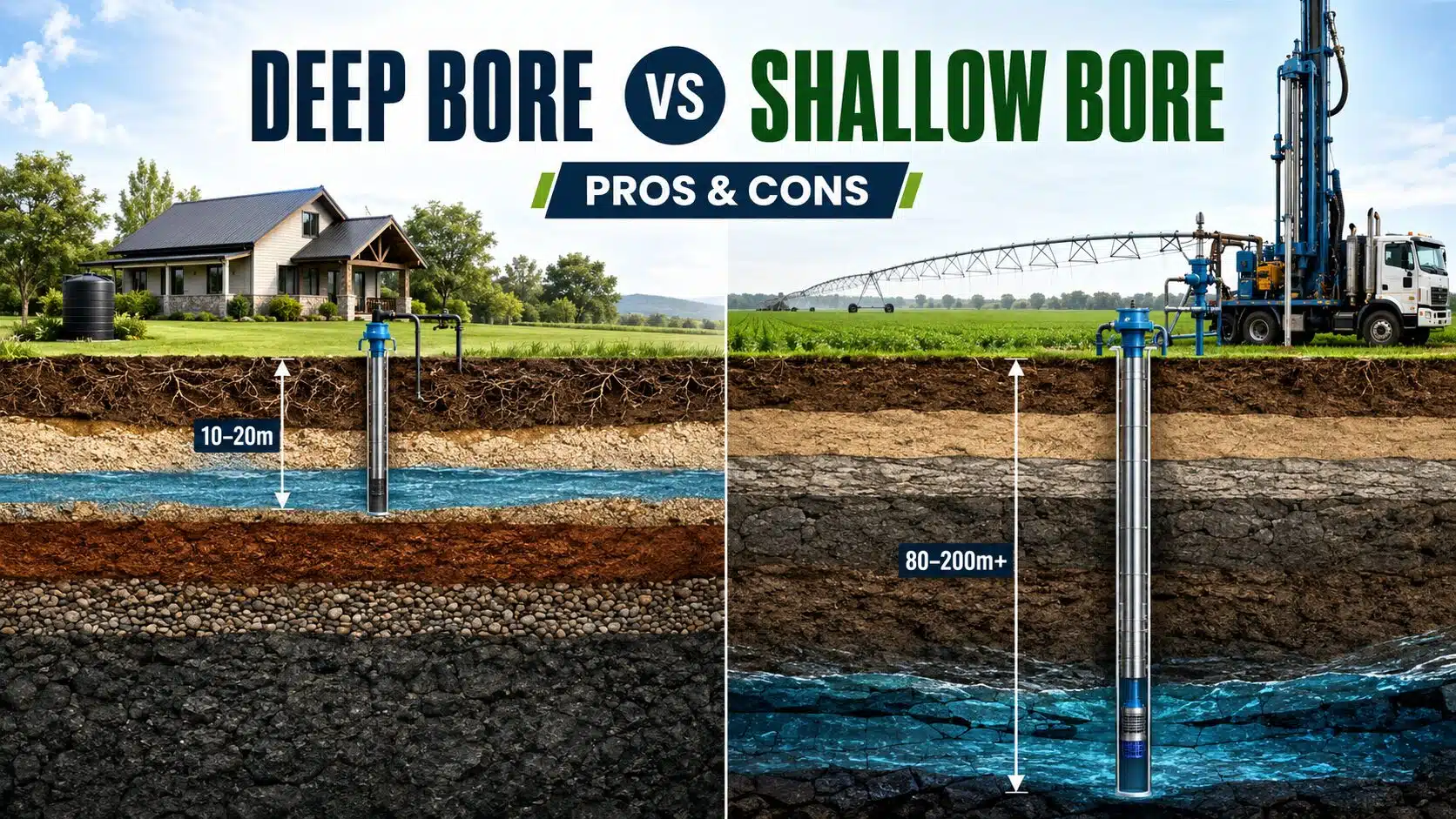
When someone plans to install a water bore, one of the first questions that comes to mind is: Should I go for a deep bore or a shallow bore? This decision is important because it directly affects water availability, installation cost, pump selection, maintenance, and long-term performance.
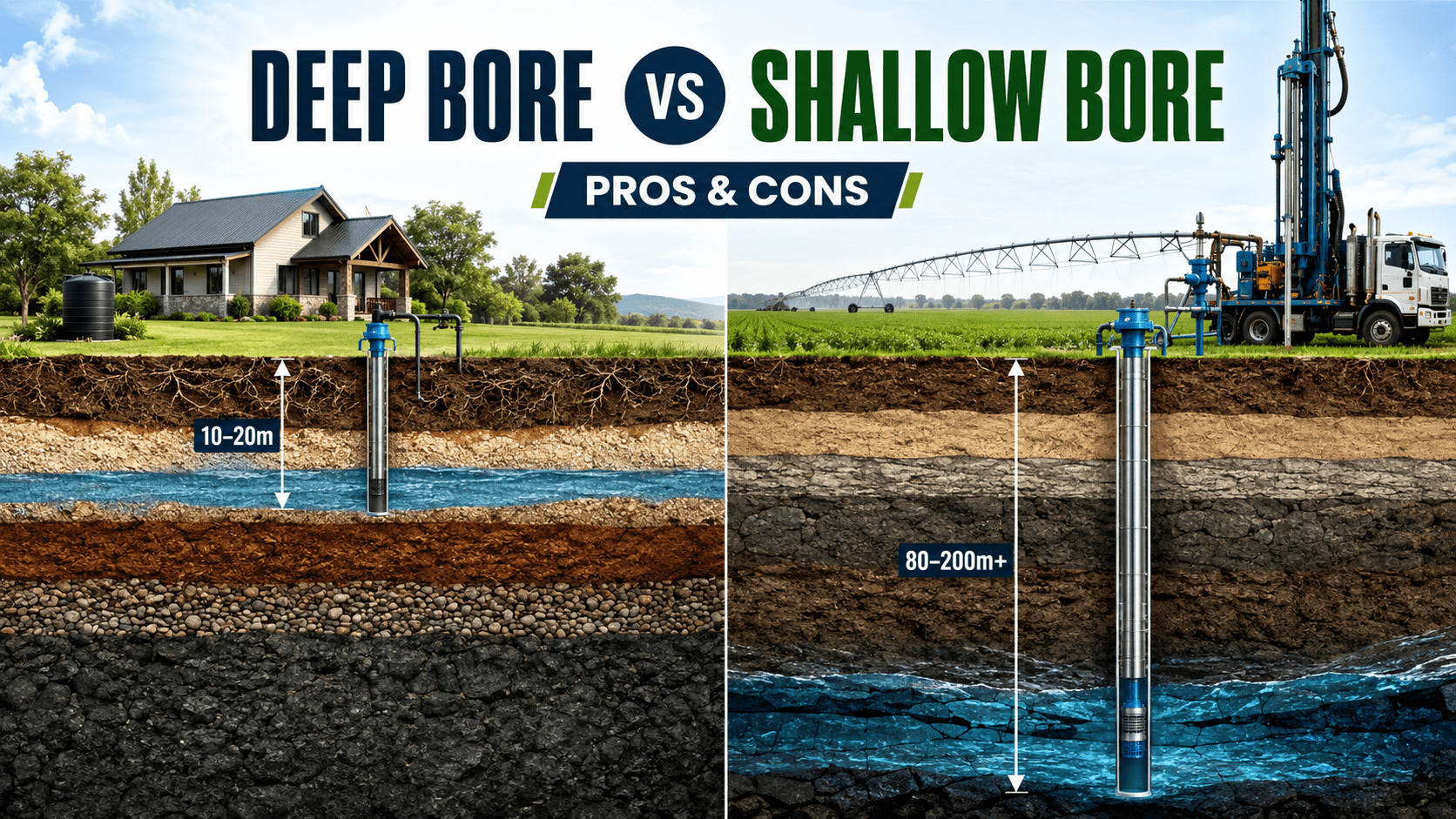
A bore is not just a hole in the ground. It is a complete water source system that depends on soil condition, underground water level, drilling depth, casing quality, pump size, motor power, and water demand. Choosing the wrong bore type can lead to low water pressure, muddy water, pump failure, dry bore problems, and repeated maintenance expenses.
In simple words:
A shallow bore is usually drilled at a lower depth where underground water is available near the surface.
A deep bore is drilled much deeper to reach stronger, more stable underground water layers.
Both have their own advantages and disadvantages. The best option depends on your location, water table, soil formation, budget, and daily water requirement.
This article explains the complete difference between deep bore and shallow bore, including pros, cons, cost factors, water quality, pump requirements, and which one is better for homes, agriculture, industries, and commercial use.
What is a Shallow Bore?
A shallow bore is a bore drilled to reach water available near the ground surface. It is commonly used in areas where the underground water level is high and water can be accessed without drilling too deep.
Shallow bores are often used for:
- Homes
- Small farms
- Gardens
- Small commercial buildings
- Temporary water needs
- Areas with high water table
The depth of a shallow bore can vary depending on the region, but generally, it is much less than a deep bore. Because it requires less drilling, the installation cost is usually lower.
However, shallow bores can be more sensitive to seasonal changes. In summer or dry months, the water level may drop, causing reduced water supply or even a dry bore.
What is a Deep Bore?
A deep bore is drilled to a greater depth to access deeper underground water layers. These layers are usually more stable and can provide a better water supply for long-term use.
Deep bores are commonly used for:
- Agriculture
- Tube wells
- Industrial water supply
- Large houses and farmhouses
- Commercial buildings
- Housing societies
- Areas with low water table
- Locations where shallow water is unreliable
Deep bores usually require stronger drilling machinery, better casing, higher-quality pipes, and more powerful pumps. The initial cost is higher, but the long-term reliability is often much better.
For users who need continuous water supply, a deep bore is usually considered a safer investment.
Deep Bore vs Shallow Bore – Quick Comparison Table
| Feature | Shallow Bore | Deep Bore |
|---|---|---|
| Depth | Lower depth | Greater depth |
| Installation Cost | Lower | Higher |
| Water Availability | Can be seasonal | More stable |
| Water Quality | May be more affected by surface contamination | Usually cleaner and more protected |
| Pump Requirement | Smaller pump may work | Powerful pump usually required |
| Best For | Homes, gardens, small use | Agriculture, industries, commercial use |
| Risk of Dry Bore | Higher in dry season | Lower if drilling is done properly |
| Maintenance Cost | Can be frequent if water is sandy/muddy | Usually more stable but pump maintenance can be costly |
| Drilling Time | Faster | Takes more time |
| Long-Term Value | Good for limited use | Better for heavy and long-term use |
| Water Pressure | Limited depending on pump and water level | Better with proper pump selection |
| Suitability for Solar Pump | Possible with smaller systems | Excellent for properly designed solar tube wells |
Main Difference Between Deep Bore and Shallow Bore
The biggest difference between deep bore and shallow bore is the depth of water source.
A shallow bore depends on water available near the surface. This type of water source can be easy to access, but it may not always be reliable. During hot weather, drought, or excessive pumping in the area, shallow water levels may decrease.
A deep bore reaches underground water layers that are much deeper. These water layers are usually more dependable and less affected by short-term weather changes. This makes deep bores more suitable for agriculture, industries, and high-water-demand projects.
In short:
- Shallow bore = lower cost, quicker installation, suitable for light use
- Deep bore = higher cost, stronger water source, suitable for long-term heavy use
Pros of Shallow Bore
Shallow bores are popular because they are simple, affordable, and quick to install in suitable areas.
1. Lower Installation Cost
One of the biggest advantages of a shallow bore is its lower cost. Since drilling depth is less, the cost of drilling, casing, labor, and machinery is usually lower.
This makes it a good option for people who have a limited budget and only need water for basic use.
2. Faster Drilling Process
A shallow bore can often be completed faster compared to a deep bore. Less drilling depth means less time spent on machinery, labor, and installation.
This is helpful when water is needed urgently.
3. Suitable for Small Water Requirements
For small homes, gardens, small shops, and light water use, a shallow bore can be enough if the water table is good.
It can support basic needs such as:
- Washing
- Gardening
- Domestic use
- Small-scale irrigation
- Construction water for small projects
4. Smaller Pump Requirement
Shallow bores often require less powerful pumps. This can reduce pump cost, electricity consumption, and maintenance expenses.
In many cases, a smaller water pump or jet pump may be enough.
5. Easy Maintenance Access
Since the bore is not very deep, some maintenance tasks can be easier and less expensive compared to a deep bore system.
Cons of Shallow Bore
Although shallow bores are affordable, they are not suitable everywhere. Their performance depends heavily on the underground water level.
1. Higher Risk of Dry Bore
The biggest disadvantage of a shallow bore is the risk of drying up. If the water table goes down, the bore may stop providing water.
This is common in areas where:
- Summer is very hot
- Rainfall is low
- Nearby bores are pumping heavily
- Groundwater level is falling
- Soil does not hold water properly
2. Water Quality Can Be Poor
Shallow groundwater is closer to the surface, which means it can be more affected by contamination.
Possible issues include:
- Muddy water
- Bad smell
- Bacteria
- Chemicals from nearby land
- Sewage leakage
- Fertilizer contamination
- Sand particles
This is why water testing is important before using shallow bore water for drinking.
3. Seasonal Water Fluctuation
A shallow bore may work well during rainy months but perform poorly in dry months. Water pressure can reduce, pump suction can become weak, and supply may become irregular.
4. Limited Water Supply
Shallow bores are usually not ideal for heavy water demand. If used for agriculture or commercial operations, they may not provide enough water continuously.
5. Pump Can Run Dry
If the water level drops below the pump’s working range, the pump may run dry. This can damage the impeller, motor, seals, and internal components.
Pros of Deep Bore
Deep bores are preferred when long-term water reliability is important. They are commonly used in farming, industrial projects, and areas with low water tables.
1. More Reliable Water Supply
Deep bores reach stronger underground water layers. These layers are usually more stable and less affected by short-term weather changes.
This makes deep bore a better option for users who need water every day without interruption.
2. Better for Agriculture
Agriculture requires a large quantity of water. Crops, orchards, farms, and tube wells need a consistent supply.
A deep bore is usually better for:
- Wheat fields
- Cotton fields
- Mango farms
- Vegetable farms
- Livestock farms
- Drip irrigation
- Center pivot irrigation
- Solar tube wells
3. Suitable for Solar Water Pumping
Deep bores can work very well with solar pumping systems if the pump is properly selected according to depth, head, flow rate, and water requirement.
A properly designed solar bore system can reduce diesel and electricity expenses significantly.
4. Better Long-Term Investment
Although the initial cost is higher, a deep bore can be more valuable in the long run because it provides better water security.
For large users, bore failure can be more expensive than bore installation. A reliable deep bore can protect farming operations, commercial projects, and industrial work from water shortage problems.
5. Lower Risk of Surface Contamination
Deep groundwater is generally more protected from surface pollution. Since the water source is deeper, it is less exposed to sewage, fertilizer, surface chemicals, and open contamination.
However, water quality still depends on the geological formation of the area, so testing is still recommended.
6. Better for Heavy-Duty Pumps
Deep bores are suitable for submersible pumps, solar pumps, turbine pumps, and high-capacity water systems.
With correct pump selection, a deep bore can deliver strong flow and pressure.
Cons of Deep Bore
Deep bores are powerful and reliable, but they also require more investment and technical planning.
1. Higher Drilling Cost
The biggest disadvantage of a deep bore is the higher installation cost. More depth means more drilling time, more casing, more labor, stronger machinery, and more technical handling.
Cost can increase depending on:
- Bore depth
- Soil hardness
- Rock formation
- Casing size
- Pipe quality
- Location access
- Machine availability
- Pump depth
2. Requires Powerful Pump
A deep bore usually needs a submersible pump or high-head pump. These pumps are more expensive than small shallow bore pumps.
The motor, cable, control box, starter, inverter, and delivery pipe also need to match the bore depth and water demand.
3. Higher Repair Cost
If a deep bore pump gets damaged, removing and reinstalling it can be costly. The deeper the pump, the more labor and time required.
Maintenance should be done carefully by experienced technicians.
4. More Technical Planning Required
Deep bore installation should not be done blindly. It requires proper planning, including:
- Water investigation
- Depth estimation
- Bore diameter selection
- Casing selection
- Pump size calculation
- Motor HP calculation
- Delivery line planning
- Electrical or solar system design
Wrong planning can lead to poor water output, pump overload, high energy bills, or bore failure.
5. Takes More Time to Complete
Compared to a shallow bore, deep bore drilling takes more time. If the soil has rock layers or hard formations, the process can take even longer.
Shallow Bore – Best Use Cases
A shallow bore can be a smart choice when the water table is high and the water requirement is limited.
Choose a shallow bore if:
- Your area has a strong shallow water table
- You need water for home use
- Your budget is limited
- Water demand is low to medium
- You need quick installation
- Nearby shallow bores are working well
- Water is not required for heavy farming or industry
Best places for shallow bore:
- Small houses
- Gardens
- Farmhouses with light use
- Small shops
- Construction sites
- Temporary water needs
- Areas near canals or high groundwater zones
Deep Bore – Best Use Cases
A deep bore is better when water demand is high and long-term reliability matters.
Choose a deep bore if:
- Shallow water is not available
- Nearby shallow bores are drying
- You need water for agriculture
- You need a tube well
- You want long-term water security
- You are installing a solar water pump
- Your area has falling water levels
- You need strong flow and pressure
- Water is required for commercial or industrial use
Best places for deep bore:
- Farms
- Orchards
- Industrial sites
- Housing societies
- Commercial buildings
- Large farmhouses
- Schools and institutions
- Factories
- Solar tube well projects
Water Quality: Which is Better?
Water quality depends on the area, soil, minerals, and nearby contamination sources.
However, generally:
Shallow bore water may be more exposed to surface contamination.
Deep bore water is usually more protected but can contain minerals, hardness, iron, salt, or other underground elements.
Before using bore water for drinking, always test it for:
- TDS
- Hardness
- Iron
- Arsenic
- Bacteria
- Smell
- Color
- Salinity
- pH level
For agriculture, water testing is also important because high salinity or poor-quality water can damage crops and soil over time.
Pump Selection: Deep Bore vs Shallow Bore
Pump selection is one of the most important parts of a bore system. Even a good bore can perform badly if the pump is not selected properly.
Shallow Bore Pump Options
For shallow bore, common options include:
- Jet pump
- Centrifugal pump
- Small submersible pump
- Surface pump
These pumps are usually affordable and easier to maintain.
Deep Bore Pump Options
For deep bore, common options include:
- Submersible pump
- High-head solar pump
- Borehole pump
- Turbine pump
- Heavy-duty agricultural pump
Deep bore pumps must be selected based on:
- Total depth
- Water level
- Delivery height
- Required flow rate
- Pipe size
- Motor HP
- Power source
- Daily water requirement
A wrong pump can cause low water pressure, high electricity bills, low discharge, overheating, or motor failure.
Cost Difference Between Deep Bore and Shallow Bore
The cost difference depends on depth, location, casing, pipe, pump, and drilling condition.
Shallow bore cost is usually lower because:
- Less drilling is required
- Less casing is used
- Smaller pump may work
- Installation is faster
- Labor cost is lower
Deep bore cost is higher because:
- More drilling depth is required
- More casing and pipe are needed
- Heavy machinery may be required
- Powerful pump is needed
- More technical work is involved
- Installation takes longer
But cost should not be the only deciding factor. A cheap bore that dries after one season can become more expensive than a properly planned deep bore.
Maintenance Difference
Maintenance depends on water quality, pump quality, bore design, and usage.
Shallow Bore Maintenance
Shallow bores may need more attention if the water contains sand, mud, or contamination.
Common issues include:
- Muddy water
- Weak suction
- Pump priming problems
- Seasonal drying
- Sand blockage
- Reduced water pressure
Deep Bore Maintenance
Deep bores are generally more stable, but pump repair can be expensive due to depth.
Common issues include:
- Pump lifting cost
- Cable damage
- Motor burning
- Low voltage problems
- Pipe leakage
- Sand entry if casing is poor
Good casing, proper pump installation, and correct electrical protection can reduce maintenance problems.
Deep Bore vs Shallow Bore for Agriculture
For agriculture, deep bore is usually the better option because farming needs a strong and consistent water supply.
Crops cannot depend on uncertain water. If a shallow bore dries during peak irrigation season, it can damage the entire crop cycle.
A deep bore is better for:
- Large fields
- Solar irrigation
- Drip irrigation
- Sprinkler systems
- Center pivot systems
- Livestock water supply
- Long operating hours
However, if a farm is located in an area with a very high water table, a shallow bore may still work for small-scale irrigation.
Deep Bore vs Shallow Bore for Home Use
For home use, the best option depends on the local water table.
A shallow bore may be enough for:
- Small homes
- Washing
- Gardening
- General domestic use
- Areas with reliable groundwater
A deep bore may be better for:
- Large houses
- Farmhouses
- Areas where shallow water is poor
- Homes needing strong water pressure
- Locations where nearby bores are drying
- Long-term property investment
For drinking water, both deep and shallow bore water should be tested before use.
Eye-Catching Decision Guide
Choose Shallow Bore If You Want:
- Lower installation cost
- Fast drilling
- Basic water supply
- Small pump setup
- Light domestic use
- Temporary or low-budget solution
Choose Deep Bore If You Want:
- Long-term water security
- Better water availability
- Stronger water output
- Agriculture or industrial use
- Solar pump installation
- Lower risk of bore drying
- Better investment for the future
Common Mistakes People Make
Many people choose a bore only by looking at the initial cost. This is one of the biggest mistakes.
Avoid these common mistakes:
- Choosing shallow bore only because it is cheaper
- Installing pump without calculating depth and water level
- Ignoring water testing
- Using poor-quality casing
- Not checking nearby bore performance
- Installing oversized or undersized pump
- Not using proper electrical protection
- Ignoring seasonal water level changes
- Hiring inexperienced drilling teams
A bore should be planned properly because it is a long-term investment.
Final Verdict: Which One is Better?
There is no single answer for everyone.
Shallow bore is better if your water table is high, your budget is limited, and your water requirement is small.
Deep bore is better if you need reliable water, better long-term performance, and a strong supply for agriculture, industry, or commercial use.
For most serious water projects, especially farms, tube wells, solar pumping systems, and industrial sites, deep bore is usually the safer and more reliable choice.
For small homes and gardens in areas with good groundwater, a shallow bore can be practical and cost-effective.
The best decision should be made after checking:
- Local water table
- Nearby bore depth
- Soil condition
- Water demand
- Budget
- Pump requirement
- Water quality
- Long-term usage plan
Conclusion
Deep bore and shallow bore both have their place. A shallow bore is affordable, quick, and suitable for light water use. A deep bore is more expensive but offers better reliability, stronger water supply, and long-term value.
Before drilling, always consult experienced bore drilling professionals, check nearby bore results, and choose the right pump according to your bore depth and water requirement.
A properly planned bore can serve you for years. A poorly planned bore can create repeated expenses, weak water supply, pump damage, and water shortage problems.
So, before choosing between deep bore and shallow bore, remember one thing:
Do not choose the cheapest option. Choose the option that gives you reliable water for your actual need.