
Cheap vs Expensive Inverter – Worth It?


Introduction: The Real Question Buyers Ask
When buying a solar inverter, most customers ask one simple question:
“Should I buy a cheap inverter and save money, or should I spend more on an expensive inverter?”
This question is very important because the inverter is not just another part of your solar system. It is the brain of the entire setup. Solar panels generate DC electricity, but your home, tube well, factory, office, shop, or farmhouse usually needs usable AC electricity. The inverter handles this conversion, manages voltage, protects equipment, controls power flow, and in hybrid systems, also manages batteries.
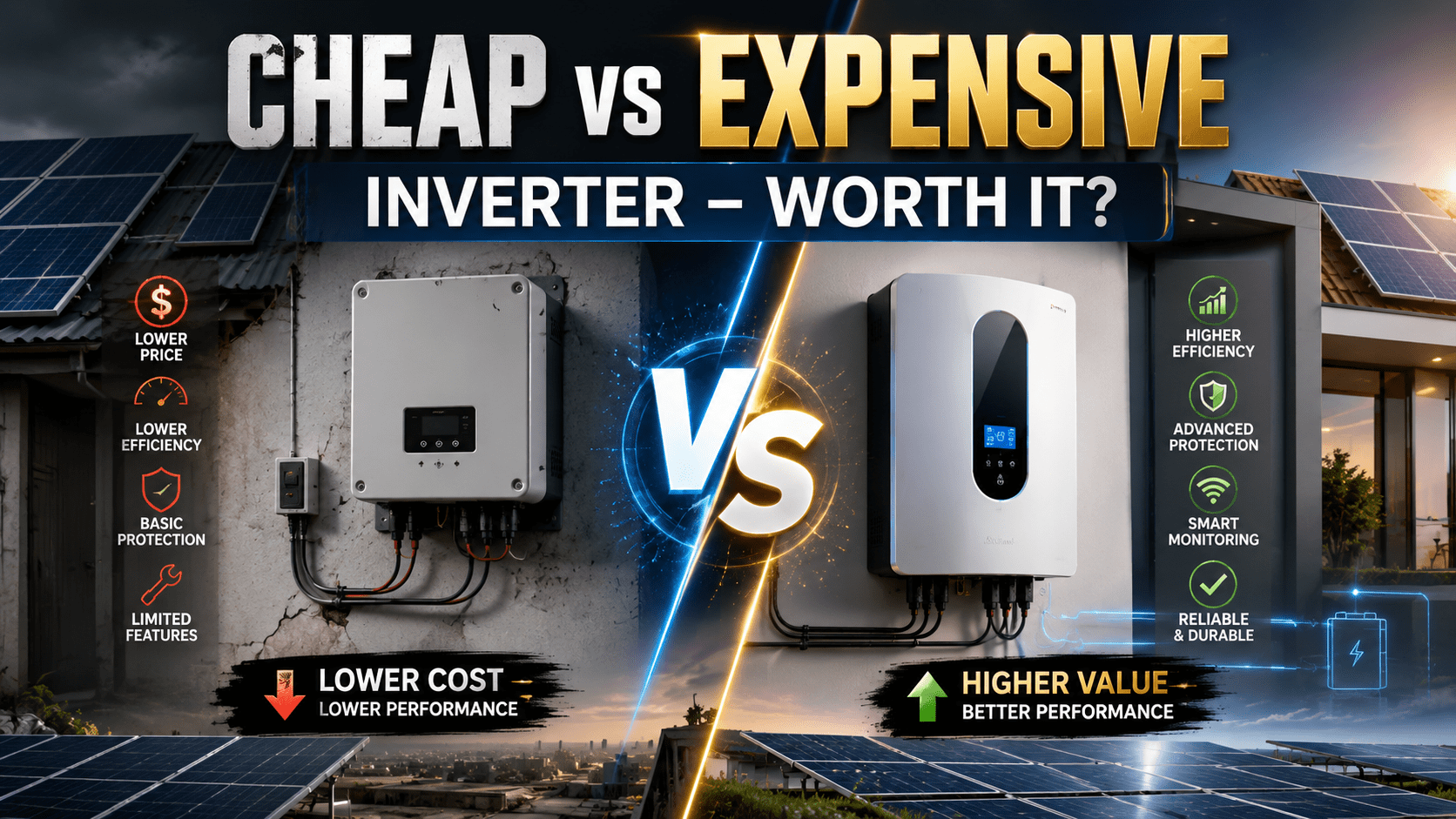
So, the real question is not only about price.
The real question is:
Will a cheap inverter save money, or will it cost more later?
The answer depends on your usage, load, installation quality, brand support, warranty, environment, and long-term expectations. A cheap inverter can be suitable for a small, simple system. But for serious usage, especially solar tube wells, commercial buildings, industrial loads, large homes, battery backup systems, or three-phase setups, an expensive inverter can often be the smarter investment.
Let’s reveal the full truth.
What Is a Solar Inverter?
A solar inverter is the device that converts electricity from solar panels into usable power. In a solar system, panels produce DC current, while most appliances, motors, pumps, and machines run on AC current.
A good inverter does more than conversion. It also manages:
- Solar panel input
- Power output
- Battery charging and discharging
- Grid connection
- Voltage stability
- Load protection
- System monitoring
- Fault detection
- Energy efficiency
In simple words:
Solar panels produce power, but the inverter controls how that power is used.
This is why choosing the right inverter is so important.
Cheap Inverter vs Expensive Inverter: Basic Difference
A cheap inverter usually focuses on one thing: low price.
An expensive inverter focuses on:
- Better performance
- Higher safety
- Longer life
- Stronger warranty
- Better monitoring
- Higher efficiency
- Better protection features
- Stable output
- Better support after sale
A cheap inverter may look attractive in the beginning because the purchase cost is lower. But an expensive inverter may deliver more value over several years because it can reduce downtime, protect appliances, improve solar generation, and last longer.
Quick Comparison Table
| Feature | Cheap Inverter | Expensive Inverter |
|---|---|---|
| Purchase Price | Low | High |
| Build Quality | Basic | Stronger components |
| Efficiency | Usually lower or average | Usually higher |
| MPPT Performance | Basic tracking | Faster and smarter tracking |
| Warranty | Shorter or limited | Longer and stronger |
| Monitoring App | Basic or missing | Better app/cloud monitoring |
| Protection Features | Limited | Advanced protections |
| Lifespan | May be shorter | Usually longer |
| Heat Handling | Average | Better thermal design |
| Battery Management | Basic | Smarter battery control |
| After-Sales Support | May be weak | Usually stronger |
| Best For | Small budget systems | Homes, farms, commercial and industrial use |
| Long-Term Value | Risky if quality is poor | Better for serious users |
Why Cheap Inverters Attract Buyers
Cheap inverters are popular because they reduce the initial investment. Many customers are already spending money on panels, structure, batteries, cables, installation, earthing, and net metering. So when they see a low-priced inverter, it feels like an easy way to save money.
Benefits of Cheap Inverters
- Lower upfront cost
- Good for small systems
- Easier to buy on a tight budget
- Suitable for basic backup
- May work fine for light loads
- Useful for temporary setups
- Good option where power requirement is low
A cheap inverter can be acceptable if your system is small and your expectations are limited. For example, if you only want to run fans, lights, a small fridge, or basic home appliances, a budget inverter may do the job.
But the problem starts when people use a cheap inverter for heavy-duty work.
Problems with Cheap Inverters
A cheap inverter can become expensive if it fails early, damages appliances, gives unstable output, or lacks proper after-sales support.
Common Issues in Cheap Inverters
- Lower quality internal components
- Weak cooling system
- Poor performance in high temperature
- Limited overload capacity
- Weak surge handling
- Poor battery charging control
- No proper monitoring system
- Short warranty
- Difficult spare parts availability
- Slow or unreliable after-sales service
- Higher chance of downtime
For small home loads, downtime may be annoying. But for a business, farm, dairy, factory, or solar tube well, downtime means financial loss.
A cheap inverter is not cheap if it stops your work.
Pros and Cons of Cheap Inverters
Pros
- Affordable for budget buyers
- Lower initial investment
- Good for simple systems
- Easy to replace if the system is small
- Suitable for low-load applications
- Can be useful where backup demand is limited
Cons
- May have shorter lifespan
- May not handle heavy loads properly
- Less efficient in real-world conditions
- Weak protection can increase risk
- Poor after-sales service can create problems
- May not perform well in heat, dust, or voltage fluctuation
- Battery life can be affected if charging control is poor
- Long-term cost can become higher than expected
Why Expensive Inverters Cost More
Expensive inverters are not expensive only because of branding. In many cases, the higher price comes from better engineering, testing, software, safety features, certifications, warranty, and support network.
A premium inverter may include:
- Better MPPT technology
- Higher conversion efficiency
- Stronger PCB and components
- Better cooling design
- More stable output
- Advanced battery management
- Smart monitoring app
- Better fault detection
- Stronger surge protection
- Remote troubleshooting
- Better grid compatibility
- Longer warranty
- Better service support
This matters because the inverter is working daily, often in heat, dust, humidity, voltage fluctuation, and heavy load conditions.
In Pakistan, this is even more important because many installations face:
- High summer temperatures
- Dusty environments
- Grid fluctuation
- Load shedding
- Unbalanced loads
- Weak earthing
- Oversized or undersized systems
- Improper installation practices
A premium inverter is usually better prepared for these conditions.
Pros and Cons of Expensive Inverters
Pros
- Better long-term reliability
- Higher efficiency
- Stronger protection features
- Better for heavy loads
- Better battery management
- Longer warranty options
- Better monitoring and troubleshooting
- More stable performance
- Better for commercial and agricultural use
- Lower risk of downtime
- Better resale value
- More peace of mind
Cons
- Higher upfront cost
- Repair cost can be higher after warranty
- Requires proper installation
- Some features may be unnecessary for very small systems
- Premium brands may need authorized support for best service
The Hidden Cost of a Cheap Inverter
Many buyers only compare purchase price. That is a mistake.
You should compare the total cost of ownership.
This includes:
- Purchase price
- Installation cost
- Repair cost
- Downtime cost
- Replacement cost
- Battery damage risk
- Appliance damage risk
- Energy loss due to lower efficiency
- Service and warranty experience
A cheap inverter may save money on day one, but if it fails after one or two seasons, the saving disappears.
For example, imagine two buyers:
Buyer A: Cheap Inverter
- Pays less upfront
- Faces overheating in summer
- No proper monitoring
- Warranty claim is difficult
- Replaces inverter earlier
- Loses work during downtime
Buyer B: Expensive Inverter
- Pays more upfront
- Gets stable performance
- Uses monitoring app
- Gets better support
- Runs system for years
- Has fewer interruptions
In the long run, Buyer B may actually spend less.
Efficiency: Small Difference, Big Impact
Inverter efficiency shows how much solar energy is converted into usable power. A more efficient inverter wastes less energy.
Even a small efficiency difference matters because solar systems run daily. If your inverter wastes more energy every day, the total loss becomes significant over months and years.
For homes, the difference may be moderate. But for farms, factories, cold storage, schools, hospitals, commercial plazas, and solar tube wells, efficiency matters a lot.
Higher efficiency means more usable power from the same panels.
That is why expensive inverters often provide better long-term value.
MPPT Quality: The Silent Game Changer
MPPT stands for Maximum Power Point Tracking. It helps the inverter extract maximum available power from solar panels.
Solar output changes throughout the day due to:
- Sunlight intensity
- Temperature
- Clouds
- Dust on panels
- Panel direction
- Shading
- Load demand
A good MPPT system adjusts quickly and keeps solar production optimized. A basic inverter may not track as effectively, especially in changing weather or partial shading conditions.
This is one major reason premium inverters often perform better in real-world conditions, not just on paper.
Protection Features: Where Cheap Inverters Often Fall Behind
A good inverter should protect both itself and your connected equipment.
Important protection features include:
- Over-voltage protection
- Under-voltage protection
- Overload protection
- Short-circuit protection
- Surge protection
- Reverse polarity protection
- Anti-islanding protection
- Ground fault protection
- Battery overcharge protection
- Battery deep discharge protection
- Temperature protection
Cheap inverters may have limited protection. Expensive inverters usually include more advanced safety systems.
This is not a small thing.
One protection failure can damage:
- Fans
- Motors
- Pumps
- Batteries
- Computers
- Refrigerators
- Industrial equipment
- Solar panels
- Wiring system
Saving money on the inverter but risking expensive equipment is not smart buying.
Battery Compatibility and Battery Life
If you are buying a hybrid inverter, battery management becomes extremely important.
A cheap hybrid inverter may not charge and discharge batteries properly. Poor battery management can reduce battery life, especially with lithium batteries.
A good inverter manages:
- Charging voltage
- Charging current
- Battery temperature
- Depth of discharge
- Battery communication
- Backup priority
- Grid charging
- Solar charging
- Load shifting
If you are using expensive lithium batteries, do not pair them with a weak inverter. The inverter and battery must communicate properly for safe and efficient performance.
A premium battery needs a premium inverter.
Heat, Dust, and Real-World Conditions
Inverters do not operate in perfect laboratory conditions. In Pakistan, they often face:
- Extreme summer heat
- Dust
- Humidity
- Poor ventilation
- Voltage fluctuation
- Overloading
- Unstable grid supply
Cheap inverters may struggle in such conditions. Premium inverters usually have better cooling systems, stronger casing, better thermal management, and stronger electronic components.
This matters especially for:
- Agricultural tube wells
- Solar pumps
- Commercial buildings
- Warehouses
- Schools
- Hospitals
- Factories
- Large homes
- Farmhouses
A cheap inverter may work fine in mild conditions but fail when load and temperature increase.
After-Sales Support: The Most Ignored Factor
Many customers only ask:
“What is the price?”
But they should also ask:
“Who will support me if it fails?”
After-sales support is one of the biggest differences between cheap and expensive inverters.
Before buying, check:
- Is the brand officially available?
- Is warranty local or international?
- Is there a proper service center?
- Are spare parts available?
- Is the seller authorized?
- Is warranty replacement easy?
- Is technical support available?
- Does the company provide monitoring support?
A cheaper inverter with no service support is a big risk.
A slightly expensive inverter with strong service support is often the better deal.
When Is a Cheap Inverter Worth It?
A cheap inverter can be worth it in some cases.
You can consider a cheap inverter if:
- Your budget is very limited
- Your load is small
- You do not need heavy backup
- You are not running motors or pumps
- You are using it for temporary use
- You can easily replace it later
- You have a trusted seller
- Warranty support is acceptable
- You are not connecting expensive batteries
- Your system is simple
For example, a small home system for fans, lights, mobile charging, and basic appliances may work with a budget inverter if installed correctly.
But do not use a low-quality inverter for serious loads.
When Is an Expensive Inverter Worth It?
An expensive inverter is worth it when reliability matters.
You should choose a better inverter if:
- You are installing a large solar system
- You need battery backup
- You are using lithium batteries
- You are running a solar tube well
- You are running motors or pumps
- You have commercial load
- You need three-phase output
- You need net metering
- You want remote monitoring
- You want longer warranty
- You want better safety
- You cannot afford downtime
- You want long-term peace of mind
For serious systems, the inverter should not be the cheapest item in the setup.
Panels generate power, but the inverter protects your investment.
Cheap vs Expensive Inverter for Solar Tube Wells
For solar tube wells, expensive inverters are usually the better choice.
Why?
Because tube wells and pumps need stable power, strong starting ability, and reliable performance. Motor loads are tougher than simple home loads. If the inverter is weak, the pump may not perform properly, may trip again and again, or may reduce motor life.
For agriculture, downtime can affect irrigation, crops, schedule, and income.
A cheap inverter may look attractive, but for solar pumping, reliability is more important than initial saving.
Cheap vs Expensive Inverter for Homes
For homes, the decision depends on load.
If you only need backup for lights, fans, and small appliances, a mid-range inverter may be enough.
But if you want to run:
- Air conditioners
- Refrigerators
- Washing machines
- Water motors
- Deep freezers
- Computers
- Lithium batteries
- Net metering system
Then a better inverter is recommended.
A home inverter should be stable because modern home appliances are sensitive. Voltage fluctuation and poor output quality can damage equipment.
Cheap vs Expensive Inverter for Businesses
For businesses, expensive inverters are usually worth it.
A business needs:
- Stability
- Monitoring
- Reliability
- Warranty
- Low downtime
- Better support
- Proper load handling
If a shop, office, school, hospital, warehouse, factory, or commercial plaza loses power due to inverter failure, the loss can be much higher than the amount saved during purchase.
For business use, the best inverter is not the cheapest one. It is the one that keeps operations running.
Buyer Checklist Before Choosing an Inverter
Before buying any inverter, ask these questions:
- What is my total load?
- Is my load single-phase or three-phase?
- Do I need battery backup?
- Am I using lithium or lead-acid batteries?
- Do I need net metering?
- Will I run motors or pumps?
- Is the brand reliable?
- What is the warranty period?
- Is local service available?
- Does it have proper protection features?
- Does it support monitoring?
- Is it compatible with my solar panels?
- Is the installer experienced?
- Is the system properly earthed?
- Are cables, breakers, and protection devices properly sized?
A good inverter can perform badly if installation is poor. So, always choose both a good product and a good installer.
Red Flags: Avoid These Inverters
Be careful if an inverter has:
- No proper brand name
- No official warranty
- No serial verification
- No service center
- Unrealistically low price
- Poor build quality
- Fake capacity claims
- No proper datasheet
- No monitoring option
- No protection details
- No authorized seller
- No clear replacement policy
If the deal looks too good to be true, it usually is.
Final Verdict: Is an Expensive Inverter Worth It?
Yes, an expensive inverter is worth it when your solar system is important, your load is heavy, your batteries are costly, or downtime can hurt you.
But this does not mean everyone must buy the most expensive inverter. The best choice is the inverter that matches your system size, usage, budget, and long-term needs.
Choose a Cheap Inverter If:
- Your usage is light
- Your system is small
- Your budget is tight
- You do not need advanced features
- You can accept some risk
Choose an Expensive Inverter If:
- You want long-term reliability
- You are running heavy loads
- You need battery backup
- You are using lithium batteries
- You are running pumps or motors
- You need commercial or agricultural performance
- You want strong warranty and support
The smart approach is simple:
Do not buy the cheapest inverter. Buy the right inverter.
A low-quality inverter can turn a good solar system into a headache. A reliable inverter can make your solar investment safer, smarter, and more profitable for years.
Conclusion
In the battle of cheap vs expensive inverter, the winner depends on your needs. Cheap inverters are useful for small and basic systems, but they come with risks. Expensive inverters cost more upfront, but they usually offer better efficiency, safety, durability, support, and peace of mind.
For homes, farms, businesses, solar tube wells, and industrial use, a quality inverter is not an expense.
It is protection for your entire solar investment.
Final advice: Spend wisely once, instead of repairing repeatedly later.