
AC vs DC Solar Pumps – Which is Better? Complete Comparison Guide

Solar water pumps have become one of the smartest choices for farmers, homeowners, industries, livestock farms, and rural water supply projects. Instead of depending on expensive diesel, unstable grid electricity, or long power cables, a solar pump uses sunlight to lift water from boreholes, wells, canals, ponds, rivers, and storage tanks.
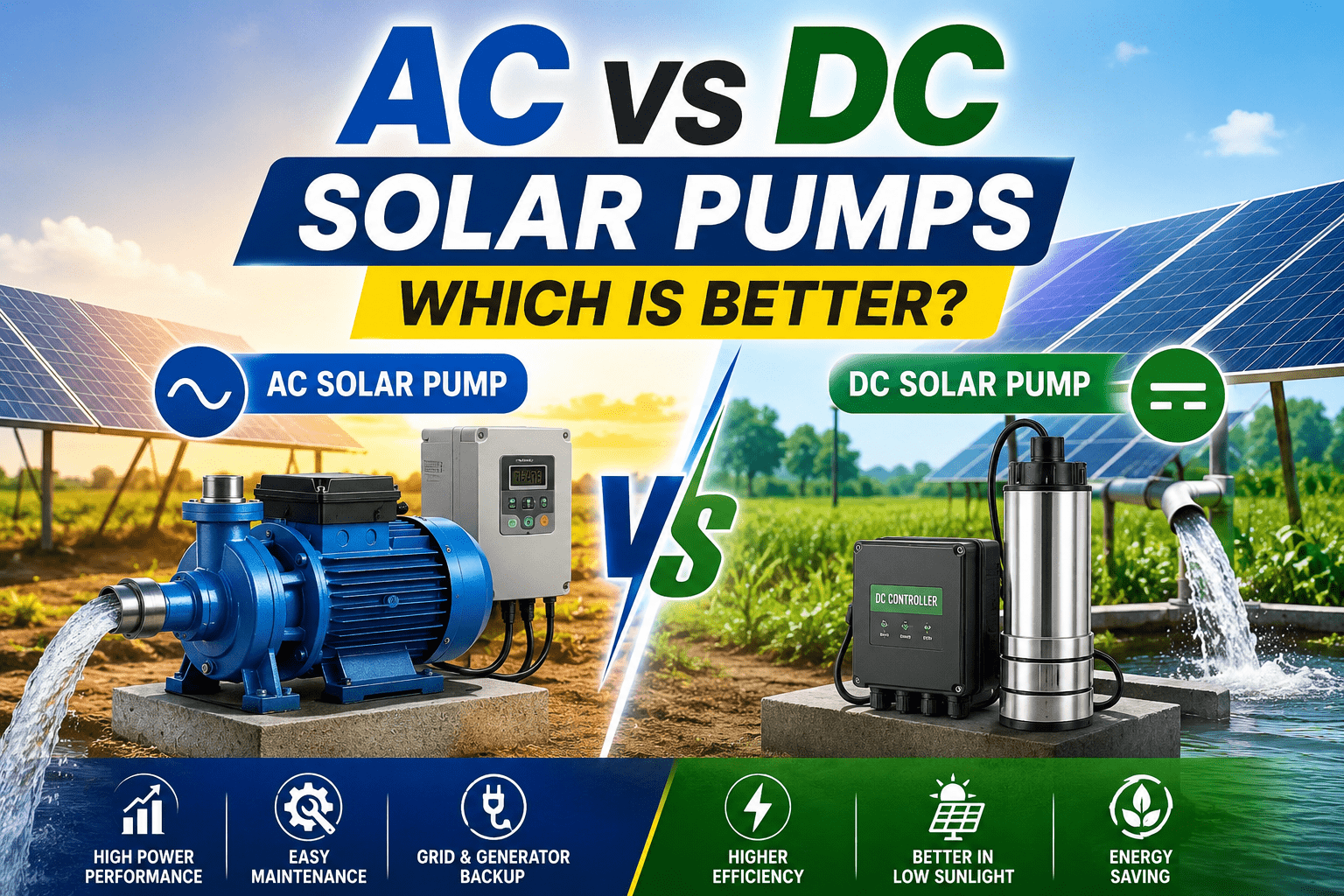
But when buying a solar pump, one question comes up again and again:
Should you buy an AC solar pump or a DC solar pump?
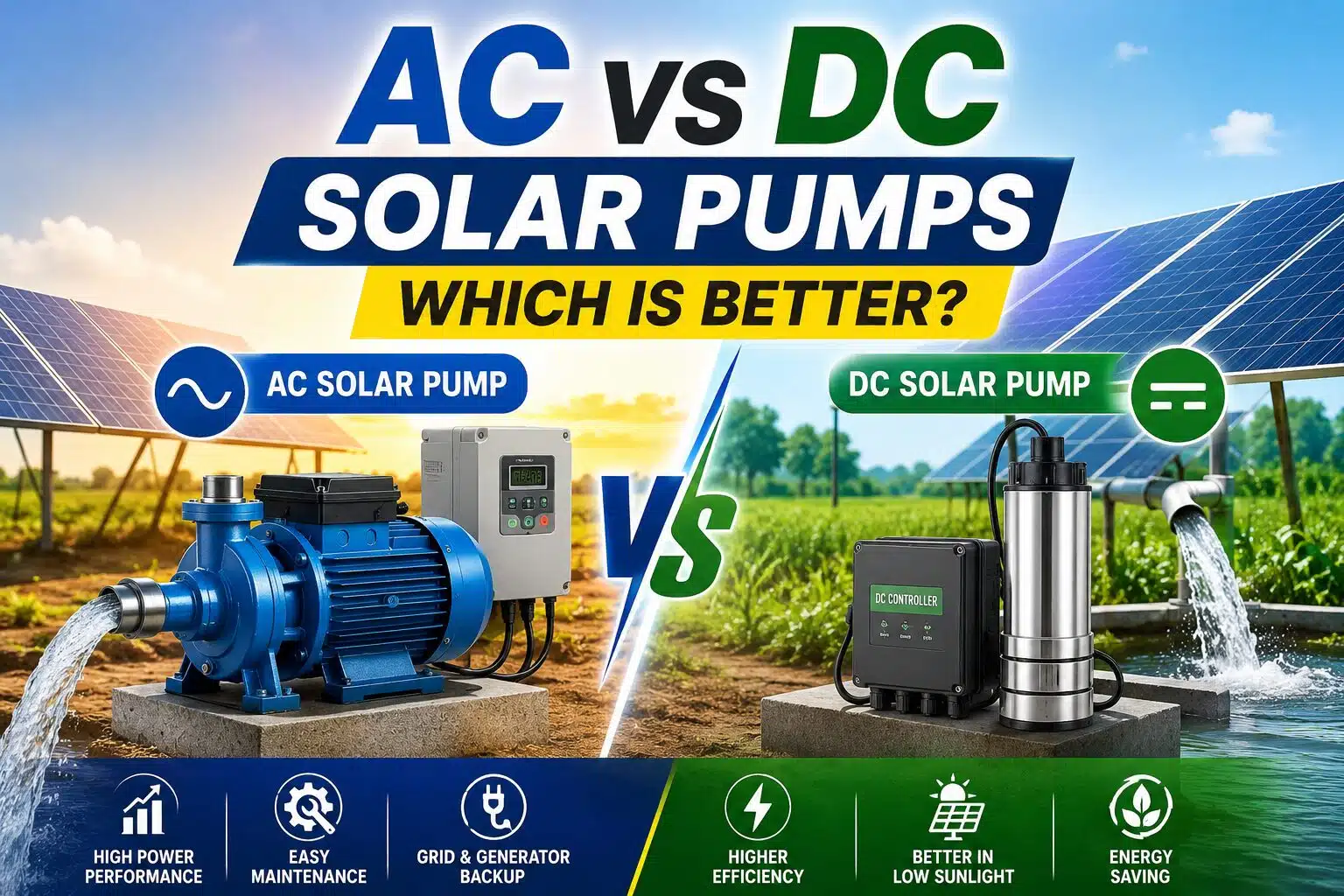
The answer is not the same for every user. A DC solar pump is often more efficient for small and medium systems, while an AC solar pump is usually better for high-power, deep bore, heavy-duty, and commercial applications. The best choice depends on your water requirement, bore depth, pump size, budget, repair availability, and whether you want backup from grid or generator.
This article explains everything in simple words.
What is a DC Solar Pump?
A DC solar pump runs on direct current. Solar panels naturally produce DC electricity, so a DC pump can use solar power more directly through a solar pump controller.
In simple terms:
Solar Panels → DC Controller → DC Pump → Water Output
DC pumps are commonly used for:
- Small farms
- Livestock watering
- Homes
- Gardens
- Small tube wells
- Shallow to medium-depth bores
- Remote areas without electricity
- Low-flow water supply systems
Because the pump runs close to the natural output of solar panels, less energy is wasted in conversion. This makes DC pumps highly efficient, especially in smaller systems.
What is an AC Solar Pump?
An AC solar pump runs on alternating current. However, solar panels produce DC electricity, so an AC pump needs a solar inverter or VFD to convert DC power into AC power.
In simple terms:
Solar Panels → Solar Pump Inverter/VFD → AC Pump → Water Output
AC pumps are commonly used for:
- Agriculture
- Deep tube wells
- High-flow irrigation
- Commercial water supply
- Industrial pumping
- Large farms
- Existing motor conversion
- Center pivot irrigation
- Heavy-duty water transfer
AC motors are widely available in the market, and technicians can repair them more easily in most areas. This is one of the biggest reasons many farmers and industrial users prefer AC solar pumping systems.
Quick Verdict: AC vs DC Solar Pump
Choose a DC Solar Pump if:
- Your pump size is small to medium
- You want higher solar efficiency
- You are using the system mainly in daytime
- You want simple solar operation
- Your water requirement is moderate
- You are installing a new solar pump system
- You do not need heavy backup from grid or generator
Choose an AC Solar Pump if:
- You need a high-power pump
- Your bore is deep
- You need large water discharge
- You already have an AC motor installed
- You want easier local repair
- You want backup from grid, generator, or hybrid inverter
- You need commercial or agricultural heavy-duty performance
AC vs DC Solar Pump Comparison Table
| Feature | DC Solar Pump | AC Solar Pump |
|---|---|---|
| Current Type | Runs on direct current | Runs on alternating current |
| Solar Compatibility | Very high because panels produce DC | Needs inverter/VFD to convert DC to AC |
| Efficiency | Usually higher in small systems | Slight conversion loss due to inverter |
| Best For | Small farms, homes, livestock, shallow/medium bores | Agriculture, deep bores, commercial and heavy-duty use |
| Pump Size Range | Common in small to medium HP | Better for medium to high HP |
| Initial Cost | Can be higher for branded DC systems | Often more economical for larger systems |
| Maintenance | Specialized parts may be required | Easier repair and spare parts availability |
| Backup Options | Limited unless hybrid controller is used | Easier to run on grid/generator with proper setup |
| Performance in Low Sunlight | Often performs better at low power | Depends on inverter quality and motor load |
| Availability | Less available in some local markets | Widely available |
| Long-Term Practicality | Excellent for small dedicated systems | Excellent for farms and large water demand |
| Best Overall Use | Efficient solar-only pumping | Powerful and flexible pumping |
How Solar Pumps Work
A solar pump system usually includes:
- Solar panels to generate electricity
- Pump controller or inverter to manage power
- Pump motor to lift water
- Bore/well/pond/canal source
- Pipe system for water delivery
- Storage tank or direct irrigation line
- Protection devices such as dry-run protection, float switch, breakers, and earthing
Solar panels generate electricity during the day. The stronger the sunlight, the more power is produced. The controller or inverter manages this power and runs the pump according to available sunlight.
This is why solar pumps usually perform best from late morning to afternoon, when sunlight is strongest.
Advantages of DC Solar Pumps
DC solar pumps are popular because they are efficient and simple for solar-based water pumping.
Main Pros of DC Solar Pumps
- Higher efficiency: Since solar panels generate DC power, the system avoids major conversion losses.
- Good for off-grid areas: Perfect where grid electricity is not available.
- Better low-sun operation: Many DC pumps can start earlier in the morning and continue running in moderate sunlight.
- Simple solar design: Fewer conversion stages can mean smoother operation.
- Lower panel requirement in small systems: Because efficiency is better, some DC systems may need fewer panels.
- Good for small water needs: Excellent for homes, animals, gardens, and small agriculture.
- Less dependence on inverter: A DC controller is usually simpler than a full AC pump inverter.
Cons of DC Solar Pumps
- Limited high-power range: DC pumps are not always ideal for very large irrigation systems.
- Spare parts can be difficult: In many areas, DC pump parts and repair experts are less available.
- Specialized repair required: Local motor mechanics may not easily repair some DC motors.
- Brand dependency: If the controller or motor fails, you may need parts from the same brand.
- Backup can be limited: Running a DC pump on grid or generator is not always simple unless the system supports hybrid input.
- Higher cost in some categories: Good-quality DC pumps can be expensive compared to standard AC motor pumps.
Advantages of AC Solar Pumps
AC solar pumps are highly practical for large farms, tube wells, and commercial water projects.
Main Pros of AC Solar Pumps
- Best for high power: AC pumps are suitable for larger HP systems.
- Good for deep bores: They perform well where high head pressure is required.
- Easy availability: AC motors, pumps, cables, and accessories are widely available.
- Easier maintenance: Most technicians already understand AC motors.
- Good for existing systems: If you already have an AC pump installed, you can solarize it with a solar pump inverter.
- Better backup flexibility: AC systems can be designed with grid or generator backup.
- Strong industrial use: Better suited for commercial water supply, agriculture, and heavy-duty irrigation.
- More brand options: The market has a wide range of AC pumps and VFD/inverter options.
Cons of AC Solar Pumps
- Needs inverter/VFD: Solar panels produce DC, so an inverter is required.
- Conversion loss: Some energy is lost during DC-to-AC conversion.
- Higher technical setup: Correct inverter sizing, motor matching, and protection settings are important.
- Can need more panels: Because of conversion losses and starting load, AC systems may need a slightly larger solar array.
- Low sunlight performance depends on inverter: A poor-quality inverter may struggle in weak sunlight.
- More components: More components can mean more points of failure if the system is not installed properly.
Which Pump is More Efficient?
In general, DC solar pumps are more efficient in small and medium systems because they use solar panel power more directly. There is no major DC-to-AC conversion stage.
However, efficiency is not the only factor.
For example, a farmer with a deep bore and high water demand may get better real-world value from an AC pump because:
- AC pumps are available in higher HP
- Repair is easier
- Backup options are better
- Existing tube well motors can be reused
- Heavy-duty operation is more practical
So, DC may win in pure energy efficiency, but AC may win in practicality for large systems.
Which Pump is Better for Agriculture?
For agriculture, the answer depends on farm size.
Small Farms
For small farms, a DC solar pump can be a very good option. It is efficient, simple, and suitable for moderate water requirements.
Best use cases:
- Vegetable farms
- Small orchards
- Tunnel farming
- Drip irrigation
- Livestock water tanks
- Small water storage systems
Large Farms
For large farms, AC solar pumps are usually more practical. They can handle bigger motors, higher water flow, deeper bores, and longer running requirements.
Best use cases:
- Wheat, cotton, sugarcane, and rice fields
- Large orchards
- High-flow irrigation
- Deep tube wells
- Center pivot irrigation
- Commercial agriculture
Which Pump is Better for Tube Wells?
For tube wells, AC pumps are often the better choice, especially when the bore is deep or the required discharge is high.
AC solar pumps are better for:
- Deep boreholes
- High-head applications
- 5HP, 7.5HP, 10HP, 15HP, and larger systems
- Large water channels
- Commercial farms
- Systems needing grid/generator backup
DC pumps can work well for smaller tube wells, but for heavy-duty agricultural tube wells, AC is usually more practical.
Which Pump is Better for Homes?
For homes, small farms, and drinking water systems, DC solar pumps can be excellent.
They are suitable for:
- Water tanks
- Domestic water supply
- Small boreholes
- Garden irrigation
- Livestock drinking water
- Remote houses
A DC pump is often enough where the water demand is not very high.
Which Pump is Better for Backup Power?
AC pumps usually win in backup flexibility.
With the right inverter/VFD, an AC pump can be designed to run from:
- Solar panels
- Grid electricity
- Diesel generator
- Hybrid power source
This is very important for farmers who cannot afford water shortage during cloudy weather or urgent irrigation days.
DC pumps can also have hybrid options, but not every DC pump supports this. You need to check the controller specifications before buying.
Cost Comparison: AC vs DC Solar Pumps
Cost depends on pump size, brand, solar panel quantity, controller quality, bore depth, pipe size, cable length, and installation quality.
DC Pump Cost Factors
DC pumps can be cost-effective for small systems because they may require fewer panels. However, branded DC motors and controllers can be expensive.
Costs may increase due to:
- Specialized controller
- Brand-specific parts
- Limited repair options
- Imported components
- Higher replacement cost
AC Pump Cost Factors
AC pumps may require a solar inverter/VFD, but AC motors are usually easier to source and repair.
Costs may increase due to:
- Inverter/VFD requirement
- Larger solar array
- Protection devices
- Professional installation
- Cable and earthing requirements
For small systems, DC may be more economical. For large systems, AC may offer better long-term value.
Maintenance Comparison
Maintenance is one of the most important buying factors.
DC Pump Maintenance
DC pumps can be efficient, but their repair may be difficult in remote areas. If the controller or motor has a fault, you may need a specialist or brand service center.
Common maintenance points:
- Controller checking
- Motor inspection
- Cable testing
- Dry-run protection
- Cleaning solar panels
- Checking water source level
AC Pump Maintenance
AC pump maintenance is usually easier because AC motors are common. Local electricians and pump mechanics are more familiar with them.
Common maintenance points:
- VFD/inverter settings
- Motor winding health
- Cable insulation
- Bearings and seals
- Earthing and surge protection
- Panel cleaning
- Pipe leakage checking
For rural and agricultural users, easy repair is a major advantage of AC pumps.
Performance in Cloudy Weather
DC pumps often perform better in low sunlight because they can start with lower available power. This makes them useful in areas where sunlight changes quickly.
AC pumps depend heavily on inverter quality. A good solar pump inverter with MPPT can manage variable sunlight and adjust pump speed smoothly. A poor-quality inverter may trip, underperform, or fail to start the pump properly.
For cloudy areas, always choose:
- High-quality controller/inverter
- Correct solar panel sizing
- Proper motor matching
- Dry-run protection
- Surge protection
- Professional installation
Eye-Catching Buyer Tip
Do not choose AC or DC only by price. Choose by water requirement.
A cheap pump that gives low water output is expensive in the long run. A slightly higher-quality system that delivers reliable water every day is the better investment.
Before buying, calculate:
- Bore depth
- Water level
- Required water per day
- Pipe distance
- Irrigation method
- Pump HP
- Solar panel size
- Backup requirement
- Maintenance availability
Common Mistakes Buyers Make
Avoid these mistakes when choosing between AC and DC solar pumps:
- Buying only by HP, not by water output
- Ignoring bore depth and water level
- Installing fewer solar panels than required
- Using poor-quality cable
- Not installing earthing
- Ignoring surge protection
- Choosing a pump without dry-run protection
- Buying a DC pump where repair support is unavailable
- Buying an AC pump with a low-quality inverter
- Not checking warranty and service availability
- Using wrong pipe size
- Expecting full output in cloudy weather
A solar pump is not just a pump. It is a complete system. Every part must be correctly matched.
AC Solar Pump: Best Use Cases
An AC solar pump is better when you need:
- High water discharge
- Deep bore performance
- Long-distance water delivery
- Heavy-duty farming
- Grid or generator backup
- Easy local repair
- Existing motor solar conversion
- Industrial water supply
- Center pivot irrigation
- Commercial tube well operation
For serious agriculture and larger systems, AC is usually the stronger option.
DC Solar Pump: Best Use Cases
A DC solar pump is better when you need:
- High efficiency
- Small to medium water output
- Simple solar-only operation
- Domestic water supply
- Livestock watering
- Garden or small farm irrigation
- Remote off-grid installation
- Low sunlight starting ability
- Lower running cost
- Compact setup
For smaller applications, DC pumps can be excellent.
Final Verdict: Which is Better?
DC solar pumps are better for efficiency. AC solar pumps are better for power, repair, and flexibility.
There is no single winner for every situation.
Choose DC solar pump if you want a simple, efficient, solar-only system for small to medium water needs.
Choose AC solar pump if you need a powerful, repairable, heavy-duty system for agriculture, deep tube wells, commercial water supply, or backup flexibility.
For most small users, DC is a smart choice.
For most farmers and commercial users, AC is the more practical choice.
Conclusion
The real question is not only “AC or DC?” The real question is:
How much water do you need, from what depth, and for what purpose?
Once you know your water requirement, bore depth, pump size, and backup needs, the choice becomes much easier.
- For homes, livestock, gardens, and small farms: DC solar pump
- For deep bores, high-flow irrigation, and large farms: AC solar pump
- For users who need both solar and backup power: AC or hybrid AC/DC system
A well-designed solar pump system can save fuel cost, reduce electricity dependency, and provide reliable water for years. But the system must be selected properly. Always match the pump, panels, inverter/controller, cable, pipe, and protection devices according to the actual site conditions.
Final Recommendation
If your goal is maximum efficiency in a small system, go with DC.
If your goal is strength, serviceability, backup, and long-term agricultural use, go with AC.
The best solar pump is not the one with the lowest price. The best solar pump is the one that gives the right water output, at the right depth, with reliable performance every day.