

Before & After: Water Flow Upgrade — How Better Flow Changes Everything


Water flow is one of those things people only notice when it becomes a problem. A weak stream from a bore, slow tank filling, low pressure in pipelines, poor irrigation coverage, or a pump running for hours without proper output can quietly damage productivity, waste electricity, and increase daily frustration.
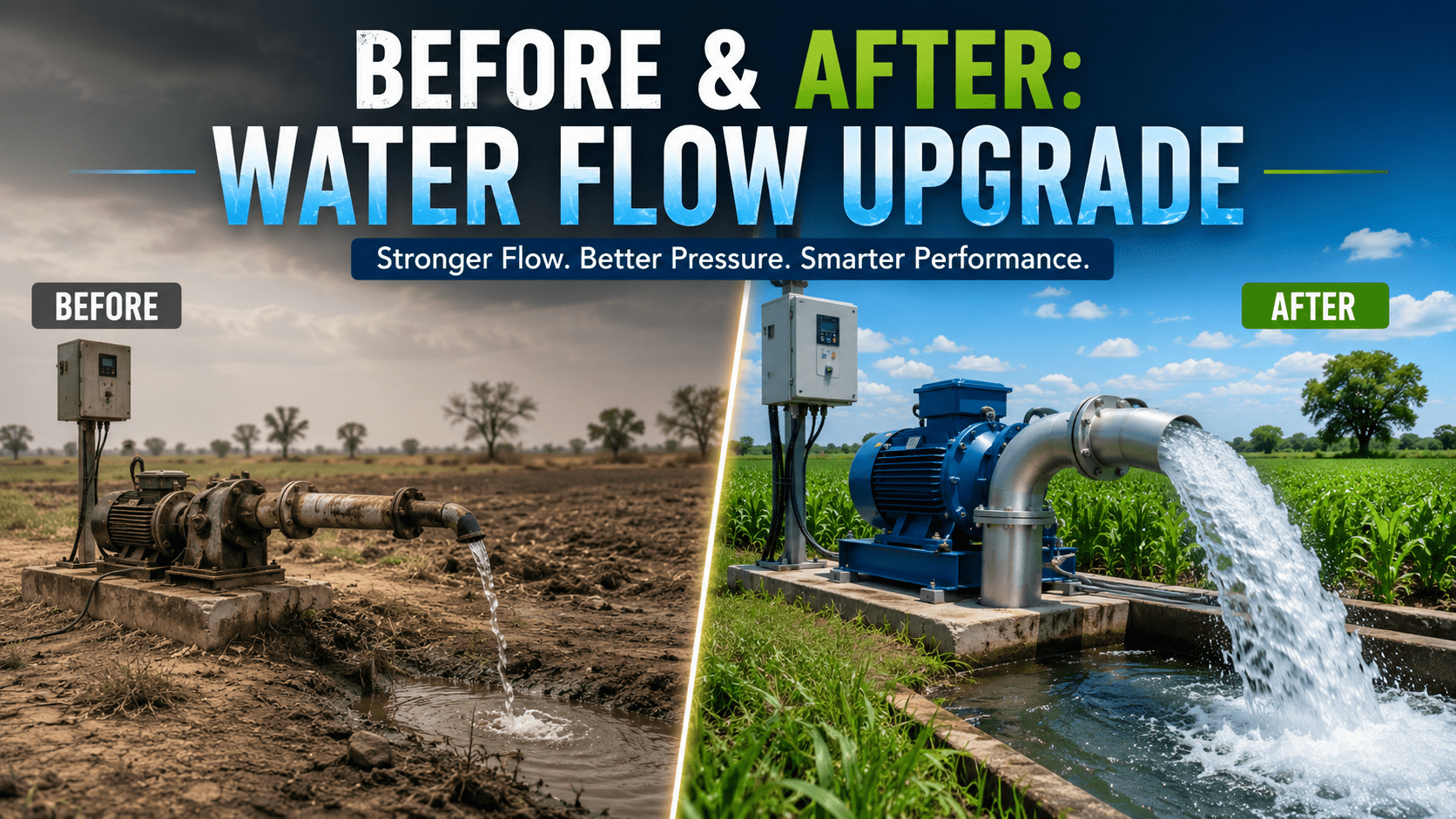
But when a proper water flow upgrade is done, the difference is visible immediately.
The “before” stage usually looks like this: the pump is running, electricity is being consumed, the motor is heating, pipes are vibrating, but the water output is not enough. The farm still needs more irrigation time. The overhead tank fills slowly. The pressure drops when multiple outlets are used. In commercial or agricultural setups, this problem becomes even more serious because low water flow directly affects operations.
The “after” stage is completely different. Water comes with stronger pressure, tanks fill faster, irrigation becomes smoother, and the pump system works more efficiently. A proper upgrade is not just about installing a bigger pump. It is about understanding the complete system: bore depth, water level, pump size, motor capacity, pipe diameter, delivery distance, pressure requirement, power source, and future demand.
A successful water flow upgrade turns a weak water system into a reliable, high-performance setup.
What Is a Water Flow Upgrade?
A water flow upgrade means improving the quantity, speed, and pressure of water moving through a system. This upgrade can be done for:
- Agricultural tube wells
- Solar pump systems
- Domestic water supply
- Commercial buildings
- Factories and industries
- Farmhouses
- Housing societies
- Livestock farms
- Center pivot irrigation systems
- Drip and sprinkler irrigation
The upgrade may include changing the pump, motor, delivery pipe, control panel, solar inverter, valves, bore accessories, or complete pipeline design.
In simple words, the goal is:
More water. Better pressure. Less wastage. Longer system life.
Before the Upgrade: Common Water Flow Problems
Most weak water systems show clear warning signs. Many people ignore these signs until the pump fails completely or the water shortage becomes serious.
Common problems before a water flow upgrade include:
- Low water pressure
- Slow tank filling
- Uneven irrigation
- Pump running for too long
- High electricity bill
- Motor heating
- Low discharge from delivery pipe
- Air in pipeline
- Frequent pump tripping
- Water flow reducing after some time
- Pipe leakage due to pressure imbalance
- Wrong pump size
- Narrow delivery pipe
- Poor bore condition
- Old or damaged impellers
- Incorrect solar inverter settings
- Undersized cable
- Voltage drop
These problems usually happen because the system was either installed without proper calculation or the water requirement increased over time.
For example, a farmer may start with a small cultivated area and later expand the land. The old pump may still work, but it cannot provide enough water for the larger area. Similarly, a building may add more washrooms, floors, or water points, but the same old pump remains in use.
That is where the water flow upgrade becomes necessary.
After the Upgrade: What Changes Immediately?
After a proper upgrade, the improvement is usually easy to see and measure. The water outlet becomes stronger, pressure improves, and the system works with less stress.
Visible improvements after the upgrade:
- Water pressure becomes stronger
- Tank filling time reduces
- Irrigation time becomes shorter
- Pump performance becomes stable
- Motor load becomes balanced
- Electricity or solar usage becomes more efficient
- Pipeline vibration reduces
- Water reaches longer distances
- Sprinklers and drip systems work better
- System breakdowns reduce
- Water distribution becomes more even
- Farm productivity improves
The biggest benefit is not only more water. The real benefit is controlled and reliable water flow.
A well-upgraded system gives the required water at the required pressure without overloading the pump or wasting energy.
Before & After Comparison Table
| Feature | Before Water Flow Upgrade | After Water Flow Upgrade |
|---|---|---|
| Water Pressure | Weak, unstable, drops quickly | Strong, stable, reliable |
| Tank Filling Time | Slow and time-consuming | Faster and more efficient |
| Irrigation Coverage | Uneven water distribution | Better coverage across the field |
| Pump Running Time | Long working hours | Reduced running time |
| Electricity Usage | Higher due to inefficiency | Better energy efficiency |
| Motor Health | Heating, overloading, tripping | Smooth and balanced operation |
| Pipeline Performance | Leakage, vibration, pressure loss | Improved flow and reduced stress |
| Maintenance Cost | Frequent repairs | Lower repair frequency |
| Water Output | Low discharge | Higher discharge |
| System Reliability | Unpredictable | More dependable |
| User Experience | Frustration and delays | Smooth daily operation |
| Long-Term Value | Costly over time | Better return on investment |
Why Water Flow Becomes Weak Over Time
Water flow does not always become weak overnight. In many cases, the problem develops slowly. At first, the change is small, but after months or years, the system becomes noticeably weaker.
Main reasons for weak water flow:
- Falling underground water level
- Old pump losing efficiency
- Damaged impellers
- Wrong pump selection
- Narrow pipe diameter
- Long delivery distance
- Clogged filters or screens
- Poor bore development
- Low voltage supply
- Incorrect solar system sizing
- Air leakage in suction or delivery line
- Rust, scaling, or sediment inside pipes
- Increased water demand
In agricultural areas, underground water level changes are very common. A pump that worked perfectly at 150 feet may not perform the same if the water level drops to 220 feet. The pump may still run, but its discharge will reduce.
This is why proper inspection is important before upgrading. Without checking the actual reason, simply installing a bigger pump can create more problems.
Key Parts Checked During a Water Flow Upgrade
A professional upgrade starts with diagnosis. The complete system must be checked before recommending changes.
Important inspection points include:
- Bore depth
- Static water level
- Dynamic water level
- Pump horsepower
- Pump head range
- Motor ampere load
- Delivery pipe size
- Pipeline length
- Water requirement per day
- Pressure requirement
- Power supply condition
- Solar panel capacity
- Inverter compatibility
- Cable size
- Control panel protection
- Valve condition
- Water quality and sand content
This step is important because every water system is different. A farmhouse, a factory, a tube well, and a center pivot irrigation system do not have the same requirement.
A good upgrade is always based on calculation, not guesswork.
Pros of Water Flow Upgrade
A proper water flow upgrade gives both immediate and long-term benefits.
Major advantages include:
- Better water pressure
Stronger pressure improves daily use, irrigation, and water distribution. - Faster work completion
Tanks fill faster and fields can be irrigated in less time. - Lower energy wastage
An efficient pump system uses energy more effectively. - Reduced pump stress
Correct sizing helps the pump and motor work smoothly. - Improved irrigation quality
Crops receive water more evenly, which can support better growth. - Better solar system performance
In solar pumping, correct pump and inverter matching can improve output. - Longer equipment life
Less overload means fewer breakdowns and better durability. - More reliable water supply
The system becomes dependable for homes, farms, and industries. - Better return on investment
A good upgrade saves time, energy, and repair cost over the years.
Cons of Water Flow Upgrade
Every upgrade has some challenges. Knowing them beforehand helps in better planning.
Possible disadvantages include:
- Initial investment is required
A quality pump, motor, pipe, inverter, or control panel can cost more upfront. - Wrong upgrade can waste money
Without proper calculation, installing a bigger pump may not solve the problem. - Bore condition may limit results
If the bore itself is weak or damaged, pump upgrade alone may not help. - Pipeline changes may be needed
Stronger flow sometimes requires wider pipes or better fittings. - Power supply must support the system
A larger pump may need better wiring, protection, or solar capacity. - Professional installation is important
Poor installation can reduce performance and equipment life.
The cons are manageable when the system is inspected properly and upgraded with the right equipment.
The Biggest Mistake: Installing a Bigger Pump Without Calculation
Many people think low water flow always means they need a bigger pump. This is not always true.
Sometimes the actual problem is:
- Pipe diameter is too small
- Voltage is low
- Cable size is incorrect
- Bore screen is blocked
- Pump is installed at the wrong depth
- Delivery distance is too long
- Motor is overloaded
- Pump head is not suitable
- Solar inverter settings are incorrect
Installing a bigger pump in these conditions can increase electricity consumption, damage the motor, or reduce system life.
The right approach is to match the pump with the bore, water level, pipe size, head requirement, and daily water demand.
Water Flow Upgrade for Agriculture
For farmers, water flow is not just a comfort issue. It directly affects irrigation timing, crop health, labor cost, and fuel or electricity expense.
A weak tube well can delay irrigation. If water does not reach the full field properly, some areas may receive more water while others remain dry. This uneven irrigation affects crop growth and can reduce yield quality.
After an agricultural water flow upgrade, farmers can benefit from:
- Faster field irrigation
- Better water coverage
- Improved pressure for sprinklers
- Better performance for drip irrigation
- Reduced diesel or electricity waste
- Less pump running time
- More reliable water during peak season
- Improved support for center pivot systems
For farms using solar pumps, the upgrade can include proper pump selection, solar panel sizing, inverter adjustment, and pipeline correction.
Water Flow Upgrade for Homes and Buildings
In homes and buildings, low water pressure creates daily problems. Showers become weak, overhead tanks fill slowly, and water pressure drops when multiple taps are opened.
A proper upgrade may include:
- Replacing the old pump
- Installing a pressure pump
- Improving pipe size
- Adding proper valves
- Fixing leakage
- Cleaning storage tanks
- Installing automatic control
- Improving electrical wiring
After the upgrade, water usage becomes more comfortable and reliable.
Water Flow Upgrade for Industry
Industrial water systems need consistency. Low water flow can disturb production, cooling, washing, processing, and machine operations.
For industries, a water flow upgrade should be handled carefully because the demand is usually higher and more technical.
Industrial upgrade may require:
- High-capacity pumps
- Heavy-duty motors
- Proper control panels
- Pressure gauges
- Flow meters
- Larger pipelines
- Backup systems
- Protection devices
- Scheduled maintenance
The goal is to create a system that can handle continuous operation without frequent failure.
Eye-Catching Before & After Example
Imagine a farm where the tube well was running for 8 hours daily, but the water still could not cover the required area properly. The pump was old, the pipeline was narrow, and the motor was heating during peak load.
After inspection, the system was upgraded with:
- Correct pump size
- Better motor matching
- Improved delivery pipe
- Proper control panel
- Better cable size
- Solar/inverter adjustment where required
Result after upgrade:
- Water flow became stronger
- Irrigation time reduced
- Motor heating reduced
- Water reached further areas
- Daily operation became smoother
- Energy usage became more productive
This is the real power of a water flow upgrade. It does not just improve water output — it improves the whole system.
Signs You Need a Water Flow Upgrade
You should consider a water flow upgrade if you notice these signs:
- Your pump is running longer than before
- Water pressure is weak
- Tank filling time has increased
- Motor heats frequently
- Pump trips again and again
- Water discharge has reduced
- Irrigation takes too much time
- Pipeline vibrates or leaks
- Solar pump output is lower than expected
- Bore water level has dropped
- More water demand has been added
- Existing system feels overloaded
Ignoring these signs can lead to bigger repair costs later.
Final Verdict: Is a Water Flow Upgrade Worth It?
Yes, a water flow upgrade is worth it when the existing system is weak, outdated, overloaded, or incorrectly designed.
The upgrade gives better pressure, stronger discharge, improved reliability, and better long-term value. For farmers, it can improve irrigation efficiency. For homes, it improves daily comfort. For industries, it supports smooth operations. For solar pump users, it helps get better output from the installed system.
But the upgrade must be done properly. The best result comes when the complete system is checked before making changes. Pump size, bore depth, water level, pipe diameter, delivery distance, power supply, and pressure requirement must all be considered.
A successful water flow upgrade is not just a change of pump.
It is a complete improvement of the water system.
Before the upgrade, water is weak, slow, and unreliable.
After the upgrade, water becomes powerful, stable, and efficient.
That is the real difference between an ordinary setup and a professionally upgraded water flow system.