
How to Choose Pump Based on Your Area – Complete Guide


Choosing the right water pump is not just about buying the biggest motor or the most expensive brand. The best pump is the one that matches your area, water depth, water quality, electricity condition, pipeline distance, pressure requirement, and daily water usage.
Many people make the mistake of buying a pump only by looking at horsepower. They ask, “Should I buy 1HP, 2HP, 3HP, or 5HP?” But the real question should be:
“Which pump is suitable for my area and water condition?”
A pump that works perfectly in one city may fail in another. A pump that gives strong water flow in a shallow-water area may become useless in a deep-water area. Similarly, a pump that works well with clean sweet water may get damaged quickly in sandy, salty, or hard water.
This guide will help you understand how to choose the right pump based on your area.
Why Your Area Matters When Choosing a Pump
Every area has different underground water conditions. Some areas have water at 40 feet, while others may need boring up to 250 feet, 400 feet, or even more. Some places have sweet water, while others have salty, sandy, or hard water.
Your area affects:
- Water depth
- Bore size
- Pump type
- Motor horsepower
- Water pressure
- Pipeline length
- Electricity load
- Solar system size
- Maintenance cost
- Pump life
That is why choosing a pump without understanding your area can lead to low water flow, high electricity bills, frequent motor burning, and poor performance.
1. First Check the Water Depth in Your Area
The first and most important factor is water depth.
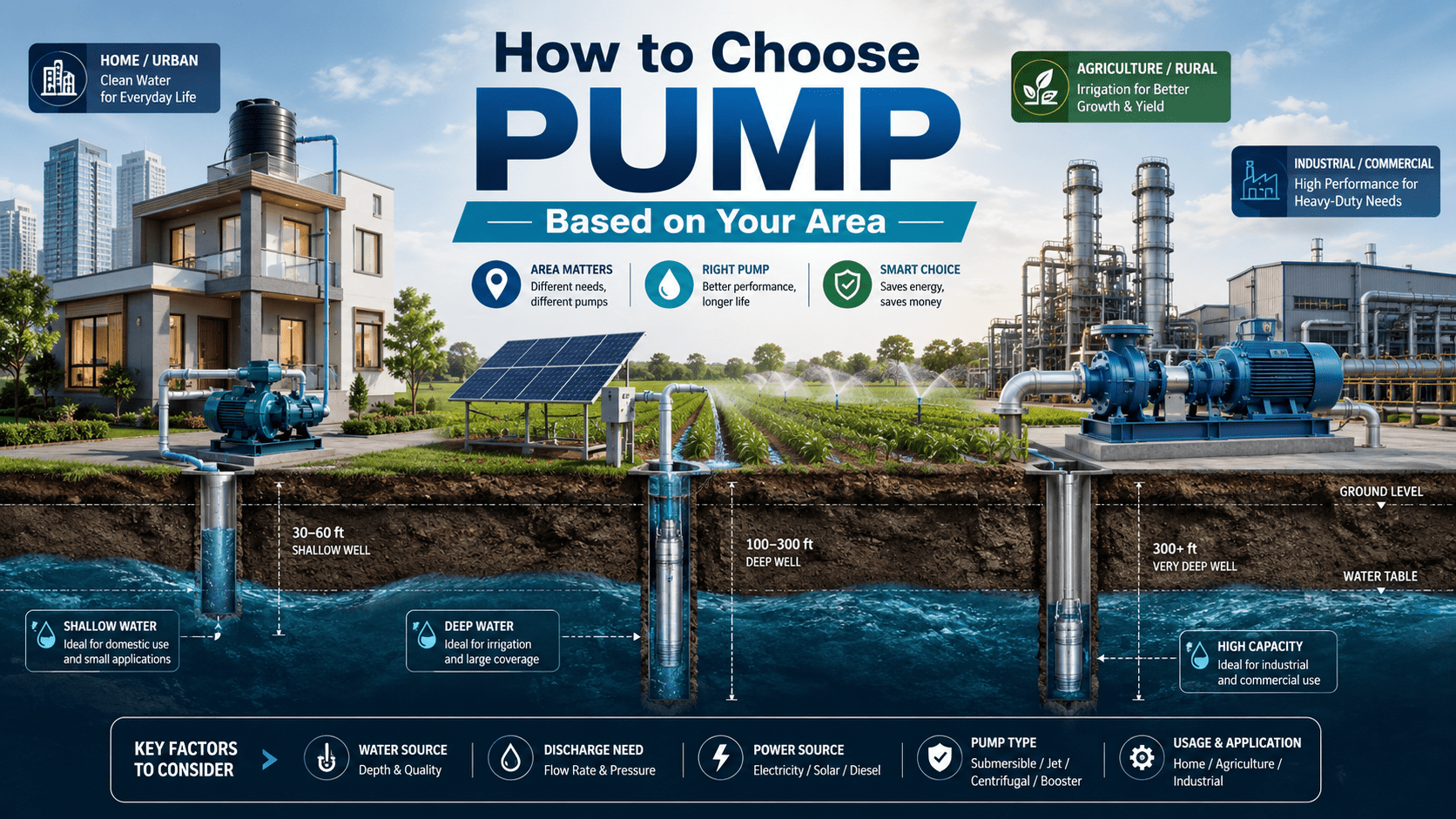
Water depth means how far below the ground the water is available. This determines whether you need a shallow pump, centrifugal pump, jet pump, or submersible pump.
Common Water Depth Categories
| Water Depth | Suitable Pump Type | Best For |
|---|---|---|
| 20–50 feet | Centrifugal Pump | Homes, small gardens, shallow water areas |
| 50–100 feet | Jet Pump / Shallow Submersible | Homes, small farms |
| 100–250 feet | Submersible Pump | Homes, agriculture, commercial use |
| 250–500 feet | Deep Well Submersible Pump | Farms, tube wells, industrial use |
| 500+ feet | Heavy-Duty Submersible / Turbine Pump | Large agriculture and industrial projects |
Important Tip
Do not guess the water depth. Ask nearby bore owners, local drilling experts, or pump installers. If possible, check the actual water level before buying the pump.
Wrong pump + wrong depth = poor water flow and wasted money.
2. Choose Pump According to Water Quality
Water quality is another major factor. Some areas have clean water, while others have sand, salt, rust, or hard minerals.
Types of Water Quality
- Clean water
- Sandy water
- Salty water
- Hard water
- Muddy water
- Rusty water
- Mineral-heavy water
If your area has sandy water, a normal pump may get damaged quickly. Sand can damage the impellers, seals, bearings, and motor parts. For such areas, you need a pump designed for rough water conditions.
Pump Selection by Water Quality
| Water Condition | Recommended Pump | Avoid |
|---|---|---|
| Clean water | Centrifugal / Submersible | Low-quality local pumps |
| Sandy water | Sand-resistant submersible | Cheap impeller pumps |
| Salty water | Stainless steel pump | Cast iron body pumps |
| Hard water | Good-quality submersible | Low-grade pumps |
| Muddy water | Sludge / dewatering pump | Normal domestic pump |
| Industrial dirty water | Heavy-duty sludge pump | Home-use pump |
Eye-Catching Point
A cheap pump in bad water becomes expensive very quickly.
You may save money on the first purchase, but you will spend more later on repairs, rewinding, impellers, seals, and service calls.
3. Understand the Purpose of the Pump
Before choosing a pump, clearly decide what you need it for.
A pump for home use is different from a pump for agriculture. A pump for a factory is different from a pump for a farmhouse. A pump for clean water is different from a sludge pump.
Common Pump Uses
- Home water supply
- Agriculture irrigation
- Tube well system
- Solar pumping
- Farmhouse water supply
- Commercial building
- Industrial water transfer
- Dewatering
- Sludge or dirty water removal
- Pressure boosting
- Garden or lawn watering
Pump Selection by Purpose
| Purpose | Best Pump Type |
|---|---|
| Home water supply | Centrifugal / Pressure pump |
| Deep bore water | Submersible pump |
| Agriculture | Submersible / Turbine / Solar pump |
| Solar tube well | AC/DC solar submersible pump |
| Dirty water | Sludge pump |
| Basement dewatering | Dewatering pump |
| Factory use | Heavy-duty centrifugal / submersible |
| Pressure boosting | Booster pump |
| Farmhouse | Submersible + pressure system |
4. Check Electricity Condition in Your Area
Electricity supply plays a big role in pump performance. In many areas, voltage fluctuation is common. Low voltage can damage the motor, reduce water flow, and increase heating.
Check These Things
- Is electricity stable?
- Is voltage low in your area?
- Is load shedding common?
- Do you have single-phase or three-phase electricity?
- Will you run the pump on solar?
- Is your wiring strong enough?
Single Phase vs Three Phase Pump
| Feature | Single Phase Pump | Three Phase Pump |
|---|---|---|
| Best For | Homes, small use | Farms, factories, heavy use |
| Power | Lower to medium | Medium to heavy |
| Efficiency | Good | Better for large systems |
| Maintenance | Easy | Requires proper setup |
| Cost | Lower | Higher |
| Load Capacity | Limited | Strong |
Important Tip
For deep bore and heavy water demand, three-phase pumps are usually more reliable. For home use and small water demand, single-phase pumps can work well.
If electricity is weak in your area, use:
- Voltage stabilizer
- Good-quality cable
- Proper control panel
- Dry-run protection
- Overload protection
- Solar inverter system if suitable
5. Consider Solar Pumping for Remote or Agricultural Areas
In areas where electricity is expensive, unreliable, or unavailable, solar pumps can be a smart option.
Solar pumping is especially useful for:
- Farms
- Tube wells
- Remote villages
- Livestock water supply
- Drip irrigation
- Center pivot irrigation
- Orchards
- Agricultural lands
Pros of Solar Pumps
- Low running cost
- No diesel expense
- Good for daytime irrigation
- Environment-friendly
- Useful in remote areas
- Long-term savings
- Less dependency on grid electricity
Cons of Solar Pumps
- Higher initial investment
- Requires proper system sizing
- Performance depends on sunlight
- Needs space for solar panels
- Poor design can reduce output
- Requires quality inverter and protection
Best Areas for Solar Pumps
Solar pumps are ideal where:
- Electricity is not reliable
- Diesel cost is high
- Water is needed during daytime
- There is open land for panels
- Agriculture is the main use
- Long-term savings matter
6. Match Pump Horsepower with Actual Requirement
Horsepower is important, but it should not be selected blindly. A higher horsepower pump does not always mean better performance.
If the pump is too small, it will not give enough water. If it is too big, it may waste electricity, damage pipes, and increase cost.
Basic Horsepower Guide
| Pump Size | Suitable Use |
|---|---|
| 0.5HP | Small home, low water demand |
| 1HP | Normal home, small garden |
| 1.5HP | Bigger home, small commercial use |
| 2HP | Deep bore home use, farmhouse |
| 3HP | Agriculture, large home, tube well |
| 5HP | Farms, commercial, heavy water use |
| 7.5HP+ | Large agriculture and industrial use |
Important Factors Before Selecting HP
- Bore depth
- Water level
- Delivery height
- Pipe distance
- Required pressure
- Daily water usage
- Number of outlets
- Water quality
- Electricity availability
Golden Rule
Do not choose horsepower first. Choose depth, flow, and pressure first — horsepower comes after that.
7. Check Pipeline Distance and Delivery Height
Many people only check bore depth but forget pipeline distance. If the water has to travel a long distance, the pump needs more pressure.
For example, a pump supplying water to a nearby tank is different from a pump supplying water to a field 500 feet away.
Pipeline Factors
- Pipe length
- Pipe diameter
- Number of bends
- Height of tank
- Distance from bore to field
- Friction loss
- Required water pressure
Common Mistake
Using a small pipe with a powerful pump can reduce water flow and increase pressure loss. This also puts extra load on the pump.
Better Practice
- Use proper pipe size
- Avoid unnecessary bends
- Use quality fittings
- Match pipe diameter with pump outlet
- Keep pipeline design simple
- Use pressure rating suitable for pump
8. Choose Pump Based on Area Type
Different areas need different pump solutions.
A. Urban Residential Areas
In cities, water is usually needed for homes, overhead tanks, bathrooms, kitchens, washing areas, and small gardens.
Recommended Pumps
- Centrifugal pump
- Pressure pump
- Small submersible pump
- Booster pump
Best For
- Houses
- Apartments
- Small shops
- Schools
- Offices
Main Requirement
- Good pressure
- Low noise
- Low electricity use
- Easy maintenance
B. Rural Areas
Rural areas often have deeper water levels and less stable electricity. Water may be needed for homes, animals, small farms, or irrigation.
Recommended Pumps
- Submersible pump
- Solar submersible pump
- Jet pump for medium depth
- Hand pump backup where needed
Main Requirement
- Strong motor
- Reliable water flow
- Low maintenance
- Ability to handle rough conditions
C. Agricultural Areas
Agriculture needs high water flow. Pump selection depends on crop type, land size, bore depth, and irrigation method.
Recommended Pumps
- Deep well submersible pump
- Solar submersible pump
- Turbine pump
- High-flow centrifugal pump
Best For
- Wheat
- Cotton
- Mango orchards
- Sugarcane
- Vegetables
- Drip irrigation
- Center pivot irrigation
Main Requirement
- High discharge
- Long running hours
- Energy efficiency
- Durable motor
- Proper pipe design
D. Industrial Areas
Industrial pumps need to handle continuous operation, higher pressure, and sometimes dirty or chemical water.
Recommended Pumps
- Heavy-duty centrifugal pump
- Industrial submersible pump
- Sludge pump
- Dewatering pump
- Stainless steel pump
Main Requirement
- Durability
- Heavy-duty performance
- Safety protection
- Correct material selection
- Easy service availability
E. Sandy or Desert-Type Areas
In sandy areas, pump selection becomes more sensitive. Sand can damage pump parts very quickly.
Recommended Pumps
- Sand-resistant submersible pump
- Stainless steel pump
- High-quality impeller pump
- Proper screen and bore development
Main Requirement
- Sand protection
- Strong filtration
- Durable impellers
- Correct bore design
- Regular maintenance
9. Pros and Cons of Different Pump Types
1. Centrifugal Pump
Pros
- Affordable
- Easy to install
- Easy to repair
- Good for shallow water
- Suitable for home use
Cons
- Not suitable for deep bore
- Needs priming
- Limited suction depth
- Not ideal for sandy water
- Can lose performance with air leakage
2. Jet Pump
Pros
- Better than centrifugal for medium depth
- Good for home use
- Can pull water from deeper levels than normal pumps
- Available in different sizes
Cons
- Lower efficiency than submersible
- More noisy
- Requires proper installation
- Not ideal for very deep water
- Can be sensitive to air leakage
3. Submersible Pump
Pros
- Best for deep water
- Strong pressure
- Good efficiency
- Quiet operation
- Long-lasting if properly selected
- Suitable for homes, farms, and commercial use
Cons
- Higher initial cost
- Installation requires expertise
- Repair requires pulling pump out of bore
- Low-quality models fail quickly
- Needs protection against dry run and voltage fluctuation
4. Solar Pump
Pros
- No monthly electricity bill for operation
- Best for daytime use
- Good for farms and remote areas
- Long-term savings
- Can be used with AC or DC pump systems
Cons
- High setup cost
- Needs proper solar sizing
- Output depends on sunlight
- Requires panel cleaning
- Needs quality inverter and protection system
5. Sludge Pump
Pros
- Best for dirty water
- Handles mud, sludge, and wastewater
- Strong body
- Useful for construction and industrial work
Cons
- Not for clean drinking water
- Higher cost than normal pumps
- Heavy-duty maintenance required
- Not suitable for deep bore water supply
10. Complete Pump Comparison Table
| Pump Type | Best Area | Water Depth | Main Use | Pros | Cons |
|---|---|---|---|---|---|
| Centrifugal Pump | Urban, shallow areas | 20–50 ft | Home, garden | Affordable, easy repair | Not for deep water |
| Jet Pump | Medium-depth areas | 50–100 ft | Home, small commercial | Better suction | Noisy, less efficient |
| Submersible Pump | Deep-water areas | 100–500+ ft | Home, farm, tube well | Strong, efficient | Higher installation cost |
| Solar Pump | Rural/agriculture | Depends on design | Irrigation, remote use | Low running cost | High initial cost |
| Booster Pump | Urban buildings | Not depth-based | Pressure boosting | Improves pressure | Needs existing water source |
| Sludge Pump | Industrial/dirty water areas | Surface/dewatering | Mud, wastewater | Handles dirty water | Not for clean bore water |
| Turbine Pump | Large agriculture | Deep wells | High-flow irrigation | Heavy-duty | Expensive setup |
11. Signs You Selected the Wrong Pump
If your pump is not suitable for your area, you may face these problems:
- Low water flow
- Pump overheating
- Motor burning again and again
- High electricity bill
- Weak pressure
- Air in water line
- Pump running but no water
- Frequent repair cost
- Sand coming with water
- Water flow decreasing over time
- Pipe vibration
- Pump noise
- Breaker tripping
- Low output on solar system
These signs usually mean the pump was not selected according to actual site conditions.
12. Checklist Before Buying a Pump
Before buying any pump, check these points:
- What is the water depth?
- What is the bore size?
- Is the water clean, sandy, salty, or hard?
- How much water do you need daily?
- Is it for home, farm, industry, or commercial use?
- What is the pipeline distance?
- What is the tank height?
- Do you need pressure or high flow?
- Is electricity single-phase or three-phase?
- Is voltage stable?
- Will the system run on solar?
- What is your budget?
- Is service available in your area?
- Is the brand reliable?
- Does the pump have warranty?
- Is the installer experienced?
13. Area-Based Pump Recommendation Guide
For Shallow Water Areas
Choose:
- Centrifugal pump
- 0.5HP to 1.5HP pump
- Good for homes and small gardens
Best when:
- Water level is not deep
- Water is clean
- Usage is limited
- Budget is low
For Medium Water Depth Areas
Choose:
- Jet pump
- Small submersible pump
- 1HP to 2HP pump
Best when:
- Water is deeper than normal suction range
- Home needs stable supply
- Pressure requirement is moderate
For Deep Bore Areas
Choose:
- Submersible pump
- 2HP to 5HP or more depending on depth
- Proper cable and control box
Best when:
- Water is below 100 feet
- Strong pressure is required
- Bore is properly designed
- Long-term use is expected
For Agriculture Areas
Choose:
- Solar submersible pump
- Deep well pump
- Turbine pump
- 3HP, 5HP, 7.5HP, 10HP or above depending on land and water need
Best when:
- Water demand is high
- Pump runs for long hours
- Diesel cost is high
- Solar option is available
For Industrial Areas
Choose:
- Heavy-duty centrifugal pump
- Industrial submersible pump
- Stainless steel pump
- Sludge pump if water is dirty
Best when:
- Pump needs to run continuously
- Pressure and durability matter
- Water quality is difficult
- Maintenance cost must be controlled
14. Common Mistakes People Make
Many pump problems start before installation because the wrong pump was selected.
Avoid These Mistakes
- Buying only by horsepower
- Choosing cheap pump for deep bore
- Ignoring water quality
- Using wrong pipe size
- Ignoring voltage fluctuation
- Not installing dry-run protection
- Using low-quality cable
- Installing without expert guidance
- Choosing pump without checking water level
- Using domestic pump for agriculture
- Using clean-water pump for sludge
- Running pump without proper control panel
Eye-Catching Advice
A pump is not selected from a shop counter. It is selected from your site condition.
15. Final Expert Recommendation
The right pump depends on your area, not just your budget. Before buying, always check the water depth, bore size, water quality, electricity condition, pipeline distance, and required water flow.
For shallow areas, a centrifugal pump may be enough. For medium-depth areas, a jet pump or small submersible pump can work. For deep bore areas, a submersible pump is usually the best choice. For agriculture and remote areas, solar pumps can provide excellent long-term savings. For dirty water and industrial use, sludge or heavy-duty pumps are more suitable.
The best pump is one that gives:
- Stable water flow
- Good pressure
- Low maintenance
- Reasonable electricity use
- Long service life
- Easy repair support
- Correct performance for your area
Do not choose a pump only because someone else is using it. Their area, water depth, pipe distance, and electricity condition may be completely different from yours.
Final Line
Choose the pump according to your area today, and you will save money, time, electricity, and maintenance for years.