

Average Bore Depth in Multan: Complete Guide


Finding the right bore depth in Multan is not just about drilling deeper and hoping for better water. It is about understanding the local soil, water table, water quality, pump requirement, and long-term usage. Many homeowners, farmers, factories, schools, mosques, farmhouses, and commercial buildings in Multan make one major mistake: they ask only, “Kitna deep bore karwana chahiye?” But the better question is: “At what depth will I get clean, stable, and usable water for my requirement?”
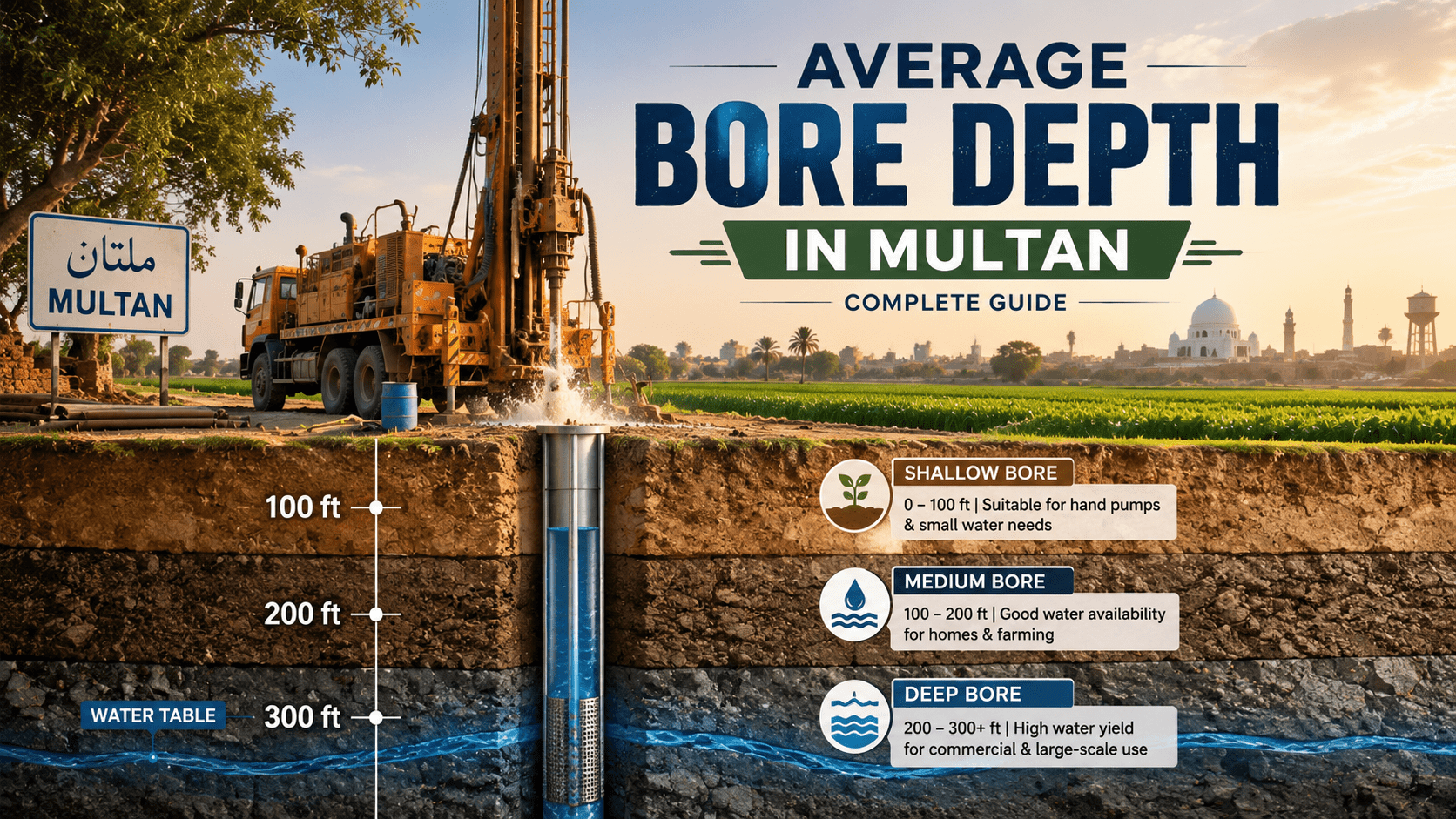
In Multan, the average bore depth can vary from area to area. A house may work well with a medium-depth bore, while an agricultural tube well may need a much deeper bore with stronger casing, a better pump, and proper testing. The right depth depends on your location, the water-bearing layer, soil type, nearby bores, water quality, and the quantity of water you need.
Quick Answer: What Is the Average Bore Depth in Multan?
For most practical projects in Multan, the average bore depth usually falls into these ranges:
- Residential house bore: 120–180 ft
- Commercial building bore: 180–250 ft
- Farmhouse bore: 180–300 ft
- Agriculture tube well: 250–400 ft or more
- Heavy-duty industrial bore: 300–500 ft or more, depending on water demand and quality
The water table may be much shallower than the final bore depth. In simple words, water may be found earlier, but a good bore is drilled deeper to reach a stable water layer, improve discharge, avoid seasonal problems, and reduce the chances of sand or weak water flow.
Water Table vs Bore Depth: Important Difference
Many people confuse water table with bore depth. These two are not the same.
The water table is the depth where groundwater first starts appearing underground. The bore depth is the total drilled depth of the bore. The bore usually goes much deeper than the first water level because the driller needs to reach a reliable aquifer layer.
For example:
- Water may appear at 40–60 ft.
- But the bore may still be drilled to 150–250 ft.
- The pump may be installed at a separate depth depending on water level and drawdown.
- The screen section is placed where the best water-bearing layer exists.
This is why a proper bore is not decided by guesswork. It should be based on local experience, nearby successful bores, soil cutting, water testing, and ideally a resistivity survey.
Why Bore Depth Changes Across Multan
Multan is not the same everywhere. Some areas have better groundwater layers, while some areas may have salinity, hardness, low discharge, or sandy formations. Bore depth can change because of:
- Distance from river or canal recharge
- Urban groundwater extraction
- Soil layers: clay, sand, silt, gravel
- Old river channels and alluvial deposits
- Nearby tube wells and pumping pressure
- Seasonal water table movement
- Water quality at different depths
- Purpose of bore: home, farm, factory, or commercial use
- Pump size and required discharge
- Casing size and screen placement
A bore in one area of Multan may perform well at 160 ft, while another area may require 300 ft or more for stable water.
Average Bore Depth Comparison Table in Multan
| Use Type | Approx. Bore Depth | Common Pump Type | Water Requirement | Best For |
|---|---|---|---|---|
| Small house | 100–150 ft | 0.5–1 HP pump | Low to medium | 1–2 families |
| Large house | 150–220 ft | 1–2 HP pump | Medium | Villas, double-storey homes |
| Commercial building | 180–250 ft | 2–5 HP pump | Medium to high | Plaza, office, school |
| Farmhouse | 180–300 ft | 2–7.5 HP pump | Medium to high | Lawn, trees, domestic use |
| Agriculture bore | 250–400 ft | 5–20 HP pump | High | Crops, orchards, fields |
| Industrial bore | 300–500+ ft | 10–50 HP pump | Very high | Factory, processing, large supply |
These ranges are practical estimates. The final bore depth should always be decided after checking the site conditions.
Shallow Bore in Multan
A shallow bore is usually less expensive and easier to install. It may work in areas where the water table is high and water quality is acceptable. However, shallow bores can be risky if the area has contamination, poor-quality upper groundwater, or seasonal water-level decline.
Pros of Shallow Bore
- Lower drilling cost
- Faster installation
- Smaller pump requirement
- Lower electricity consumption
- Suitable for small houses
- Easier maintenance
- Good option where water table is stable
Cons of Shallow Bore
- Higher risk of poor water quality
- More affected by seasonal changes
- Lower discharge capacity
- Can dry or weaken in peak summer
- More chances of sand coming into water
- Not suitable for high water demand
- May not be reliable for agriculture or industry
A shallow bore may look cheaper in the beginning, but if the water quality is poor or flow reduces later, the repair and re-drilling cost can become much higher.
Medium Bore in Multan
For most homes, farmhouses, and small commercial users, a medium-depth bore is often the safest choice. It balances cost, water flow, and reliability. In many areas of Multan, a bore between 150 and 250 ft is considered practical for domestic and medium commercial use.
Pros of Medium Bore
- Better reliability than shallow bore
- Usually stronger water flow
- Suitable for residential and commercial use
- Better chance of reaching stable aquifer layers
- Less seasonal fluctuation than shallow bore
- Can support submersible pumps effectively
- Good balance between cost and performance
Cons of Medium Bore
- More expensive than shallow bore
- Needs proper casing and screen placement
- Water quality still needs testing
- Wrong pump selection can reduce performance
- Not always enough for large agriculture demand
For most people building a new home, school, mosque, small factory, or farmhouse in Multan, medium-depth drilling is often the most practical starting range.
Deep Bore in Multan
A deep bore is used when the water demand is high or when shallow/medium layers do not provide enough quantity or quality. Agriculture and industrial users often go deeper because they need continuous water supply for longer operating hours.
Pros of Deep Bore
- Higher chance of stable discharge
- Better for agriculture and heavy usage
- Can support larger submersible pumps
- Less affected by short-term seasonal drops
- Suitable for long-term projects
- Better option where upper layers are weak
Cons of Deep Bore
- Higher drilling cost
- More casing and material cost
- Larger pump and cable cost
- More electricity or solar requirement
- Water quality can still be salty in some areas
- Repair and lifting cost is higher
- Wrong depth can waste a large budget
A deeper bore does not automatically mean better water. In some areas, going too deep can increase salinity or hardness. That is why water testing at different levels is very important.
Best Bore Depth for a House in Multan
For a normal house in Multan, a bore depth of 120–180 ft is commonly considered practical. For larger houses, double-storey homes, or properties with gardens, the bore may go toward 180–220 ft.
A house bore should be designed according to:
- Number of family members
- Number of bathrooms
- Lawn or garden size
- Overhead tank capacity
- Daily water usage
- Pump running hours
- Water quality requirement
- Nearby successful bore depths
For drinking water, never rely only on taste or appearance. Water can look clean but still have high TDS, hardness, bacteria, or salts. A proper lab test is always recommended.
Best Bore Depth for Agriculture in Multan
Agriculture requires more water than domestic use. A farm bore must be designed for continuous operation, crop demand, discharge requirement, and irrigation method. For agriculture in Multan, the bore depth is often around 250–400 ft, but some locations may require more.
Agricultural bore planning should include:
- Crop type
- Acreage
- Required discharge
- Canal water availability
- Soil salinity
- Pump horsepower
- Solar or electric power source
- Pipe size
- Screen length
- Water quality testing
If the water is brackish, it may damage soil over time. Farmers should check EC, SAR, and RSC before using groundwater for irrigation. In some cases, mixing groundwater with canal water can reduce salinity impact.
Best Bore Depth for Solar Tube Well in Multan
Solar tube wells are becoming popular in Multan because farmers want to reduce diesel and electricity costs. But solar does not fix a bad bore. A solar pump performs well only when the bore is properly designed.
For solar tube wells, the required bore depth depends on:
- Static water level
- Dynamic water level
- Total head
- Pump discharge
- Pipe size
- Motor horsepower
- Solar panel capacity
- Daily operating hours
- Field water requirement
A wrong bore depth or wrong pump selection can reduce solar output badly. For example, if the bore is deep but the pump is underpowered, water flow will be weak. If the pump is oversized, it may waste energy and reduce system life.
Signs That Your Bore Depth Is Not Correct
A bore may be drilled, but that does not mean it is successful. Watch for these warning signs:
- Water flow becomes weak after a few minutes
- Sand appears in water
- Pump runs dry or makes noise
- Motor trips frequently
- Water smells bad
- Water has high hardness or salt taste
- Pump discharge reduces in summer
- Water level drops quickly during pumping
- Muddy water appears after starting the pump
- Electricity consumption is high but flow is low
These signs may indicate poor bore depth, wrong screen placement, low-quality casing, pump mismatch, or weak aquifer selection.
Key Factors Before Finalizing Bore Depth
Before drilling a bore in Multan, check these points:
- Ask nearby property owners about their bore depth.
- Check if their water is sweet, salty, hard, or sandy.
- Note their pump size and flow.
- Get a resistivity survey for serious projects.
- Choose proper casing diameter.
- Use good-quality screen.
- Do not ignore gravel packing where required.
- Test water before final pump installation.
- Match pump horsepower with depth and discharge.
- Keep future water demand in mind.
The cheapest bore is not always the best bore. A properly planned bore may cost more in the beginning, but it saves money in pump repairs, electricity, re-drilling, and water quality problems.
Bore Depth and Pump Selection
Bore depth and pump selection are connected. You cannot select the right pump without knowing the water level and total head.
For example:
- A shallow domestic bore may need a 0.5–1 HP pump.
- A medium house bore may need a 1–2 HP pump.
- A commercial bore may need a 2–5 HP pump.
- An agriculture bore may need a 5–20 HP pump.
- A heavy industrial bore may require even larger pumps.
The pump should be selected after checking:
- Static water level
- Dynamic water level
- Required flow rate
- Pipe length
- Delivery height
- Friction losses
- Bore diameter
- Power source
A common mistake is installing a pump only by horsepower. Horsepower alone does not decide performance. Head, discharge, impeller design, motor quality, and bore condition matter equally.
Shallow vs Medium vs Deep Bore: Full Comparison
| Feature | Shallow Bore | Medium Bore | Deep Bore |
|---|---|---|---|
| Approx. depth | 80–150 ft | 150–250 ft | 250–500+ ft |
| Cost | Low | Medium | High |
| Water reliability | Moderate | Good | High |
| Seasonal risk | Higher | Medium | Lower |
| Water quality risk | Higher | Medium | Area-dependent |
| Pump cost | Low | Medium | High |
| Best use | Small home | Home/commercial | Farm/industry |
| Maintenance | Easy | Moderate | Costly |
| Long-term value | Limited | Good | Strong if designed well |
Should You Drill Deeper for Better Water?
Not always. This is one of the biggest misconceptions in bore drilling.
A deeper bore can improve water flow, but it can also increase cost and sometimes reach poorer water quality. In some locations, deeper layers may be more saline. In other locations, deeper layers may provide better quantity and stability. The correct answer depends on the actual underground formation.
The best approach is:
- Study nearby successful bores.
- Conduct a resistivity survey.
- Observe soil cutting during drilling.
- Test water during development.
- Finalize pump after water level measurement.
Depth should be selected scientifically, not emotionally.
Common Bore Drilling Mistakes in Multan
Many bore problems happen because of poor planning. Avoid these mistakes:
- Drilling only based on neighbor’s depth
- Choosing the cheapest contractor
- Using low-quality casing
- Ignoring water quality testing
- Installing pump before proper bore development
- Selecting pump without checking dynamic water level
- Using narrow pipe for high discharge
- Not considering future water demand
- Stopping drilling too early
- Drilling too deep without testing water quality
A bore is a long-term investment. A small mistake during drilling can create years of water problems.
Practical Recommendation for Multan
For most residential users in Multan, start planning around 150–200 ft. For larger homes and commercial projects, plan around 200–250 ft. For agriculture and solar tube wells, plan from 250–400 ft, depending on water demand and site conditions.
But do not treat these numbers as a final rule. Treat them as a starting guide. The final bore depth should be decided after checking:
- Location
- Soil layers
- Water quality
- Required discharge
- Nearby bore performance
- Pump size
- Budget
- Long-term usage
Final Verdict
The average bore depth in Multan depends on purpose and location. A normal house may not need a very deep bore, while a farm or factory may require a deeper and stronger system. The safest approach is to avoid guesswork and design the bore according to water demand, groundwater layer, and water quality.
A good bore should provide:
- Stable water flow
- Clean water
- Less sand
- Proper pump performance
- Long service life
- Lower repair cost
- Better value for money
In Multan, drilling the right depth is not about going as deep as possible. It is about reaching the right water-bearing layer with the right casing, screen, pump, and testing. That is what makes a bore successful.