

How to Calculate Pump Size — Save Your Money Before Buying the Wrong Pump


Buying a pump without calculating the right size is one of the most common mistakes people make. Many customers simply ask, “Should I buy a 1HP, 2HP, 3HP, or 5HP pump?” But the real question should be:
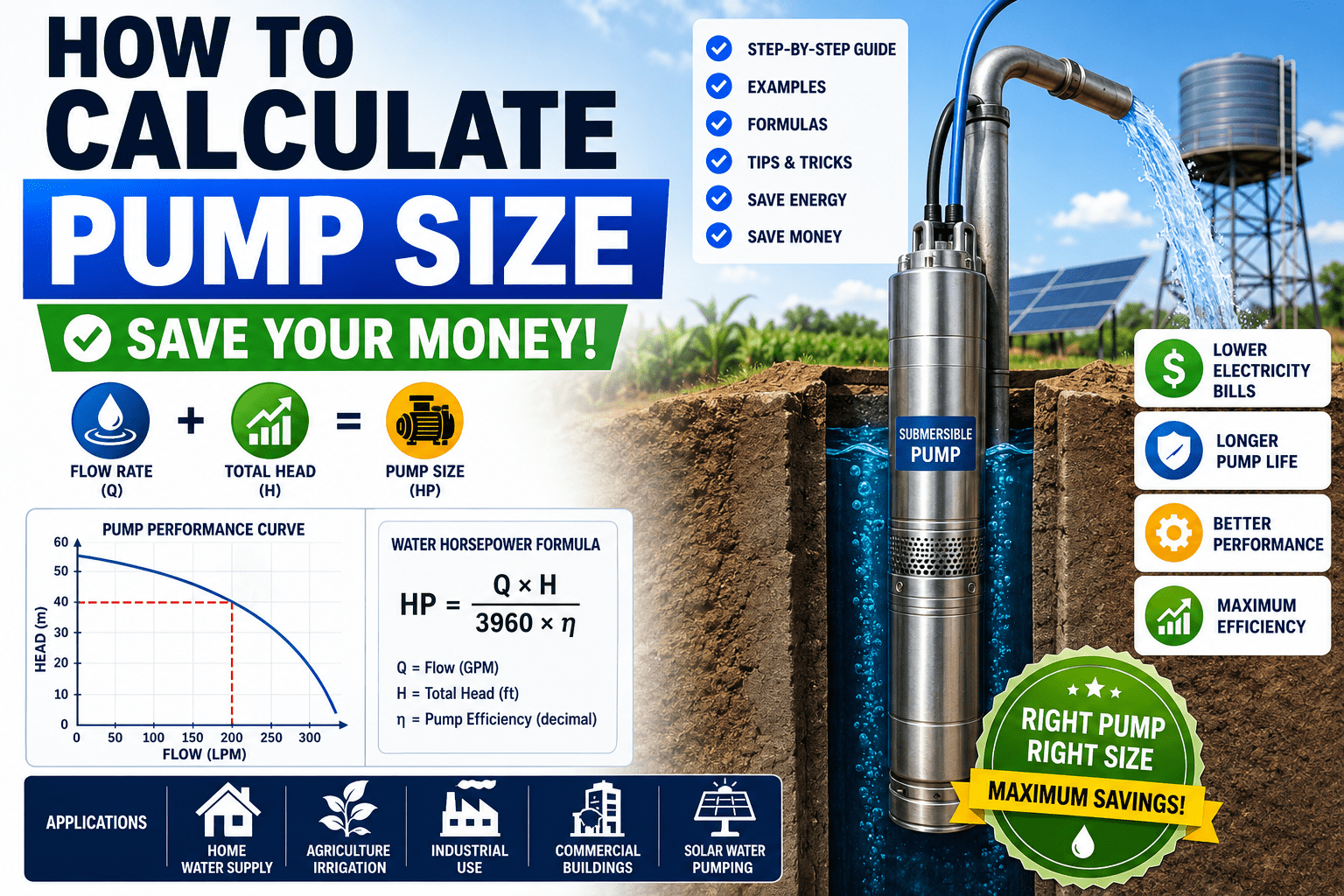
How much water do you need, and how high or far does the pump need to push it?
Pump size is not only about horsepower. A bigger HP pump does not always mean better performance. In many cases, an oversized pump wastes electricity, damages pipes, increases maintenance cost, and shortens motor life. On the other side, an undersized pump struggles, overheats, gives low water pressure, and fails earlier than expected.
The smart way is to calculate your pump requirement before buying. This saves your money in three major ways:
- You avoid buying an unnecessarily expensive pump.
- You reduce monthly electricity cost.
- You protect your motor, pipes, cables, and water system.
Whether you need a pump for a home, farmhouse, agriculture land, tube well, bore, commercial building, solar system, or industrial setup, the basic pump sizing method remains the same.
Why Pump Size Calculation Matters
A pump has one main job: to move water from one place to another. But every water system is different. Some systems need high flow. Some need high pressure. Some need deep lifting. Some need long-distance delivery.
A pump that works perfectly for one site may fail badly at another site.
For example:
- A 1HP pump may be enough for a small house overhead tank.
- A 2HP pump may be suitable for a medium-depth bore.
- A 5HP pump may be required for agriculture or long pipe delivery.
- A 10HP+ pump may be needed for deep tube wells or center pivot irrigation.
But these are only rough ideas. The correct pump depends on actual site conditions.
The most important factors are:
- Required water flow
- Total head
- Bore depth or water level
- Pipe length
- Pipe diameter
- Number of bends and fittings
- Required pressure
- Pump efficiency
- Power source: electricity, diesel, or solar
- Daily water requirement
The Two Main Things You Must Calculate
To calculate pump size properly, focus on two things:
1. Flow Rate
Flow rate means how much water the pump can deliver in a certain time.
It is commonly measured in:
- Liters per minute — LPM
- Gallons per minute — GPM
- Cubic meters per hour — m³/h
Example:
If a pump delivers 100 liters per minute, it means it can fill:
- 1,000 liters in 10 minutes
- 6,000 liters in 1 hour
- 60,000 liters in 10 hours
Flow rate tells you how fast the pump can supply water.
For homes, flow rate depends on bathrooms, taps, tanks, and usage. For agriculture, it depends on land size, crop water requirement, irrigation method, and daily watering time. For industrial use, it depends on machine demand, process requirement, cooling systems, or water transfer needs.
2. Total Head
Total head means the total height and resistance the pump must overcome to move water.
Many people only check bore depth, but that is not enough. A pump does not only lift water vertically. It also pushes water through pipes, bends, valves, filters, sprinklers, drips, or storage tanks.
Total head usually includes:
- Vertical lift from water level
- Delivery height
- Friction loss in pipes
- Pressure requirement
- Losses from bends, valves, filters, and fittings
A simple formula is:
Total Head = Vertical Lift + Delivery Height + Friction Loss + Pressure Requirement
For a submersible pump, calculate from the dynamic water level, not just total bore depth.
This is very important.
If your bore is 300 feet deep but water level is at 120 feet while pumping, then the pump is mainly lifting from 120 feet, not 300 feet. However, pump setting depth still matters for installation safety and water availability.
Important Pump Sizing Terms You Should Know
Before calculating, understand these terms:
Static Water Level
This is the water level inside the bore when the pump is not running.
Dynamic Water Level
This is the water level when the pump is running. It is usually lower than static water level because water is being drawn out.
Drawdown
This is the difference between static water level and dynamic water level.
Example:
- Static water level: 80 feet
- Dynamic water level: 120 feet
- Drawdown: 40 feet
Head
Head is the height the pump can push water. It is commonly measured in meters or feet.
Friction Loss
Friction loss happens when water moves through pipes. Long pipes, small pipe diameter, bends, elbows, valves, and filters increase friction loss.
Pressure Head
If your system needs pressure, such as sprinklers, drip irrigation, RO plant, filters, or center pivot system, you must add pressure head.
As a rough guide:
- 1 bar pressure is approximately equal to 10 meters head.
- 2 bar pressure is approximately equal to 20 meters head.
- 3 bar pressure is approximately equal to 30 meters head.
Step-by-Step Method to Calculate Pump Size
Step 1: Calculate Your Required Flow
First decide how much water you need per day.
For Home Use
Ask:
- How many people live in the house?
- How many bathrooms are used?
- How large is the overhead tank?
- How quickly do you want to fill the tank?
Example:
If your overhead tank is 1,000 liters and you want to fill it in 20 minutes:
Required Flow = 1,000 ÷ 20 = 50 LPM
So you need a pump that can deliver around 50 liters per minute at your required head.
For Agriculture Use
Ask:
- How many acres need water?
- Which crop is being grown?
- How many hours per day will the pump run?
- Is it flood irrigation, drip, sprinkler, or center pivot?
- How much water is required daily?
Example:
If your land needs 60,000 liters per day and you want to run the pump for 5 hours:
5 hours = 300 minutes
Required Flow = 60,000 ÷ 300 = 200 LPM
So your pump must deliver around 200 LPM at the required head.
Step 2: Calculate Total Head
Now calculate how hard the pump needs to work.
Example for a bore pump:
- Dynamic water level: 120 feet
- Height to overhead tank: 30 feet
- Pipe friction loss: 20 feet
- Extra pressure requirement: 10 feet
Total Head = 120 + 30 + 20 + 10 = 180 feet
So you need a pump that can deliver your required flow at 180 feet head.
This is where many people make mistakes. They buy a pump by HP only, but they do not check whether that pump can deliver the required flow at that head.
A 2HP pump from one brand may give different flow and head compared to another 2HP pump. Always check the pump curve or performance chart.
Step 3: Convert Head if Needed
Sometimes head is given in meters, sometimes in feet.
Use these conversions:
| Measurement | Conversion |
|---|---|
| 1 meter | 3.28 feet |
| 1 foot | 0.3048 meter |
| 10 meters | 32.8 feet |
| 100 feet | 30.48 meters |
| 1 bar pressure | Approx. 10 meters head |
Example:
180 feet ÷ 3.28 = 54.8 meters
So 180 feet head is about 55 meters.
Step 4: Estimate Required Horsepower
For water pumping, a practical formula is:
HP = Flow × Head ÷ 4560 × Efficiency
Where:
- Flow is in LPM
- Head is in meters
- Efficiency is pump efficiency in decimal form
Common pump efficiency may range from around 40% to 70%, depending on pump type, brand, model, operating point, and installation.
For practical calculation, you can use 50% to 60% efficiency if exact data is not available.
Example Calculation
Required flow: 200 LPM
Total head: 55 meters
Efficiency: 55% or 0.55
Formula:
HP = 200 × 55 ÷ 4560 ÷ 0.55
HP = 4.38 HP
In this case, a 5HP pump may be suitable, depending on the pump curve.
But do not stop here. You must still check whether the selected 5HP pump gives 200 LPM at 55 meters head.
Comparison Table: Undersized vs Correct Size vs Oversized Pump
| Factor | Undersized Pump | Correct Size Pump | Oversized Pump |
|---|---|---|---|
| Initial Cost | Lower | Balanced | Higher |
| Water Flow | Low | As required | Too high or unstable |
| Electricity Bill | May increase due to long running | Efficient | High |
| Motor Life | Shorter due to overload | Better | Can reduce due to cycling/load issues |
| Pressure | Weak | Proper | Too much pressure |
| Pipe Safety | Usually safe but poor output | Safe | Risk of pipe/fitting damage |
| Maintenance | Frequent issues | Lower maintenance | More wear and tear |
| Best For | Temporary use only | Long-term use | Only if system needs it |
| Money Saving | Poor | Best | Poor |
The best pump is not the biggest pump. The best pump is the pump that matches your actual water requirement.
Pros & Cons of Calculating Pump Size Before Buying
Pros
- Saves money on pump purchase.
- Reduces electricity bills.
- Improves water pressure and flow.
- Protects pipes, valves, and fittings.
- Reduces motor overheating.
- Helps select the right cable, panel, inverter, or solar system.
- Improves pump life.
- Reduces repair and maintenance cost.
- Helps avoid wrong HP selection.
- Makes the system more professional and reliable.
Cons
- Requires basic site measurements.
- Needs correct water level information.
- Friction loss may require expert help.
- Pump curve reading can be confusing for beginners.
- Wrong assumptions can still lead to wrong selection.
Even with these cons, calculation is still much better than guessing.
Common Mistakes People Make When Buying a Pump
Many people waste money because they make these mistakes:
- Buying pump by HP only
- Ignoring total head
- Ignoring dynamic water level
- Using small pipe diameter
- Installing too many bends
- Not checking voltage stability
- Not matching pump with solar inverter/VFD
- Ignoring cable size
- Buying cheap low-efficiency pumps
- Not checking pump curve
- Using one pump for the wrong application
- Not considering future water demand
One of the biggest mistakes is using a small delivery pipe with a high-flow pump. This creates high friction loss. The pump consumes power, but water output remains poor.
Sometimes the problem is not the pump. The problem is pipe size, wrong installation, low voltage, blocked filter, or poor bore yield.
Pump Size Guide by Application
| Application | Main Requirement | Important Factor | Common Mistake |
|---|---|---|---|
| Home Water Supply | Moderate flow, moderate head | Tank height and pipe size | Buying too much HP |
| Bore/Submersible Pump | Lifting water from depth | Dynamic water level | Using bore depth only |
| Agriculture Flood Irrigation | High flow | Water volume per acre | Ignoring pipe loss |
| Drip Irrigation | Controlled flow and pressure | Filter and pressure head | No pressure calculation |
| Sprinkler System | Pressure + flow | Nozzle pressure | Low-pressure pump |
| Center Pivot Irrigation | High flow and stable pressure | System pressure demand | Wrong pump curve |
| Industrial Use | Continuous duty | Efficiency and reliability | Cheap pump selection |
| Solar Pumping | Flow during sunlight hours | Solar sizing and pump curve | Wrong inverter/pump match |
How Correct Pump Size Saves Your Money
Correct pump sizing saves money in both short-term and long-term.
1. Lower Purchase Cost
If your site needs a 3HP pump and you buy a 5HP pump without reason, you pay extra for the pump, motor, cable, starter, panel, and installation.
2. Lower Electricity Bill
A bigger pump consumes more power. If it runs daily, the extra electricity cost becomes a major expense over time.
3. Lower Solar System Cost
For solar pumping, oversizing the pump increases the required solar panels, inverter/VFD size, cable size, structure cost, and installation cost.
4. Less Maintenance
Correct pumps operate smoothly. Oversized or undersized pumps often face heating, vibration, pressure problems, dry run issues, and mechanical wear.
5. Better Water Output
Correct sizing gives stable flow and pressure. You get the water you need without wasting power.
Practical Example: Selecting a Pump for a Farm
Let’s say a farmer needs water for irrigation.
Site details:
- Required water: 72,000 liters per day
- Pump running time: 6 hours per day
- Dynamic water level: 100 feet
- Delivery height: 20 feet
- Pipe friction loss: 30 feet
- Required extra pressure: 15 feet
Flow Calculation
6 hours = 360 minutes
Flow = 72,000 ÷ 360 = 200 LPM
Head Calculation
Total Head = 100 + 20 + 30 + 15 = 165 feet
Convert to meters:
165 ÷ 3.28 = 50 meters approx.
HP Calculation
Flow = 200 LPM
Head = 50 meters
Efficiency = 55%
HP = 200 × 50 ÷ 4560 ÷ 0.55
HP = 3.98 HP
So a 4HP pump may be close, but in the market, the practical choice may be a 5HP pump, depending on brand, pump curve, bore conditions, voltage, and required safety margin.
This is how calculation prevents blind buying.
Should You Add Safety Margin?
Yes, but do not overdo it.
A safety margin of around 10% to 15% is usually reasonable. It helps cover minor friction loss errors, future pipe aging, voltage fluctuation, and small demand increase.
But adding 50% or 100% extra “just to be safe” is not smart. That leads to oversizing and unnecessary cost.
Good pump selection means:
- Enough capacity
- Good efficiency
- Safe operation
- Reasonable energy use
- Proper pressure
- Long service life
Final Checklist Before Buying a Pump
Before finalizing pump size, collect this information:
- Required daily water quantity
- Required flow rate in LPM or m³/h
- Static water level
- Dynamic water level
- Total vertical height
- Pipe length
- Pipe diameter
- Number of bends and valves
- Required pressure
- Pump running hours
- Power source
- Voltage availability
- Cable distance
- Application type
- Pump curve/performance chart
Do not buy only by asking, “How much HP?” Instead, ask:
“How much flow will this pump give at my required head?”
That one question can save you serious money.
Conclusion
Calculating pump size is not complicated when you understand the basics. You only need to know two main things: flow rate and total head. Once you know how much water you need and how much resistance the pump must overcome, you can estimate the right horsepower and select a pump from the performance chart.
The wrong pump can waste money every month. It can increase electricity bills, damage pipes, reduce water output, and create maintenance problems. The right pump gives you stable water, better pressure, lower running cost, and longer service life.
So before buying a pump, do not guess. Calculate first.
The cheapest pump is not always the best pump. The biggest pump is not always the best pump. The best pump is the one that gives the required water at the required head with maximum efficiency.