
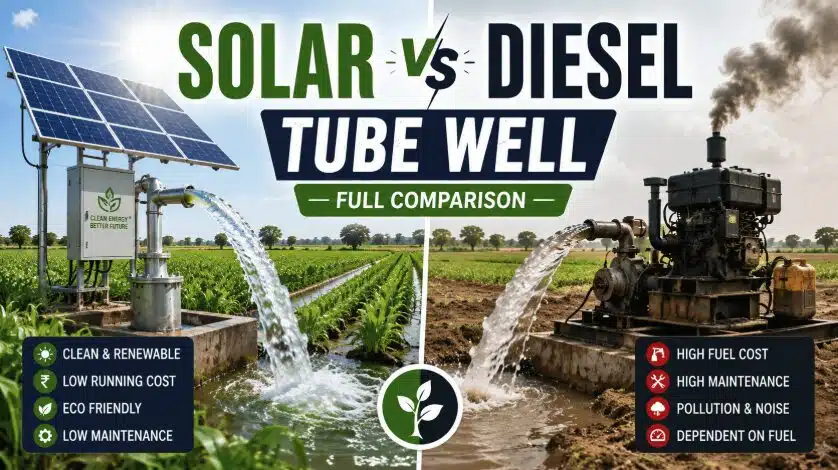
Solar vs Diesel Tube Well – Full Comparison

Introduction: Which Tube Well System Is Better for Farmers?
For farmers, landowners, and agricultural businesses, water is not just a basic need — it is the backbone of crop production. Whether you are growing wheat, cotton, sugarcane, vegetables, orchards, fodder, or seasonal crops, a reliable tube well can directly affect your yield, income, and peace of mind.
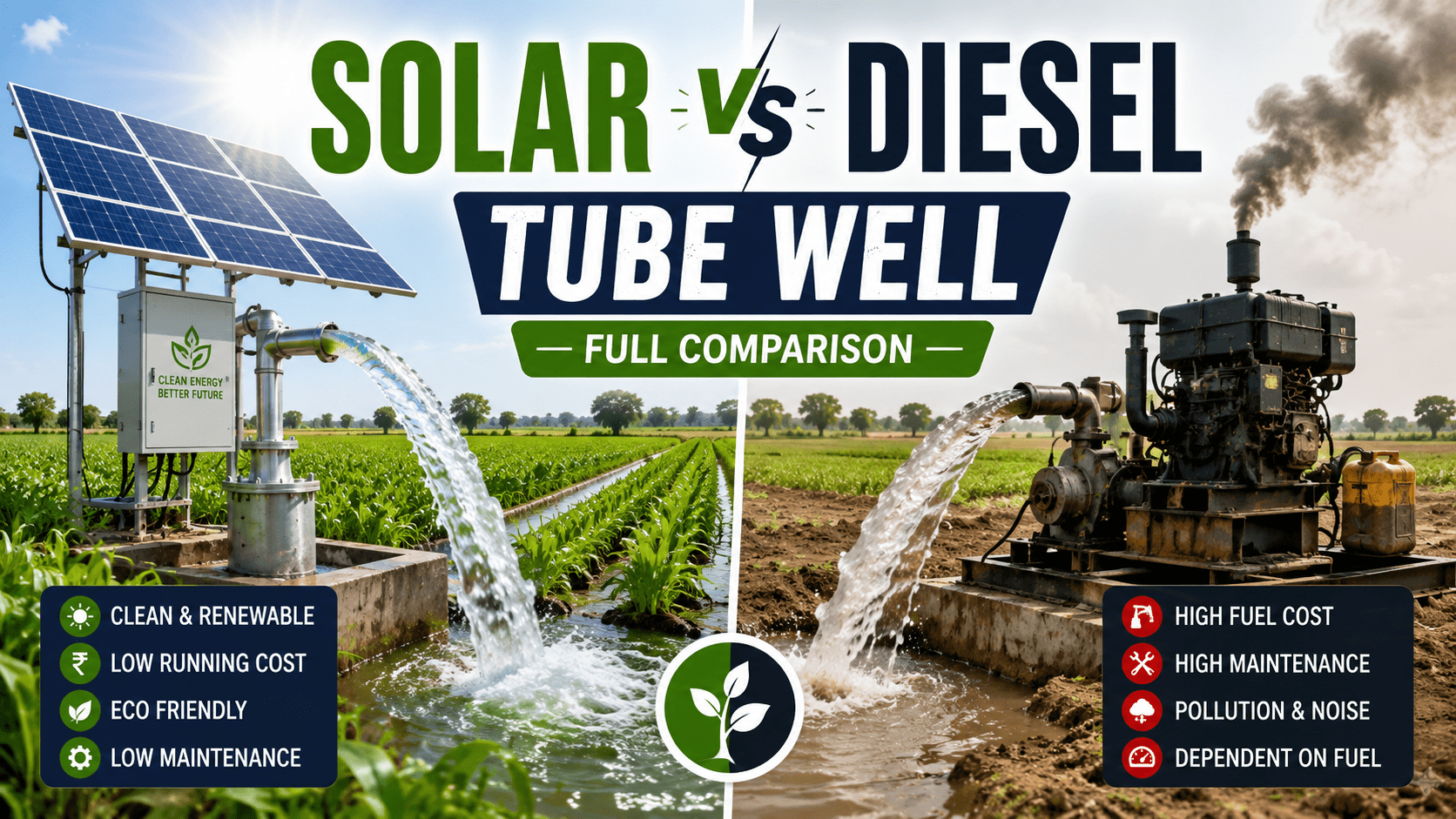
For many years, diesel tube wells have been widely used in rural areas because they are easy to install, powerful, and can run anywhere without electricity. However, with rising fuel prices, maintenance issues, and increasing interest in renewable energy, solar tube wells have become one of the most popular alternatives.
Today, the main question is:
Should you continue with a diesel tube well, or should you invest in a solar tube well?
The answer depends on your land size, water depth, daily running hours, budget, crop type, and long-term goals. A diesel tube well may look cheaper at the start, but its running cost can become heavy over time. A solar tube well requires a bigger initial investment, but it can reduce daily fuel expenses and provide long-term savings.
This article gives you a complete comparison of solar vs diesel tube wells, including cost, performance, maintenance, pros and cons, and which one is better for different farming needs.
What Is a Solar Tube Well?
A solar tube well is a water pumping system powered by solar panels. The solar panels convert sunlight into electricity, which runs a submersible pump, turbine pump, or centrifugal pump through a solar inverter or VFD.
A typical solar tube well system includes:
- Solar panels
- Solar mounting structure
- Solar pump inverter / VFD
- Submersible pump or surface pump
- Motor
- Cables and protection devices
- Bore or water source
- Delivery pipe system
The biggest benefit of a solar tube well is that it uses sunlight instead of diesel or grid electricity. Once installed properly, it can run during daytime with very low operating cost.
What Is a Diesel Tube Well?
A diesel tube well uses a diesel engine to run a pump. The engine burns diesel fuel and converts it into mechanical power, which rotates the pump and pulls or pushes water from the ground.
A typical diesel tube well system includes:
- Diesel engine
- Pump
- Fuel tank
- Belt or coupling system
- Pipe fittings
- Foundation frame
- Suction and delivery pipes
- Regular oil and filter system
Diesel tube wells are common because they are simple, familiar, and can work without sunlight or electricity. However, their biggest weakness is the continuous fuel cost.
Quick Verdict: Solar vs Diesel Tube Well
If you want a simple answer:
Choose Solar Tube Well If:
- You run your tube well for several hours daily
- You want to reduce fuel expenses
- You have open land for solar panels
- You want long-term savings
- You want low maintenance
- You mostly irrigate during daytime
- You are tired of diesel price fluctuations
Choose Diesel Tube Well If:
- You need water at night
- You have a limited initial budget
- Your usage is occasional
- Your land has no proper space for panels
- You need a temporary pumping solution
- You want quick installation
- You already own a diesel engine
In most long-term farming cases, solar tube wells are more economical, while diesel tube wells are better for short-term, emergency, or occasional use.
Solar vs Diesel Tube Well Comparison Table
| Feature | Solar Tube Well | Diesel Tube Well |
|---|---|---|
| Power Source | Sunlight through solar panels | Diesel fuel |
| Initial Cost | Higher | Lower |
| Daily Running Cost | Very low | High |
| Maintenance | Low | High |
| Fuel Requirement | No fuel required | Diesel required daily |
| Best Running Time | Daytime | Day and night |
| Noise Level | Quiet | Noisy |
| Smoke / Pollution | No smoke | Produces smoke |
| Lifespan | Long if installed properly | Engine wears out faster |
| Operating Skill | Easy after setup | Requires fuel handling and engine care |
| Best For | Regular irrigation | Backup or temporary irrigation |
| Long-Term Saving | Excellent | Weak |
| Performance Stability | Depends on sunlight and design | Depends on fuel and engine condition |
| Scalability | Easy to expand with panels/inverter planning | Requires bigger engine for more power |
| Environmental Impact | Clean energy | Higher emissions |
| Payback Period | Usually strong with daily use | No payback; ongoing fuel expense |
| Night Operation | Needs battery/grid/hybrid support | Can run anytime |
| Common Problem | High upfront investment | High fuel and maintenance cost |
Cost Comparison: Initial Cost vs Running Cost
The biggest difference between solar and diesel tube wells is not just the purchase price — it is the total cost over time.
A diesel system usually costs less at the beginning. You buy an engine, pump, and accessories, and the system can start working quickly. This looks attractive for farmers who have limited capital.
But diesel has a hidden cost: daily fuel expense.
Every hour the engine runs, it burns fuel. If you irrigate often, your diesel cost keeps increasing. Add engine oil, filters, repairs, belt replacement, mechanic charges, and downtime — the total cost becomes much higher over the years.
A solar tube well is the opposite. It costs more at the start because solar panels, inverter, structure, cables, and protections are required. But once the system is installed, the daily running cost becomes very low.
Cost Logic in Simple Words
- Diesel tube well = Low starting cost + high daily cost
- Solar tube well = High starting cost + very low daily cost
This is why solar is usually better for farmers who run their tube well frequently.
Running Cost: The Biggest Difference
Running cost is where solar wins strongly.
A diesel tube well needs fuel every time it runs. Even if your pump is efficient, the engine still consumes diesel. If the engine is old, poorly maintained, or overloaded, fuel consumption becomes even higher.
Solar tube wells use sunlight, so there is no daily diesel cost. You may still need occasional cleaning, checking, and servicing, but there is no major fuel expense.
Diesel Tube Well Running Costs Include:
- Diesel fuel
- Engine oil
- Oil filter
- Air filter
- Fuel filter
- Belt replacement
- Engine repair
- Pump repair
- Mechanic visits
- Transportation of diesel
- Time wasted in fuel arrangement
Solar Tube Well Running Costs Include:
- Panel cleaning
- Occasional inverter checking
- Cable inspection
- Pump servicing when needed
- Structure inspection
- Protection system checking
The difference is clear: diesel keeps taking money every day, while solar mostly needs care and inspection.
Performance Comparison
Both solar and diesel tube wells can perform well if they are properly designed. The problem starts when the system is mismatched.
For example, if a farmer installs fewer solar panels than required, the pump will not perform properly. Similarly, if a diesel engine is too small for the pump load, it will consume more fuel and may overheat.
Solar Tube Well Performance
Solar performance depends on:
- Solar panel capacity
- Sunlight intensity
- Pump horsepower
- Water depth
- Pipe size
- Inverter quality
- Motor efficiency
- Installation angle
- Cable quality
- Bore condition
A well-designed solar tube well can provide excellent daytime water output. It is especially useful in areas where irrigation is mainly needed during sunny hours.
Diesel Tube Well Performance
Diesel performance depends on:
- Engine horsepower
- Pump condition
- Fuel quality
- Engine maintenance
- Water depth
- Pipe friction
- RPM stability
- Cooling condition
- Belt/coupling condition
Diesel engines can provide strong power, but performance drops when the engine becomes old, poorly tuned, or overloaded.
Maintenance Comparison
Maintenance is another major reason farmers are shifting toward solar.
A diesel engine has many moving parts. It burns fuel, produces heat, creates vibration, and requires frequent servicing. If ignored, small problems can quickly become expensive repairs.
A solar system has fewer moving parts. Solar panels do not need oil, fuel, or daily mechanical servicing. The pump and inverter still need attention, but overall maintenance is much lower than diesel.
Diesel Maintenance Problems
- Engine oil change
- Filter replacement
- Injector problems
- Piston/ring wear
- Starting problems
- Smoke issues
- Overheating
- Belt slipping
- Fuel leakage
- Engine vibration
- Frequent mechanic dependency
Solar Maintenance Requirements
- Clean panels regularly
- Keep cables protected
- Check earthing and protections
- Keep inverter safe from dust and heat
- Inspect pump performance
- Avoid shading on panels
- Tighten structure bolts if needed
In simple terms, diesel needs regular mechanical maintenance, while solar needs preventive electrical maintenance.
Pros and Cons of Solar Tube Well
Pros of Solar Tube Well
- Very low running cost: No daily diesel purchase required.
- Long-term savings: Best for farmers who irrigate regularly.
- Low maintenance: No engine oil, filters, smoke, or fuel handling.
- Clean and quiet operation: No noise or diesel smoke.
- Good for remote areas: Useful where electricity is unavailable or unreliable.
- Stable daytime irrigation: Works well during sunny hours.
- Modern and scalable: System can be designed according to pump size and water needs.
- Less dependency: No need to arrange diesel every day.
Cons of Solar Tube Well
- High upfront cost: Initial investment is higher than diesel.
- Daytime dependency: Standard solar systems work best in sunlight.
- Space required: Panels need open area without shade.
- Design must be accurate: Wrong pump, inverter, or panel sizing can reduce performance.
- Protection is important: Poor wiring, weak structure, or no earthing can damage the system.
- Not ideal for every bore: Deep water and high flow requirements need proper technical calculation.
Pros and Cons of Diesel Tube Well
Pros of Diesel Tube Well
- Lower initial cost: Cheaper to start compared to solar.
- Works day and night: Can run anytime if diesel is available.
- Quick installation: Easier to arrange and start.
- Familiar technology: Most farmers and mechanics understand diesel engines.
- Good for emergency use: Useful as a backup system.
- Portable options available: Can be moved in some setups.
Cons of Diesel Tube Well
- High fuel cost: Diesel expense keeps increasing with usage.
- Frequent maintenance: Engine oil, filters, belts, and repairs are common.
- Noise and smoke: Creates pollution and disturbance.
- Fuel dependency: Irrigation stops if diesel is unavailable.
- Engine wear and tear: Performance reduces over time.
- Unstable long-term cost: Fuel prices can change suddenly.
- More downtime: Mechanical issues can stop irrigation during important crop stages.
Which One Saves More Money?
For regular irrigation, solar usually saves more money over time.
Let’s understand with a simple example. Suppose a farmer runs a diesel tube well for several hours daily during irrigation season. Every day, diesel is consumed. Every week, fuel cost adds up. Every month, maintenance and service costs appear. Over a few years, the running cost can become much higher than the initial price of the engine.
With solar, the farmer pays more at the beginning. But after installation, the system can run for years with minimal daily expense.
Solar Saves More When:
- Tube well runs daily or frequently
- Diesel consumption is high
- Water requirement is regular
- Crops need repeated irrigation
- Farmer plans to use the land for many years
- Bore and pump size are suitable for solar conversion
Diesel May Be Cheaper When:
- Tube well runs only occasionally
- Farm is temporary or rented
- Water is needed mostly at night
- Initial budget is very low
- Existing diesel engine is already available
- Solar panel space is not available
For serious farming, solar is not just an expense. It becomes an investment.
Water Output: Does Solar Give Enough Water?
Many farmers ask: Can solar give the same water as diesel?
The answer is yes — but only if the system is designed properly.
A solar tube well can give strong water output when the solar panels, inverter, pump, motor, and bore conditions are correctly matched. The mistake many people make is installing a weak solar system on a heavy pump. This creates poor water output and gives solar a bad reputation.
For Better Solar Water Output, Check These Things:
- Actual water depth
- Required gallons/liters per minute
- Pump horsepower
- Motor efficiency
- Solar panel capacity
- Pipe size and friction loss
- Total dynamic head
- Inverter/VFD quality
- Cable size
- Shade-free panel area
A professional survey is very important before installing a solar tube well. Guesswork can waste money.
Reliability: Solar or Diesel?
Diesel is reliable in the sense that it can run anytime — morning, evening, or night — as long as fuel is available and the engine is working.
Solar is reliable in the sense that it uses free sunlight and has fewer moving parts. But it depends on daytime sunlight. During cloudy weather, water output may reduce. At night, a standard solar system will not run unless it is connected to batteries, grid, or a hybrid system.
Best Practical Setup
For many farmers, the best setup is:
Solar tube well as the main system + diesel engine as backup
This gives the best of both worlds. Solar handles daily irrigation, while diesel is kept for emergency, night use, or cloudy days.
Environmental Impact
Diesel tube wells create smoke, noise, and carbon emissions. In rural areas, this may feel normal, but over time it affects air quality, fuel dependency, and operating comfort.
Solar tube wells are much cleaner. They do not burn fuel while operating and do not create engine noise. For farms, orchards, schools, dairy farms, poultry farms, and remote agricultural land, solar provides a cleaner and more peaceful water solution.
Solar Is Better For:
- Cleaner farming
- Reduced fuel dependency
- Long-term sustainability
- Noise-free operation
- Modern agricultural planning
- Areas with strong sunlight
Which Tube Well Is Better for Pakistan?
For Pakistan, solar tube wells are becoming more attractive because many farming areas have strong sunlight and high irrigation demand. In Punjab, Sindh, Balochistan, and South Punjab, many farmers run tube wells for long hours. In such cases, diesel becomes expensive.
Solar is especially useful for:
- Agricultural farms
- Orchards
- Dairy farms
- Remote lands
- Livestock water supply
- Drip irrigation
- Sprinkler irrigation
- Center pivot irrigation
- Fish farms
- Farmhouses
- Tube wells without grid electricity
Diesel still has its place, especially where water is needed at night or where farmers cannot invest in solar immediately. But for long-term use, solar is usually the smarter option.
Common Mistakes When Choosing Solar Tube Well
Many solar tube well problems happen because of poor planning, not because solar technology is weak.
Avoid These Mistakes:
- Choosing solar panels only by price
- Installing fewer panels than required
- Using low-quality inverter or VFD
- Ignoring water depth
- Not checking pump efficiency
- Using undersized cables
- Installing panels under shade
- Weak mounting structure
- No proper earthing
- No lightning protection
- No professional survey
- Buying from non-technical sellers
A solar tube well is a technical system. It should be designed by people who understand pumps, motors, bore depth, water demand, and solar sizing.
Common Mistakes With Diesel Tube Wells
Diesel systems also fail when they are not properly maintained.
Avoid These Diesel Mistakes:
- Running the engine without proper oil level
- Using dirty fuel
- Ignoring filter replacement
- Overloading the engine
- Using wrong pump size
- Poor belt alignment
- Running with overheating issues
- Delaying small repairs
- Using old leaking pipes
- Ignoring vibration and smoke
Diesel engines can work well, but they demand regular attention. If maintenance is ignored, fuel consumption increases and repair costs become heavy.
Solar vs Diesel Tube Well: Which Is Better for Small Farmers?
Small farmers usually look at the initial price first. Diesel may seem easier because it costs less to start. But if the farmer irrigates regularly, diesel cost can become a burden.
For small farmers, solar is better when:
- The land is owned
- Water is needed regularly
- Daytime irrigation is acceptable
- A proper financing or installment option is available
- The farmer wants to reduce monthly expenses
Diesel is better when:
- The land is rented
- Irrigation is occasional
- Budget is very limited
- Water is needed at night
- Existing diesel engine is already available
Solar vs Diesel Tube Well: Which Is Better for Large Farms?
For large farms, solar is often a stronger choice because bigger farms usually need more water and longer running hours. More running hours mean more diesel cost. That is where solar provides major savings.
Large farms can also benefit from hybrid systems, bigger solar arrays, and properly designed pump solutions.
For large farms, solar is better for:
- Regular irrigation
- High fuel-saving potential
- Multiple crops
- Orchards
- Drip and sprinkler systems
- Center pivot irrigation
- Long-term land development
Diesel can still be kept as backup, but using diesel as the main system for a large farm can become expensive.
Final Recommendation: Solar or Diesel Tube Well?
The best choice depends on how often you use your tube well.
Choose Solar Tube Well If You Want:
- Long-term savings
- Low running cost
- Less maintenance
- Clean operation
- Daytime irrigation
- Modern farming solution
- Protection from diesel price increases
Choose Diesel Tube Well If You Want:
- Lower initial investment
- Night operation
- Emergency backup
- Temporary setup
- Occasional irrigation
- Quick installation
Best Overall Choice
For most farmers who use their tube well regularly, the better long-term choice is:
Solar Tube Well
It may cost more at the beginning, but it can save a huge amount in fuel and maintenance over time. Diesel tube wells are still useful, especially as backup systems, but relying completely on diesel for daily irrigation can become expensive.
The smartest approach is to calculate your water requirement, running hours, bore depth, pump size, and budget before making a decision.
A properly designed solar tube well is not just a pump system — it is a long-term farming investment.
Conclusion
Solar and diesel tube wells both have their own value. Diesel offers quick power, night operation, and lower initial cost. Solar offers low running cost, cleaner operation, and long-term savings.
If your tube well runs only a few times a month, diesel may still work for you. But if your tube well runs daily or frequently, solar is usually the better financial decision.
The most important thing is not to choose blindly. Before buying any system, check:
- Water depth
- Required water flow
- Pump horsepower
- Daily running hours
- Available sunlight
- Land space for panels
- Budget
- Long-term farming plan
In the end, the right tube well is the one that gives you reliable water at the lowest total cost.
For modern farming, especially in sunny regions, solar tube wells are becoming the future of irrigation. They reduce fuel pressure, lower operating cost, and give farmers more control over their water supply.
Final line:
If diesel is a daily expense, solar is a long-term investment.