
Real Farmer Case Study from Multan: How Better Water Planning Changed One Farm’s Future


Introduction: A Farmer’s Problem That Many Multan Farmers Understand
In South Punjab, especially around Multan, farming is not just a business — it is a family legacy. From wheat and cotton to mango orchards, fodder, vegetables, and sugarcane, the land of Multan has always been known for agriculture. But in recent years, farmers have started facing one major issue again and again:
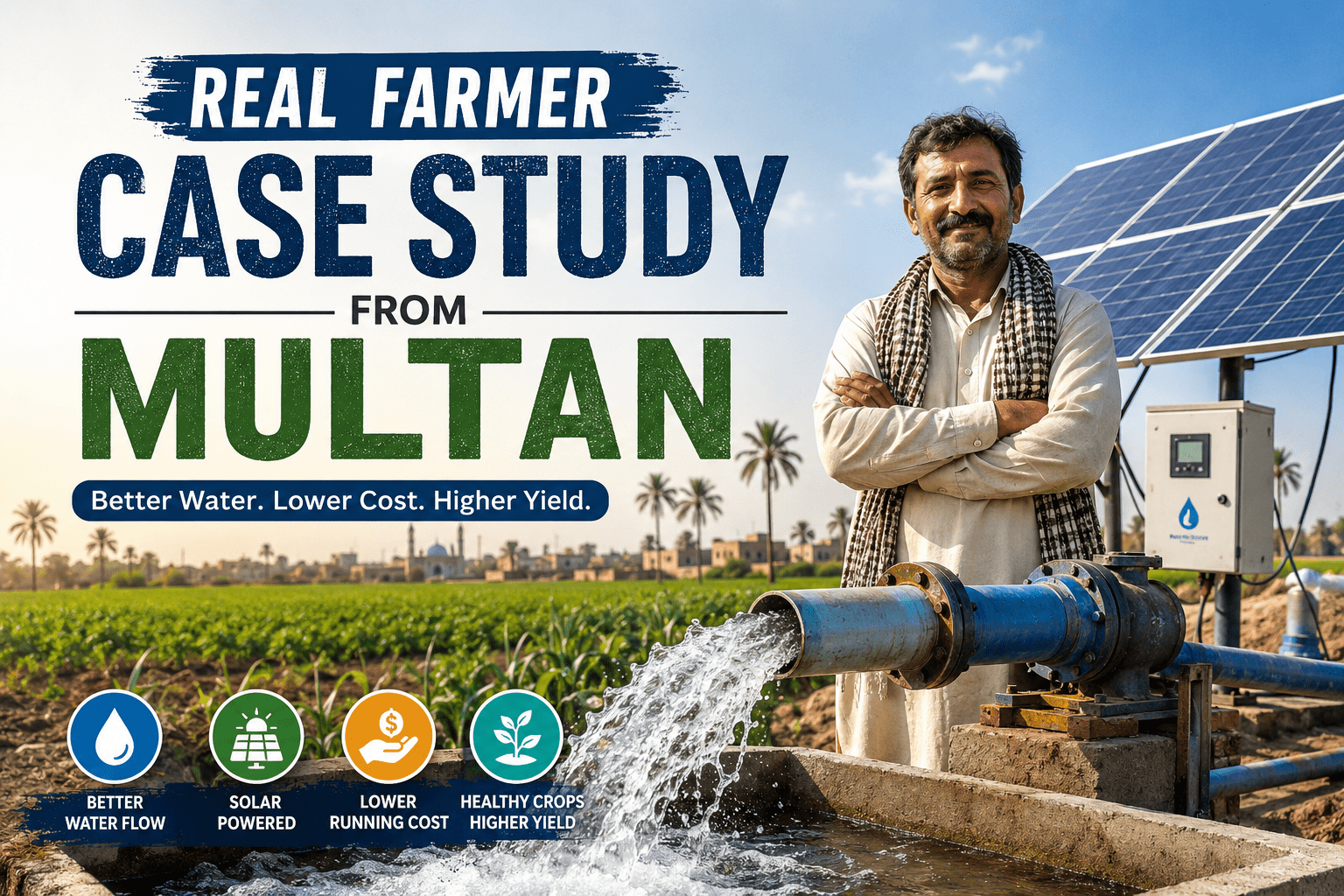
Water is no longer simple.
Some farmers have land but not enough water. Some have bore water, but the discharge is weak. Some have diesel tube wells, but fuel cost eats their profit. Some install pumps without proper testing, and later they realize the motor, pipe size, bore depth, or solar system was not suitable for their land.
This case study explains the story of a farmer from Multan who was facing exactly these problems. His farm was productive, his soil was good, and his experience was strong — but his irrigation system was holding him back.
For privacy, we will call him Farmer Akram, a medium-scale farmer from the Multan region. His case is similar to many real farmers in areas around Multan, Shujabad, Jalalpur Pirwala, Makhdoom Rashid, Basti Malook, and nearby agricultural belts.
This article explains:
- What problem the farmer was facing
- What mistakes were damaging his farm productivity
- How water investigation helped
- What solution was installed
- What results he achieved
- Pros and cons of the upgrade
- Cost vs benefit comparison
- Lessons for other farmers in Multan
Farmer Background
Farmer Akram owned agricultural land near Multan where he mostly cultivated:
- Wheat in winter
- Cotton in summer
- Fodder for animals
- Seasonal vegetables on a small portion
- A small mango orchard on one side of the land
His farm size was medium, but his water requirement was high because he had both field crops and fruit trees. For years, he depended on a traditional tube well setup. The system worked fine in the beginning, but with time, the problems started increasing.
The old setup included:
- A traditional bore
- Diesel engine-based water pumping
- Old delivery pipes
- No proper discharge measurement
- No water quality testing
- No proper pump matching
- No solar support
At first, the farmer thought the issue was only with the pump. But after proper inspection, it became clear that the problem was not one thing. It was a combination of bore condition, pump selection, pipe losses, energy cost, and poor water planning.
Main Problems Before the Upgrade
1. Weak Water Flow
The first and biggest problem was weak water flow. The farmer noticed that the water discharge had dropped compared to previous years.
Earlier, the tube well was enough to irrigate fields on time. But later, the same area required more hours of pumping. This caused delays in watering crops, especially during hot months when water demand was higher.
Weak water flow affected the farm in many ways:
- Crops did not receive water on time
- Irrigation cycle became longer
- Diesel cost increased
- Labor hours increased
- Crop stress became visible
- Some fields remained unevenly irrigated
2. High Diesel Expense
Diesel pumping was becoming expensive. Even when the crop market price was uncertain, the fuel cost remained high. Every irrigation round meant spending money before earning anything.
The farmer said his biggest pressure was not only crop disease or weather. It was the daily cost of running the tube well.
Diesel-based irrigation created these issues:
- High running cost
- Regular engine maintenance
- Oil and filter replacement
- Noise and smoke
- Dependency on fuel availability
- More manual supervision
3. Poor Pump Matching
The existing pump was not properly matched with the bore depth, water level, pipe size, and field requirement. Many farmers make this mistake. They buy a pump based on horsepower only, but horsepower alone does not decide performance.
A pump should be selected according to:
- Bore depth
- Static water level
- Dynamic water level
- Required discharge
- Pipe diameter
- Delivery distance
- Total head
- Crop water requirement
- Power source
In this case, the farmer had a pump that was consuming energy but not giving proper output.
4. Old Pipeline Losses
Another hidden problem was the pipeline. The pipe system was old, and some sections had leakage and friction losses. Water was being produced from the bore, but not all of it was reaching the field efficiently.
Common pipeline issues included:
- Undersized pipe diameter
- Leakage from joints
- Rusted or damaged sections
- Poor layout
- Unnecessary bends
- Pressure loss
Even a good pump can perform badly if the pipe system is not suitable.
5. No Water Quality Testing
The farmer had never done proper water testing. In Multan and South Punjab, water quality can vary from area to area. Some water may have salinity, hardness, or other mineral issues. If bad water is used for a long time, it can affect soil health and crop performance.
Water quality matters because it can affect:
- Soil structure
- Crop growth
- Fertilizer efficiency
- Long-term land productivity
- Drip or sprinkler system performance
- Pump and pipe life
Investigation Process: What Was Checked First?
Before suggesting any new system, the farm was inspected properly. This is the most important step. Many farmers directly install a pump, motor, or solar system without investigation. That can lead to wrong investment.
The inspection focused on these points:
Water Source Checking
The bore condition was checked to understand whether the water source was still reliable. The team looked at water level, discharge, and pumping behavior.
Pump Performance Checking
The old pump was checked to see whether it was suitable for the required work. Its output was compared with the farm’s irrigation needs.
Pipe Layout Checking
The delivery pipeline was inspected to identify possible losses. Old joints, bends, pipe size, and leakage points were reviewed.
Energy Cost Analysis
Diesel consumption was calculated to understand the real cost per irrigation cycle. This helped compare diesel pumping with solar pumping.
Crop Requirement Review
The farmer’s cropping pattern was reviewed. Wheat, cotton, fodder, and mango trees all have different water needs. A good irrigation system should support the actual farm plan, not just the bore.
Recommended Solution
After the inspection, the solution was not simply “install a bigger pump.” Bigger is not always better. The real solution was to design the system properly.
The recommended upgrade included:
- Bore performance improvement
- Proper pump and motor selection
- Better pipe sizing
- Solar-powered pumping setup
- Improved irrigation scheduling
- Basic water quality awareness
- Regular system maintenance plan
The goal was simple:
More water output, lower running cost, and better irrigation control.
Before vs After Comparison Table
| Feature | Before Upgrade | After Upgrade |
|---|---|---|
| Water Flow | Weak and inconsistent | Improved and stable |
| Power Source | Diesel engine | Solar-assisted pumping |
| Running Cost | High due to fuel | Much lower in daytime operation |
| Pump Selection | Not properly matched | Selected according to bore and field need |
| Pipeline | Old with losses | Better pipe sizing and reduced leakage |
| Irrigation Time | Longer watering hours | Faster and more controlled irrigation |
| Maintenance | Frequent engine issues | Lower routine maintenance |
| Noise & Smoke | High | Very low |
| Crop Stress | Visible in hot months | Reduced due to timely irrigation |
| Farmer Control | Manual and costly | Easier daytime operation |
| Long-Term Value | Costly and inefficient | More sustainable and profitable |
Results After the Upgrade
1. Better Water Discharge
After the system was improved, the farmer noticed better water flow. The fields that previously took longer to irrigate were watered more efficiently. This saved time and reduced crop stress.
The farmer could now plan irrigation more confidently instead of waiting for the engine, arranging diesel, or dealing with weak flow.
2. Lower Daily Irrigation Cost
The biggest improvement was in running cost. Since solar energy was used during daylight hours, the farmer reduced dependence on diesel.
This helped in three ways:
- Lower fuel expense
- Less engine maintenance
- More predictable irrigation cost
For a farmer, this is a major advantage because every rupee saved in irrigation improves net profit.
3. Better Crop Timing
In farming, timing matters. If a crop needs water today and receives it after three days, the damage may already be done. With better water availability, the farmer was able to irrigate on time.
Timely irrigation helped:
- Reduce heat stress
- Improve crop standing
- Support better flowering and growth
- Protect young plants
- Improve field uniformity
4. Less Dependence on Labor
The old diesel system needed more supervision. Someone had to arrange fuel, start the engine, check the engine, and monitor the system.
The upgraded system reduced daily hassle. The farmer still needed to monitor irrigation, but the process became easier and smoother.
5. Better Long-Term Planning
After the upgrade, the farmer started thinking differently. Earlier, he only reacted to problems. Now, he started planning water use according to crop needs.
This is a major mindset shift. Good farming is not only about seed and fertilizer. Water planning is equally important.
Pros of the Upgrade
1. Lower Running Cost
Solar-based pumping reduces daily fuel dependence. Once the system is installed, daytime pumping becomes much cheaper compared to diesel.
2. Better Water Control
A properly matched pump gives better discharge and makes irrigation more predictable.
3. Less Maintenance Pressure
Diesel engines need regular service, oil, filters, and repairs. Solar pump systems still need maintenance, but daily mechanical wear is generally lower.
4. Good for Remote Farms
Many farms face electricity issues or load-shedding. Solar pumping can be useful where grid power is unreliable.
5. Better Crop Protection
Timely water protects crops from stress, especially in hot weather.
6. Long-Term Investment
A well-designed system can support the farm for years if maintained properly.
7. Cleaner Operation
Solar pumping reduces smoke, noise, and fuel handling issues.
Cons of the Upgrade
1. Initial Cost Can Be High
The biggest challenge is upfront investment. Solar panels, inverter, pump, structure, wiring, and installation require capital.
2. Needs Proper Design
If the system is not designed correctly, performance can be poor. Wrong pump size, wrong inverter, poor wiring, or bad pipe selection can waste money.
3. Daylight Dependency
Solar pumping works best during sunlight hours. Cloudy weather, winter days, and short daylight periods can affect output.
4. Space Requirement
Solar panels require space. The structure must be installed safely where panels get proper sunlight.
5. Security Risk
Panels and equipment must be protected from theft or damage.
6. Groundwater Responsibility
Cheaper pumping should not mean careless water use. Farmers must avoid over-pumping because groundwater is a long-term resource.
Cost vs Benefit Table
| Area | Diesel System | Solar Pumping System |
|---|---|---|
| Initial Cost | Lower | Higher |
| Daily Running Cost | High | Low |
| Maintenance | Frequent engine maintenance | Lower but technical maintenance required |
| Fuel Dependency | Yes | No daytime fuel dependency |
| Best Use | Short-term or backup | Long-term irrigation planning |
| Noise | High | Low |
| Pollution | Smoke and emissions | Cleaner operation |
| Control | Depends on fuel and engine | Easier in daylight |
| Long-Term Savings | Low | High |
| Risk | Fuel price increase | Poor design or low sunlight |
Important Lessons from This Farmer’s Case
Lesson 1: Do Not Buy Pump by Horsepower Only
Many farmers say, “Give me a 3HP pump” or “I need a 5HP motor.” But this is not the right way to select a pump.
Pump selection should be based on actual farm conditions. A 5HP pump can fail if the head is wrong. A 3HP pump can perform well if it is matched correctly.
The right way is to check:
- Bore depth
- Water level
- Required flow
- Pipe size
- Delivery distance
- Crop requirement
- Power source
Lesson 2: Water Investigation Comes First
Before investing money, farmers should check the water source. Without investigation, the investment becomes risky.
Water investigation helps answer:
- Is water available at the required depth?
- Is the existing bore performing well?
- Is the water quality suitable?
- What pump size is required?
- Is solar pumping practical?
Lesson 3: Pipeline Matters More Than Farmers Think
A pump is only one part of the system. If the pipeline is wrong, the water output will suffer. Pipe size, layout, leakage, and friction loss can reduce performance.
A good pipeline can save:
- Water
- Pressure
- Pump load
- Electricity or fuel
- Irrigation time
Lesson 4: Solar Is Powerful, But It Must Be Used Wisely
Solar pumping can reduce cost, but it should not encourage overuse of groundwater. Farmers should follow proper irrigation scheduling and avoid unnecessary pumping.
The best approach is:
- Pump according to crop need
- Avoid flooding fields without reason
- Use water-saving methods where possible
- Maintain the bore and pump
- Monitor water level over time
Lesson 5: Farming Profit Comes from Efficiency
Many farmers focus only on production. But profit depends on both production and cost control.
If a farmer increases yield but spends too much on diesel, repairs, and labor, the profit may still remain low.
Better irrigation efficiency means:
- Lower cost
- Better crop timing
- Less stress
- Better long-term planning
- Higher net return
What Other Multan Farmers Can Learn
This case study shows that many water problems are not solved by one simple purchase. A farmer may think he needs a bigger pump, but the real issue could be water level, pipe loss, bore condition, or wrong system design.
Farmers in Multan should consider a complete water system check if they notice:
- Weak water flow
- Pump taking too long
- Diesel cost becoming too high
- Crop stress despite irrigation
- Uneven water distribution
- Frequent motor or engine issues
- Drop in bore performance
- Salty or hard water symptoms
- Increasing irrigation time every season
A professional inspection can save farmers from wrong investment.
Eye-Catching Farmer Checklist
Before Installing a New Pump or Solar System, Ask These Questions:
- What is the actual bore depth?
- What is the static and dynamic water level?
- How much water discharge is required?
- What crops are being irrigated?
- What is the field distance from the bore?
- What pipe size is currently installed?
- Is the water quality safe for crops?
- Is the pump suitable for solar?
- How many hours of pumping are required daily?
- What is the expected saving compared to diesel?
Final Verdict
Farmer Akram’s case proves one important point:
A farm does not need only water — it needs the right water system.
In Multan, where agriculture depends heavily on timely irrigation, a weak or poorly designed water system can reduce profit, damage crops, and increase stress for the farmer. But with proper investigation, correct pump selection, better pipeline planning, and solar-assisted pumping, farmers can improve both productivity and savings.
The biggest success in this case was not only better water flow. The real success was that the farmer gained control over his irrigation again.
He moved from a costly, uncertain diesel-based system to a more planned and efficient setup. His crops received water on time, his daily running cost reduced, and his farm became easier to manage.
For farmers in Multan, the message is clear:
Before spending money on a pump, motor, bore, or solar system — get the water system checked properly.
A correct decision today can save years of cost, stress, and crop loss.
FAQs
1. Is solar pumping good for farmers in Multan?
Yes, solar pumping can be a strong option for Multan farmers, especially where diesel cost is high or electricity supply is unreliable. However, the system must be designed according to bore depth, pump size, and crop water needs.
2. Should farmers install a bigger pump for more water?
Not always. A bigger pump can waste energy if it is not matched with the bore and pipeline. Proper pump selection is more important than simply increasing horsepower.
3. Why does water flow decrease over time?
Water flow may decrease due to falling water level, bore blockage, pump wear, pipe leakage, poor motor performance, or wrong system design.
4. Is water testing necessary?
Yes. Water testing helps farmers understand salinity, hardness, and suitability for crops. Poor water quality can damage soil and reduce crop performance over time.
5. What is the best solution for weak water flow?
The best solution depends on the cause. Farmers should check bore condition, water level, pump size, motor performance, and pipeline layout before making a decision.
6. Can solar completely replace diesel?
In many cases, solar can reduce diesel use significantly during daytime. But some farmers may still keep diesel or grid power as backup for cloudy days or emergency irrigation.
7. What is the most important step before installing a solar tube well?
The most important step is proper survey and system design. Without checking bore depth, water level, pump load, and irrigation requirement, the system may not perform well.
Conclusion
This real-style farmer case study from Multan highlights the future of agriculture in South Punjab. Farming is changing. Water is becoming more valuable, fuel is becoming more expensive, and old methods are no longer enough.
Farmers who plan their water system properly will have a stronger advantage. They will save money, protect crops, reduce stress, and improve long-term farm performance.
For Multan farmers, the smartest investment is not just a pump or solar panel.
The smartest investment is a complete water solution designed for the farm.