
Old Irrigation vs Modern Solar System: Which One Is Better for Farmers?


Introduction: Farming Is Changing Fast
Water is the backbone of agriculture. Without proper irrigation, even the best seed, fertilizer, and land cannot give strong results. For decades, farmers have depended on traditional irrigation methods such as flood irrigation, canal water, diesel engines, electric tube wells, and manual water distribution. These systems helped agriculture grow, but today they are becoming costly, unreliable, and inefficient.
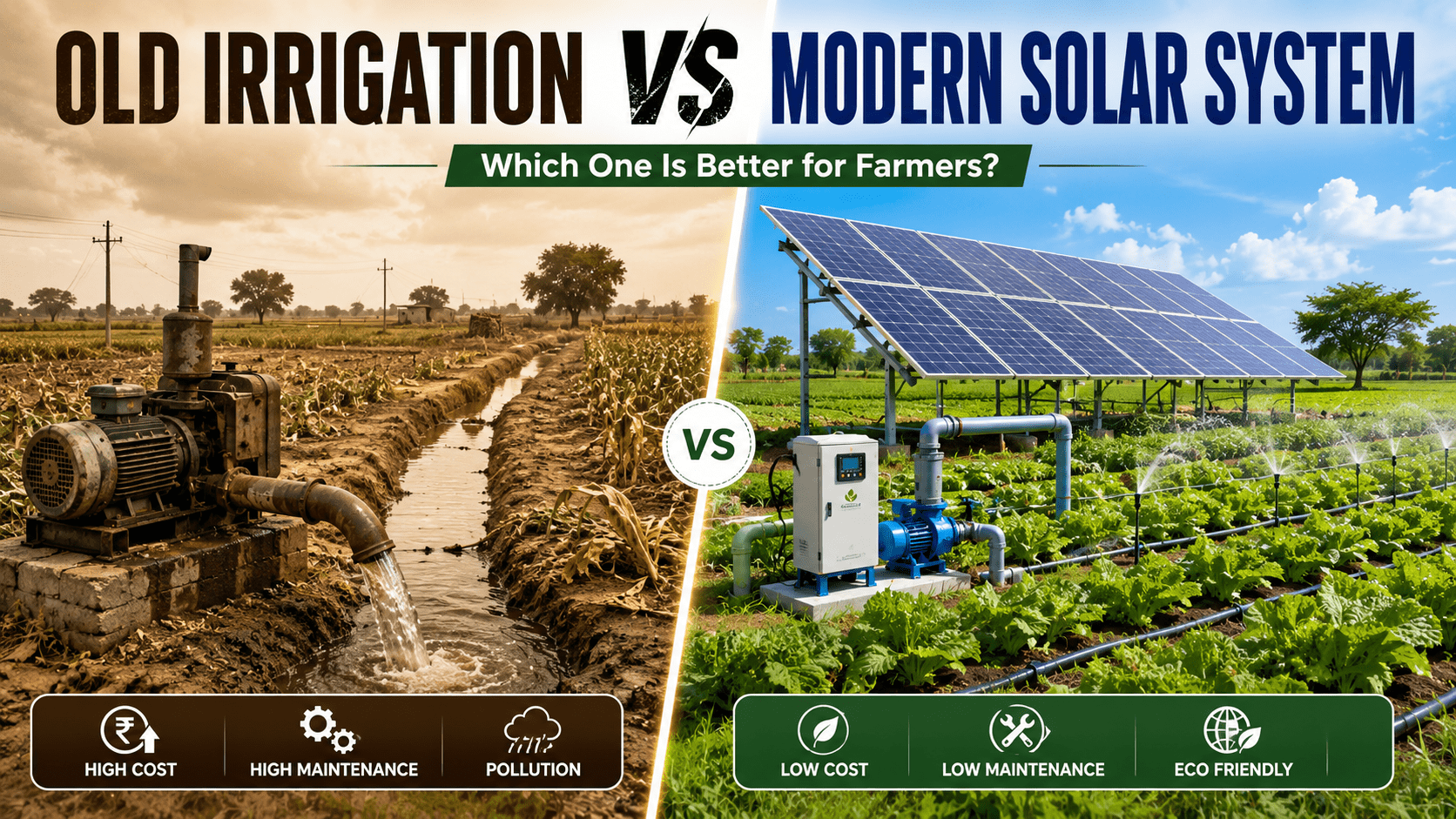
On the other side, modern solar irrigation systems are changing how farmers manage water. A solar irrigation system uses solar panels, inverters, pumps, and sometimes drip or sprinkler systems to lift and distribute water more efficiently. Instead of depending fully on diesel, grid electricity, or canal schedules, farmers can use sunlight to power their water pumping system.
The big question is simple:
Is old irrigation still practical, or is modern solar irrigation the smarter choice?
The answer depends on land size, water depth, crop type, budget, location, and long-term farming goals. However, one thing is clear: agriculture is moving toward energy-saving, water-saving, and low-maintenance systems. Modern solar irrigation is not just a trend; it is becoming a serious investment for progressive farmers.
What Is Old Irrigation?
Old irrigation usually means traditional methods that have been used for many years. These include:
- Flood irrigation
- Canal irrigation
- Diesel-powered tube wells
- Electric tube wells
- Open water channels
- Manual water flow control
- Traditional field leveling
- Unlined watercourses
In many areas, farmers still use these methods because they are familiar, simple, and already installed. For small farmers, old irrigation may feel affordable because the initial setup is already there. But the hidden cost comes in the form of water loss, fuel bills, electricity problems, labor, maintenance, and uneven crop growth.
Traditional irrigation often sends water across the field through open channels. A large quantity of water is lost through seepage, evaporation, overflow, and poor distribution. Some parts of the field receive too much water, while other parts remain dry. This affects crop quality and yield.
What Is a Modern Solar Irrigation System?
A modern solar irrigation system uses sunlight to power a water pump. The system normally includes:
- Solar panels
- Solar pump inverter
- AC or DC water pump
- Submersible or surface pump
- Mounting structure
- Cables and protection system
- Controller or VFD
- Optional drip or sprinkler irrigation
- Optional water storage tank
The system converts sunlight into electricity. That electricity runs the water pump and supplies water to crops. In advanced setups, the system can be connected with drip irrigation, sprinklers, smart controllers, moisture sensors, and automatic valves.
This makes irrigation more controlled, more efficient, and less dependent on fuel or grid electricity.
Quick Verdict
Old irrigation is simple, familiar, and low-cost at the beginning.
Modern solar irrigation is cleaner, more efficient, and better for long-term savings.
For farmers who want to reduce diesel expenses, manage water better, and modernize their land, solar irrigation is a powerful upgrade.
Old Irrigation vs Modern Solar System: Comparison Table
| Feature | Old Irrigation System | Modern Solar Irrigation System |
|---|---|---|
| Energy Source | Diesel, grid electricity, canal flow, manual control | Solar energy from sunlight |
| Running Cost | High due to fuel, electricity, and labor | Very low after installation |
| Water Efficiency | Usually low due to seepage and evaporation | Higher, especially with drip or sprinkler |
| Maintenance | Frequent maintenance for diesel engines and channels | Lower maintenance if quality equipment is used |
| Dependency | Depends on fuel, electricity, canal schedule, or labor | Depends mainly on sunlight |
| Initial Cost | Low to medium if old setup already exists | Higher initial investment |
| Long-Term Cost | Expensive over time | Cost-effective over time |
| Crop Growth | Uneven water distribution can affect yield | More controlled and uniform watering |
| Environmental Impact | Diesel smoke, fuel use, water wastage | Clean energy and lower emissions |
| Automation | Mostly manual | Can be automated |
| Best For | Small farms with existing canal or basic setup | Medium to large farms, tube wells, drip systems |
| Reliability | Can be affected by load shedding, diesel prices, canal timing | Strong in sunny areas |
| Water Control | Limited control | Better control over timing and flow |
| Farmer Workload | More physical supervision required | Less manual supervision |
| Future Value | Traditional but less scalable | Modern, scalable, and future-ready |
Pros of Old Irrigation
Traditional irrigation still has some advantages, especially for farmers who already have the setup.
1. Lower Initial Cost
Old irrigation systems usually do not require a major new investment if the farmer already has:
- Canal access
- Existing diesel engine
- Electric motor
- Old watercourse
- Traditional field layout
This makes it easier for small farmers to continue using the same system.
2. Easy to Understand
Farmers have been using traditional irrigation for generations. The method is familiar and does not require technical training. Most local mechanics can repair diesel engines, electric motors, and basic pumps.
3. Useful Where Solar Setup Is Not Possible
In some locations, solar installation may be difficult due to:
- Limited space for panels
- Shaded land
- Security issues
- Very deep water levels
- Small landholding
- Budget limitations
In such cases, old irrigation may still be practical.
4. Works at Night
Diesel and electric pumps can run at night if fuel or electricity is available. Solar systems usually work best during daytime unless batteries or hybrid backup systems are installed.
5. Good for Canal-Based Areas
If canal water is regular, affordable, and properly managed, traditional canal irrigation can still support farming. It is especially useful for crops that require larger water volumes.
Cons of Old Irrigation
Despite being common, old irrigation has serious limitations.
1. High Running Cost
Diesel prices, engine maintenance, oil changes, spare parts, and labor make traditional pumping expensive. Electric tube wells also become costly when electricity tariffs rise or supply becomes unreliable.
2. Water Wastage
Old irrigation methods often waste water through:
- Seepage in open channels
- Evaporation
- Overflow
- Uneven field leveling
- Over-irrigation
- Poor timing
This is a major issue in areas where groundwater levels are falling.
3. Uneven Crop Growth
In flood irrigation, water does not always spread evenly. Some areas receive too much water, while others receive less. This can cause:
- Weak plant growth
- Root damage
- Soil salinity
- Nutrient loss
- Lower yield
4. More Labor Required
Traditional systems need more manual work. Farmers or workers must open and close water channels, check flow, move pipes, manage diesel, and monitor the field.
5. Pollution and Noise
Diesel engines create smoke, noise, and heat. They also require fuel transportation and storage, which adds risk and inconvenience.
6. Less Future-Proof
Old systems are becoming less attractive because energy prices, water scarcity, and labor costs are increasing. Farming now requires smarter resource management.
Pros of Modern Solar Irrigation System
Modern solar irrigation offers several strong benefits for farmers.
1. Very Low Running Cost
Once the solar system is installed, sunlight becomes the main energy source. Farmers do not need to buy diesel every day or depend heavily on grid electricity. This makes solar irrigation highly attractive for long-term savings.
2. Best for Sunny Regions
In countries with strong sunlight, solar irrigation works very well. During peak sunlight hours, the pump can deliver strong performance and supply water for crops, tanks, or drip lines.
3. Better Water Management
Solar systems can be combined with:
- Drip irrigation
- Sprinkler irrigation
- Water storage tanks
- Automatic valves
- Moisture sensors
- Smart controllers
This allows farmers to apply water more carefully and avoid wastage.
4. Environment-Friendly
Solar irrigation reduces the use of diesel and lowers smoke pollution. It is a cleaner option for farms, villages, and the environment.
5. Less Maintenance
A quality solar system has fewer moving parts compared to diesel engines. Solar panels can last for many years with basic cleaning and proper installation. Pumps and inverters need maintenance, but the overall workload is usually lower than diesel-based systems.
6. Protection Against Load Shedding
Many farmers face electricity load shedding, low voltage, and transformer issues. Solar irrigation reduces dependence on unstable grid electricity.
7. Long-Term Investment
Although the initial cost is higher, the system can save money over time. For farmers who irrigate regularly, the payback can be strong because fuel and electricity expenses are reduced.
8. Increases Farm Value
A farm with a proper solar irrigation system becomes more modern and valuable. It shows that the land has a reliable water and energy solution.
Cons of Modern Solar Irrigation System
Solar irrigation is powerful, but it also has some challenges.
1. Higher Initial Cost
The biggest challenge is the upfront investment. A proper solar irrigation system needs quality panels, inverter, pump, structure, wiring, protection, and installation. Cheap systems may create problems later.
2. Depends on Sunlight
Solar systems perform best during sunny hours. On cloudy days, rainy days, or during low sunlight, water output may reduce. Farmers may need a storage tank or hybrid backup for better reliability.
3. Requires Technical Planning
Solar irrigation is not a “one-size-fits-all” solution. The system must be designed according to:
- Water depth
- Required flow rate
- Crop water demand
- Pump size
- Land area
- Pipe length
- Daily running hours
- Solar panel capacity
Wrong sizing can lead to poor performance.
4. Security Risk
Solar panels and cables are installed in open areas. In some locations, theft protection, fencing, and proper mounting are necessary.
5. Groundwater Overuse Risk
Because solar pumping has very low running cost, some farmers may pump more water than needed. Without proper water management, this can put pressure on groundwater levels.
6. Quality Matters
Low-quality panels, weak inverters, poor wiring, and incorrect installation can damage performance. Solar irrigation should be installed by experienced professionals.
Which System Saves More Money?
In the short term, old irrigation may look cheaper because the setup already exists. But in the long term, modern solar irrigation usually saves more money.
Old irrigation costs keep coming again and again:
- Diesel cost
- Engine oil
- Spare parts
- Mechanic charges
- Electricity bills
- Labor cost
- Water losses
- Crop losses due to uneven watering
Solar irrigation has a higher starting cost, but after installation, daily operating cost becomes much lower. This is why many farmers see solar as an investment, not an expense.
Which System Saves More Water?
Modern solar irrigation saves more water when used with proper design and smart water distribution.
Old irrigation often uses flood methods, where water spreads across the field. This can waste water and damage soil if not managed carefully.
Modern systems can control water better through:
- Drip lines
- Sprinklers
- Pressure systems
- Timers
- Moisture-based irrigation
- Proper pipe networks
The result is better water use, healthier roots, and more uniform crop growth.
Which System Gives Better Crop Results?
Crop results depend on many factors, but proper irrigation plays a major role. Modern solar systems can help improve crop results because they allow farmers to water crops at the right time and in the right quantity.
Better irrigation can support:
- Stronger root development
- Better fertilizer absorption
- Reduced plant stress
- Improved crop quality
- Better yield consistency
- Less waterlogging
Old irrigation can still give good results if land leveling, water supply, and timing are managed properly. But it requires more labor and careful supervision.
Old Irrigation Is Better When:
Old irrigation may still be suitable if:
- The farmer has regular canal water
- The land area is small
- The budget is limited
- Diesel or electricity is easily available
- Water demand is low
- The existing setup is working well
- The farmer does not want technical changes
In such cases, upgrading small parts of the old system may be enough. For example, lining water channels, improving field leveling, or using better pipes can reduce water loss.
Modern Solar Irrigation Is Better When:
Solar irrigation is a better choice if:
- Diesel cost is too high
- Electricity supply is unreliable
- The farm has good sunlight
- Water pumping is needed regularly
- The farmer wants long-term savings
- The land is medium or large
- The farmer wants drip or sprinkler irrigation
- Groundwater is available
- The farmer wants a modern, scalable setup
Solar is especially useful for tube wells, orchards, vegetable farms, dairy farms, and remote agricultural land where grid electricity is difficult.
Eye-Catching Farmer Tip
Do not choose solar only by horsepower. Choose it by water requirement.
Many farmers ask, “How many HP pump do I need?”
But the better question is:
How much water does my crop need daily, and from what depth?
A correct solar irrigation design should consider:
- Bore depth
- Water level
- Pipe distance
- Required gallons or liters per day
- Crop type
- Land size
- Sunlight hours
- Pump efficiency
- Future expansion
This is how farmers avoid underpowered or oversized systems.
Best Practical Approach: Hybrid Irrigation
The smartest solution for many farms is not always 100% old or 100% modern. A hybrid approach can be very effective.
A farmer can use:
- Solar during daytime
- Grid or generator as backup
- Storage tank for evening irrigation
- Drip irrigation for high-value crops
- Canal water when available
- Solar tube well when canal water is not available
This gives flexibility and reduces risk.
Final Recommendation
Old irrigation has served farmers for many years, but farming conditions are changing. Water is becoming more valuable, energy is becoming more expensive, and crop competition is increasing. Farmers who want to stay profitable need systems that save water, reduce running cost, and improve control.
Modern solar irrigation is a strong solution because it uses free sunlight, reduces fuel dependency, and supports better water management. The initial cost is higher, but the long-term benefits can be much greater.
Final Verdict
- Choose old irrigation if your budget is limited, canal water is reliable, and your current setup is working well.
- Choose modern solar irrigation if you want long-term savings, reliable daytime pumping, lower running cost, and better water control.
- Choose a hybrid system if you want the safest and most practical farming solution.
In simple words:
Old irrigation keeps the farm running.
Modern solar irrigation helps the farm grow smarter.
For today’s farmer, the future is clear: less fuel, less wastage, more control, and more profit.